Get Full Government Meeting Transcripts, Videos, & Alerts Forever!
Get email alerts on the Municipal Finance Fees topic
No spam. Unsubscribe anytime.
San Mateo Council adopts FY25–26 fee schedule and waives recreation staffing fees for approved neighborhood association meetings
Summary
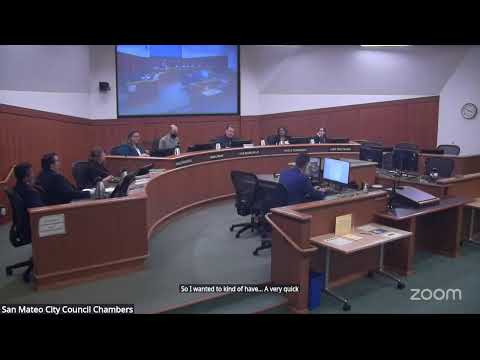
The San Mateo City Council on April 7 adopted a resolution approving revisions to the fiscal year 2025–26 comprehensive fee schedule and added an amendment exempting recognized neighborhood associations and qualifying nonprofits from recreation center facility staffing fees and certain hourly surcharges until a formal city policy is developed.
The San Mateo City Council on April 7 adopted a resolution approving revisions to the fiscal year 2025–26 comprehensive fee schedule and added an amendment exempting recognized neighborhood associations and qualifying nonprofits from recreation center facility staffing fees and certain hourly surcharges until a formal city policy is developed.
The change was proposed by Councilmember Sohorkoeketi and approved on a 5-0 roll call. Councilmember Swierko Guditsky, Councilmember Fernandez, Councilmember Diaz Nash, Deputy Mayor Lorraine and Mayor Newsome all voted yes.
The amendment — read into the record and incorporated into the motion — directs that recreation center facility staffing fees and any hourly surcharges “shall not be charged for nonprofits or neighborhood association meetings as approved by the parks and recreation director until such a time as a city policy will be created to address this matter in more detail.” The amendment was advanced after several neighborhood leaders told the council that one-off staffing charges (speakers cited examples including fees as high as roughly $300) were imposing a barrier to organizing low-cost community meetings.
In the staff presentation, Carly Toffee, senior management analyst in the finance department, said the annual revisions generally follow cost-recovery rules and are tied to the Bay Area Consumer Price Index (CPI), which was 2.4% this year. “Fees are reviewed annually and are typically increased by Bay Area Consumer Price Index or CPI, which was 2.4 this year,” Toffee said, noting that most fees should not exceed the cost of providing the service. She identified categories of changes in the draft schedule, including new fees (for example, a small wireless facility permit appeal fee referenced in Title 17, Chapter 10 of the San Mateo Municipal Code), fees that increased in excess of CPI (for instance, police outside-detail rates tied to salary schedule changes), and fees that were reduced or eliminated.
Suzette Silverman, business manager for the Parks & Recreation Department, walked the council through a multi-year effort to modernize how activity fees are set. The department moved away from a long, detailed class-by-class pricing method toward a framework that ranks activities along a common-good to individualized-good spectrum and gives staff a pricing tool to set fees by category. “We also have developed a pricing tool, which empowers staff and has all of this data from that cost of service behind it to price their activities without a lot of extra time and effort,” Silverman said. Staff told the council the parks and recreation fee approach had not been updated since 2004 and that the new model is meant to improve equity and reduce back-office burden.
Councilmembers who supported the waiver amendment said it is a stopgap measure to address reported inconsistencies in how neighborhood associations are being charged, and to allow staff time to develop a consistent citywide policy across all municipal facilities. Councilmember Sohorkoeketi said the waiver would apply to recognized neighborhood associations as approved by the Parks & Recreation director. Staff explained the waiver targets staffing fees (costs the city incurs when sending a staff member to open a facility for a single meeting) rather than underlying room rental rates such as those charged by the library.
There was broad support on the dais for returning with a comprehensive, citywide framework to standardize facility and staffing fees across libraries, community centers and other municipal spaces. Staff committed to bring back more detailed recommendations and a holistic assessment of city facilities and fees as part of the annual budget and future agenda items.
The council adopted the revised comprehensive fee schedule with the amendment; the resolution will be finalized as part of the FY 2025–26 budget process.
Votes at the April 7 meeting on the fee schedule were recorded by roll call: Councilmember Swierko Guditsky — yes; Councilmember Fernandez — yes; Councilmember Diaz Nash — yes; Deputy Mayor Lorraine — yes; Mayor Newsome — yes. Motion carries 5-0.
Less urgent details: staff noted sewer service fees are outside this revision process; the Finance Department will confirm links in the city’s fee schedule to the San Mateo Consolidated Fire Department’s fee pages for new-business fire inspection and related items. Parks & Recreation said it will continue facility assessments to identify underused spaces that could host neighborhood meetings and reported it is coordinating with the library on facility-fee approaches.
Speakers quoted in this article appear in the speaker list below.