
Manor ISD trustees conduct Lone Star Governance self-evaluation, approve quarterly tracker and set next steps
Get AI-powered insights, summaries, and transcripts
Sign Up Free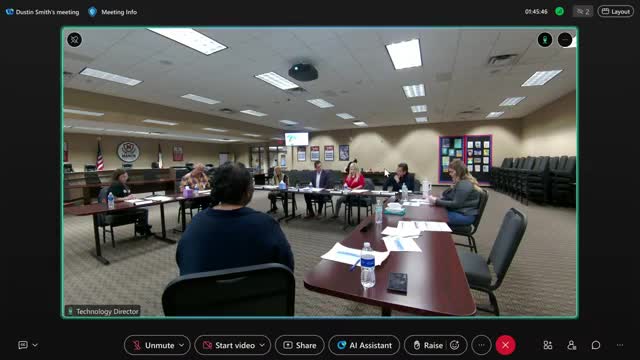
Summary
At its April 7 meeting trustees ran through a Lone Star Governance self-evaluation and quarterly progress tracker, discussed limits on measures and monitoring frequency, and set short timelines for memorizing the district vision and student outcome goals; the board rated its governance at 86 percent on the tracker.
Manor Independent School District trustees on April 7 conducted a Lone Star Governance (LSG) self-evaluation and walked through a quarterly progress tracker meant to align the board, superintendent and community around district vision, student outcome goals and monitoring practices.
The exercise, led by an LSG facilitator and discussed with Superintendent Dr. Samani and multiple trustees, reviewed the district's vision and mission, the board's student outcome goals and the board's monitoring calendar. Trustees repeatedly emphasized the need for broad community ownership of goals and for board members to know the district's vision and student outcome goals by heart.
Board members and the facilitator detailed specific governance rules the LSG framework uses: the board should adopt no more than three goal progress measures (GPMs) for each student outcome goal and no more than three superintendent constraint progress measures (CPMs) for each constraint; student outcome goals should include a population, baseline and a five-year deadline with annual targets; the monitoring calendar should report student outcome goals at least four times per year and constraints at least once per year. The facilitator summarized the community-ownership requirement: "All board members and the superintendent agree there is broad community ownership of the goals, vision, and student outcome goals through involvement and communication with students, staff, and community members." (Trainer)
Trustees discussed how that community ownership might be measured and broadened, including suggestions such as web pages, surveys, town halls and more visible campus-level displays of progress (for example, campuses posting I-Ready award ceremonies and progress monitoring results to social media and other public venues). Trustees noted that digital methods alone will not reach all families and suggested in-person outreach at shopping centers and community locations.
The LSG instrument asks boards to track time spent in board-authorized public meetings on improving student outcomes. Under LSG scoring, "mastery" requires 50% or more of total quarterly meeting minutes to be invested in improving student outcomes; according to the facilitator's review during the April 7 session, the board's tracker produced an overall score of 86. Trustees marked that score as a point of progress while identifying areas to continue improving, such as increasing community communications and ensuring final meeting materials are received in advance according to the board's timeline.
Several procedural clarifications emerged during discussion: the board agreed that monitoring reports should include the current status of goals, the superintendent's interpretation and recommended next steps, and comparisons to previous targets and baselines. Trustees also reviewed the LSG expectation that constraints are concise operational limits (what the superintendent may not do) and that CPMs be predictive of the related constraint.
Next steps recorded in the meeting included trustees committing to memorize the district vision and student outcome goals within the next quarter and to continue refining the quarterly progress tracker and monitoring calendar. The superintendent and staff will provide supporting data and a timeline for trustee follow-up. The board concluded the meeting with a motion to adjourn.
The board noted its next regular meeting is scheduled for April 21.