Get Full Government Meeting Transcripts, Videos, & Alerts Forever!
Get email alerts on the Strategic Planning topic
No spam. Unsubscribe anytime.
City of Indio holds strategic-plan workshop; residents, staff flag infrastructure, housing and downtown experience as top priorities
Summary
City of Indio council and staff spent a multi‑hour workshop reviewing an environmental scan and stakeholder outreach, agreeing to emphasize infrastructure, housing options, economic development/downtown activation, community safety, parks/programming and health services as five‑to‑six strategic focus areas to guide a five‑year plan.
City of Indio elected officials, staff and consultants spent an extended workshop session reviewing community input and drafting priorities for a five‑year strategic plan that the council expects to bring back as a draft for review in mid‑May and for adoption in late spring/early summer.
The meeting brought together city leadership, staff and consultants from BerryDunn to review an environmental scan, stakeholder outreach results and a SWOT analysis, and to begin wordsmithing a mission, vision, core values and a short list of strategic focus areas. "As stated, this is our workshop on the strategic plan," City Manager Montgomery told the council when the session began. Consultant Michelle Kennedy told the council she and her team had compiled outreach and would use council input to shape measurable objectives: "I've been doing this for almost 30 years with local governments all over the country. It's a passion area of mine," she said.
Why it matters: council members emphasized that Indio's recent momentum — downtown activation, events and infrastructure investments — gives the city leverage to guide growth deliberately. Council members repeatedly told staff they want a plan that is actionable and reportable to the public, with frequent progress updates and visible results to sustain trust.
Most of the workshop focused on outreach the consultants gathered and how that input should shape priorities. Consultants described outreach that included three public meetings (one in person and two virtual), targeted stakeholder and key‑leader interviews, employee surveys and a Social Pinpoint site. The consultants reported 778 views, 585 visitors, 65 active contributions and 20 distinct contributors on the Social Pinpoint site; when all engagement channels were combined they reported 430 contributors and roughly 800 passive engagements. Consultants also summarized thematic results: top concerns were traffic congestion, housing affordability and the local economy; community priorities included accessible and effective government, more community events and amenities, business improvement, parks/recreation, health care access and public safety.
Council members and staff used sticky‑note exercises to nominate and refine draft focus areas. By the end of the session the group converged on a draft set of priorities the consultants will refine with department leadership: (1) infrastructure and utilities (roads, bridges, water, power, broadband), (2) economic development and downtown experience (including Highway 111 and event‑related opportunity), (3) housing options and innovative homeownership models, (4) community safety and public‑safety resources, and (5) community events, parks/programming and health/wellness. Participants also identified cross‑cutting objectives — staffing and organizational capacity, maintenance/operations funding, and improved communications — that should appear in the implementation plan.
Council members repeatedly raised specific implementation questions staff will need to address in the next drafting step: where funding will come from, how to sequence multi‑year infrastructure projects (several speakers mentioned Monroe and Jackson as congestion points), how to coordinate with regional partners (tribal governments, Desert Recreation District, transit agencies) and how to expand health‑care access and childcare so workers and families can stay in Indio. The consultants noted that some items — notably homelessness outreach and hospital/medical services — are regional in scope and will require collaboration beyond city authority.
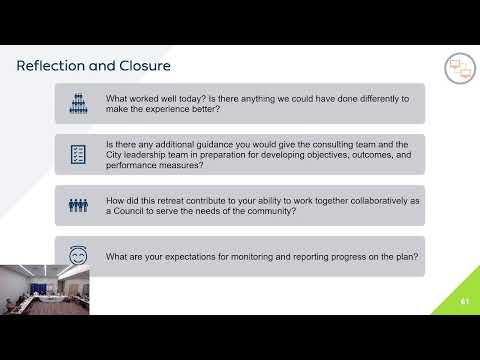
Next steps and public reporting: consultants said they will take the council's workshop output into an internal staff session the following day to produce draft goal statements and measurable objectives. Staff will then produce a draft strategic plan for council review in a work session, and the consultants indicated they expect to return a recommended draft for council comment in mid‑May with a target for adoption in late May or June. Council members asked that progress reporting be visible to the public — proposals discussed included a state‑of‑the‑city event, short public videos for social media and periodic biannual updates to highlight accomplishments and in‑progress work.
What council members said: Council member Ortiz noted the city is changing quickly and asked staff to bring demographic trends and growth projections to future meetings so the council can calibrate objective targets. Mayor Pro Tem Holmes emphasized the need to maintain momentum and public trust by reporting accomplishments and clarifying how city investments are being used. Consultant Maddie Powers, who led facilitation exercises, told the council the next step is to translate today’s priorities into measurable objectives and performance measures that staff will refine with department leadership.
What was not decided: the workshop produced no formal votes, ordinances or budget commitments. The session was a planning workshop to gather council direction; all formal policy or funding actions will come later through staff proposals and council votes.
What to expect: staff and the consultant team will draft goal statements and measurable objectives tied to each priority area, then return those drafts to the council for review. The council asked staff to include clearer near‑term milestones and to consider public‑facing ways to show progress, including a possible community event or video series to show "before/after" results for downtown and infrastructure investments.
For now, the council left the workshop with a consolidated set of strategic priorities and direction to staff and consultants to complete a draft plan that will be circulated to the public and brought back for formal consideration in the weeks ahead.