Get Full Government Meeting Transcripts, Videos, & Alerts Forever!
Get email alerts on the Waste Management topic
No spam. Unsubscribe anytime.
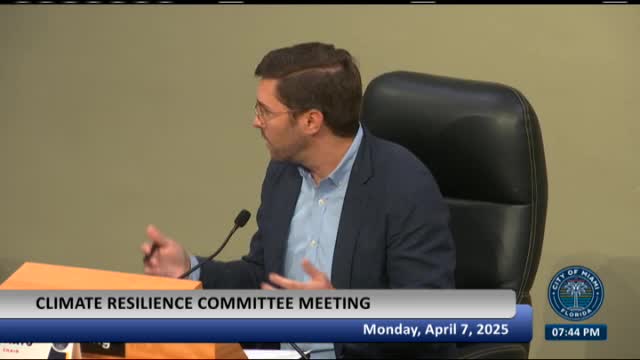
Climate Resilience Committee backs resolution calling for citywide waste‑reduction and recycling plan
Summary
Committee approved a resolution directing the city manager to work with Solid Waste and other departments to develop an enforceable, funded recycling and waste‑reduction program; members emphasized education, enforcement and fleet modernization; the motion passed unanimously.
The City of Miami Climate Resilience Committee on Tuesday unanimously approved a resolution urging the city manager to develop and implement a comprehensive waste‑reduction and recycling program, strengthen enforcement of existing recycling requirements and identify funding for fleet modernization and long‑term financial sustainability.
Committee member Aaron DeMeo read a section of the resolution outlining the committee’s request: to "develop and implement an effective waste reduction and recycling program that maximizes the value of materials, reduces landfill dependency, moves the city toward a low waste future, adjusts the waste fee and identifies alternative funding sources to make the waste management system financially sustainable." Committee members voted to forward the resolution to the City Commission for consideration.
The resolution calls on the city manager to work with the solid‑waste department and other necessary departments to: enforce current recycling rules for commercial properties (including multifamily buildings), pursue an investment plan for modernizing the city’s fleet, collaborate with county and state agencies on regional solutions, and establish an implementation timeline with specific action steps. The draft cites Miami‑Dade County Code Section 15‑2 and City of Miami Code Section 20‑2‑1 as existing requirements for commercial recycling programs discussed during the meeting.
Committee members’ discussion highlighted practical barriers to recycling in Miami. Several members and public commenters described commercial and multifamily properties shifting to private haulers and, in some cases, suspending recycling collection because of market disruption and contamination of recyclable streams. One member noted that the city’s recycling tonnage buyers have changed since China’s market shift, while another committee member urged more public education so residents view trees and waste diversion as public benefits rather than burdens.
Public commenters supported the committee action. Resident Steve Leitner said the city “needs guidance” and urged the committee to pass the resolution; he argued that recycling can add value if contamination is controlled. Wellness and environmental consultant Orlani Perez offered a low‑cost technology brief and volunteering support for pilot programs in neighborhoods.
Committee members approved the resolution by voice vote; the motionmaker and second were recorded in discussion and the committee indicated the vote was unanimous. Committee members asked staff to consult with Solid Waste and other departments and return with more detail, including how enforcement would be operationalized and how proposed investments could be funded.
The committee also discussed companion ideas such as event‑level recycling standards and receipts from waste haulers showing final destinations of materials to increase transparency. Members suggested that the resolution could be used to seek additional data from vendors and to partner with county programs and local nonprofits engaged in zero‑waste work.
Next steps: the resolution will be submitted for City Commission consideration; committee members requested staff and the volunteer lead to coordinate with Solid Waste to develop an implementation schedule and outreach/education strategy.