Get Full Government Meeting Transcripts, Videos, & Alerts Forever!
Get email alerts on the Urban Forestry topic
No spam. Unsubscribe anytime.
City committee hears Southwest Streetscape Master Plan to expand urban tree canopy in canopy‑poor neighborhoods
Summary
Design team presented inventory and pilot projects aimed at increasing tree canopy, reducing urban heat and improving stormwater management across 13 neighborhoods; city received $2 million of a $20 million forestry grant and public works will pilot one street in East Little Havana.
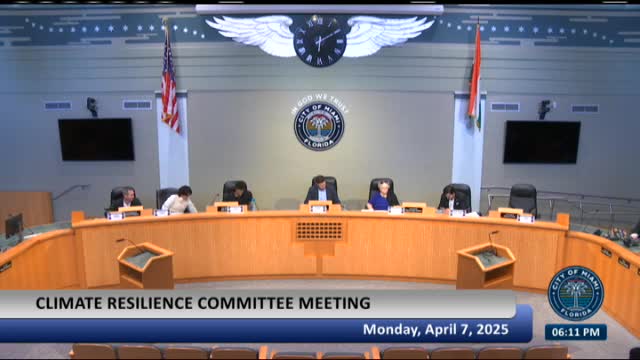
The City of Miami Climate Resilience Committee on the evening reviewed the Southwest Streetscape Master Plan, a multi-year effort to expand street‑tree canopy, reduce urban heat and improve stormwater performance across 13 neighborhoods in roughly 6.7 square miles of the city.
The Curtis and Rogers Design Studio team presented the plan’s inventory and recommendations. Robert Curtis, a landscape designer with Curtis and Rogers, said the team collected data for more than 25,000 trees in the project area and ran hotspot analyses to identify canopy‑poor and high‑priority zones. “We collected data for over 25,000 trees in the project area,” Curtis said.
Committee members were shown maps combining hydrology, land surface temperature and social‑vulnerability indicators; those overlays identified the northern project area in East Little Havana as the most canopy‑deficient, with about 8% street‑right‑of‑way canopy coverage, while some south‑central pockets had roughly 20% coverage. The designers found palms made up about 30% of inventoried trees and that many mature trees were planted in inadequate soil volumes, limiting longevity.
The plan recommends protecting existing canopy, improving growing conditions, replacing street palms with broader‑canopy trees where feasible, increasing permeable area in rights‑of‑way and focusing plantings to create shaded walking routes to community resources. Designer Jenny, a Curtis and Rogers presenter, outlined a system of street typologies (A through D) that classify planting feasibility: type A streets are easiest to plant, while type D streets have little or no swale space and will generally require reclaiming some parking space to add trees.
The team proposed infrastructure improvements such as structural soil and soil‑cell systems to increase effective soil volume, and pervious paving options for curb edges, sidewalks and driveways. The designers showed modeling indicating canopy could rise from about 35% using existing green space to roughly 59% if structural planting infrastructure (silva cells/soil cells) were installed.
Andrea Sandoval of the Planning Department said the master plan’s first phase went to the City Commission in July 2023 and was approved. The city applied for a forestry grant that requested about $20 million but was awarded $2 million; public works and planning are coordinating the use of that $2 million and public works has funds to implement one pilot project in the East Little Havana priority zone. Sandoval said the city has extended the master‑plan inventory and analysis into the Northwest corridor and is preparing community outreach for that expansion.
Committee members sought operational details. Members asked about cost comparisons between conventional streets and proposed permeable/soil‑cell systems, and whether the plan ties to utility, bike and stormwater master plans. Designers and staff said a full cost‑benefit comparison was not completed in phase one but recommended as a next step; they also said the pilot projects are intended to give public works hands‑on experience with nonstandard materials and maintenance requirements before wider rollout.
Committee discussion also unearthed questions about long‑term maintenance and governance. Multiple members urged that the City consider a formal urban‑forester role or elevate current arborist responsibilities, and to expand the tree trust fund beyond planting to cover maintenance and management so newly installed trees are sustained. City staff noted public‑works maintenance capacity is limited and that the city maintains an inventory in a GIS platform called Cartograph.
Designers and staff emphasized community engagement as a core part of implementation. The team described outreach tactics used during the project’s initial phase (HOA meetings and two virtual meetings during the pandemic) and said future outreach will prioritize informal, neighborhood‑based events, partnering with established community organizations to increase participation.
Committee members asked staff to return with more detailed cost analyses, an implementation timeline for pilot projects and proposals for public‑education and stewardship programs. Several members suggested the committee include funding or policy recommendations in its upcoming budget‑priority work.
The presentation concluded with staff noting ongoing quarterly updates and a city “virtual resilience tour” that will include story maps and project pages for public review.
Background: The Southwest Streetscape Master Plan focuses planting and infrastructure interventions on canopy‑deficient, higher‑vulnerability neighborhoods to reduce heat exposure and improve stormwater outcomes. The plan includes four pilot streets (two “blue” for low‑lying, permeable priority, two “green” for uphill stormwater storage) and a recommended planting palette that emphasizes species diversity and context‑appropriate selections.