Get Full Government Meeting Transcripts, Videos, & Alerts Forever!
Get email alerts on the Civil Rights Policy topic
No spam. Unsubscribe anytime.
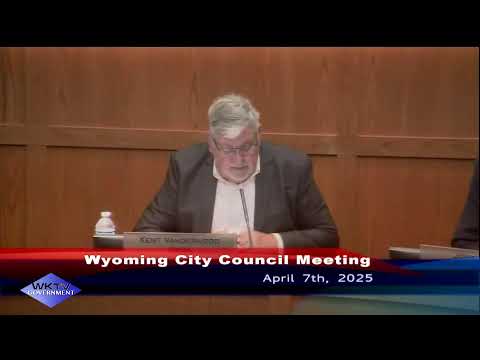
Wyoming council adopts updated Fair Treatment Policy amid questions over federal-state alignment
Summary
The Wyoming City Council adopted a consolidated Fair Treatment Policy intended to align city contract language with recent federal and state nondiscrimination requirements. City Attorney Scott Smith told council the changes aim to preserve federal funding; one council member voiced unease about automatically adopting federal rule changes.
Wyoming — The Wyoming City Council on Monday adopted an updated Fair Treatment Policy that consolidates the city’s nondiscrimination and accommodation rules and updates contract language to reflect recent changes in state and federal requirements.
City Attorney Scott Smith told council the consolidated policy incorporates recent changes to state law and to federal agency guidance and executive orders, and that keeping city policy aligned with those changes is necessary to maintain federal funding for programs such as Federal Highway Administration grants and Community Development Block Grant (CDBG) funds.
“Compliance with these changes in federal requirements is essential to maintaining federal funding,” Smith said. “We rely on a large amount of federal funds … If we don’t do that, we won’t maintain our federal funding.”
The policy retains the city’s stated commitment to treating “all persons with fairness, courtesy, respect, and dignity” and to accommodating people with disabilities or language barriers. Smith said the policy also shortens and revises some nondiscrimination verbiage that will be inserted into city contracts and bid documents to reflect current federal executive orders and directives.
Council members pressed staff for clarity about how the city will handle situations where state and federal requirements differ. Smith said the city must comply with both and that, where ambiguity exists, the city attorney will review statutory language, court decisions and administrative guidance and recommend how to proceed.
“In that case, go with maybe the stricter interpretation of state law,” Smith said, describing the city’s approach where state law provides broader protections than federal law. He referenced last year’s changes to Michigan’s Elliott-Larsen Civil Rights Act that expanded protected categories, and noted some state requirements can be more expansive than federal standards.
One council member said they were “a little leery” of language in the policy that tracks federal changes automatically and urged caution about a blanket acceptance of federal rule changes. Smith responded that the policy will be revised when judicial decisions or subsequent federal or state rule changes require it and that staff have updated the consolidated policy multiple times since 2018.
The council voted to adopt the policy (Resolution D). The roll call recorded one “no” vote from Council Member Posler; the remaining members voting were recorded as yes. Smith and city staff said the policy changes will be applied to contract and bid documents going forward and that staff will return with any necessary clarifications if federal or state guidance shifts.
Why it matters: The Fair Treatment Policy governs nondiscrimination language the city inserts into contracts and programs that depend on federal funding. Changes in federal executive orders and state law can affect whether the city remains eligible for certain grants, and council members emphasized both fiscal consequences and constituent concerns in their questions.
What’s next: City staff said contract language and bid specifications will be updated under the new policy and that the city attorney will advise on interpretation where state and federal requirements are not fully aligned.