Get Full Government Meeting Transcripts, Videos, & Alerts Forever!
Get email alerts on the Solar Development topic
No spam. Unsubscribe anytime.
Volta residents and farmers urge county limits on large solar farms, cite health, environmental and agricultural harms
Summary
Residents and farmers urged the Northampton County Board of Commissioners to tighten limits on utility‑scale solar projects, citing smoke from construction burns, chemical and groundwater concerns, wildlife impacts and the loss of productive farmland.
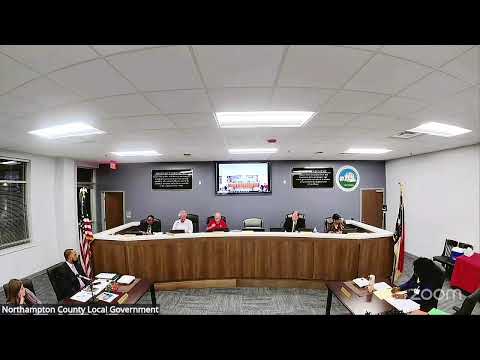
Residents and farmers from the Volta and Gassen areas urged the Northampton County Board of Commissioners to tighten limits on utility‑scale solar projects during a lengthy public‑comment period, saying large solar fields have harmed farmland, wildlife and public health and that current county rules and enforcement are insufficient.
Sylvia Vinson, speaking for Citizens for Solar Farm Limitations, presented photographs and described soil erosion, habitat loss, smoke from brush burning during construction, and concerns about chemical use and long‑term contamination. She said roughly "3,000 acres or more in the Volta community alone" are involved and warned of construction‑phase smoke settling over neighborhoods and of risks from fencing that fragments wildlife corridors.
"There are health risks to our citizens," Vinson said, listing herbicides and naming chemical compounds she said are associated with panel manufacture and maintenance. She told commissioners panels can appear as bodies of water to birds, causing fatal collisions, and she cited an abandoned solar field and permitted but not‑yet‑constructed sites as evidence that decommissioning is inconsistent in practice.
Farmer and resident Debbie Davis said her family’s land is part of a local solar project and opposed further conversion of productive farmland to long‑term leases. "Expansion of solar facilities on productive farmland threatens the livelihood of farmers and their family, but also threatens the economic integrity of Northampton County," Davis said, listing local agribusinesses and suppliers that depend on farming.
A third resident, identified in the meeting as John (last name not specified), questioned the neutrality of the Center for Energy Education and said the center is closely linked to a solar developer (GenX). He and other speakers recommended that the county extend its moratorium on new solar projects while hiring impartial environmental counsel to draft stronger special‑use permit conditions. Specific recommendations offered to the commission included:
- Extend the current moratorium for additional time while the county updates its special‑use permit process; - Retain an independent environmental law firm to draft or review decommissioning and special‑use provisions; the speakers suggested the Law Office of M. Byron Rice Jr. as an example; - Require firms to post bonds or other financial assurances that would cover decommissioning and proper disposal of panels and equipment; - Limit the total acreage of agricultural and timberland that may be leased to solar developers; and - Prohibit open burning of clearing debris and instead require chipping, grinding or removal.
Speakers described large lease terms of 20 to 60 years and warned that the anticipated volume of end‑of‑life panels will create disposal challenges. The presentation cited industry estimates of millions of tons of panels eventually retiring and said recycling costs could be substantial; speakers urged that decommissioning obligations be written into leases so future remediation costs are covered.
Commission response and context
Commissioners listened and asked procedural questions about notification of special‑use hearings and the county’s authority to regulate land use and decommissioning. Multiple residents said they had not received rezoning notices in some prior cases, a concern they repeated at the meeting.
The speakers urged the board to use the time of a moratorium to require stronger notifications, set acreage limits, require bonds and explicit, inflation‑adjusted decommissioning cost estimates in leases, and prohibit burning of clearing debris. They recommended the county seek third‑party legal and technical assistance rather than relying on industry‑affiliated groups for guidance.
At the meeting, no new zoning decision was taken; these comments were part of the public‑comment period and an informational solar‑farm presentation. The board did not adopt new ordinance language during the session but county staff indicated the issue will be part of ongoing planning discussions and drafting work.
Quotes and sources
- "There are health risks to our citizens," Sylvia Vinson said, listing pesticides and panel‑manufacturing chemicals she said concern residents. - "Expansion of solar facilities on productive farmland threatens the livelihood of farmers and their family," Debbie Davis said.
Documentation and next steps
Speakers provided photographs and an outline of suggested ordinance changes. They asked the board to retain independent counsel, adopt stronger notification and decommissioning rules, and consider bonding requirements. Commissioners did not vote on those requests during the meeting; the matters were left for staff follow‑up and further ordinance drafting if the board directs.