Get Full Government Meeting Transcripts, Videos, & Alerts Forever!
Get email alerts on the Short Term Rentals Udo Proposal topic
No spam. Unsubscribe anytime.
Wake County opens public consideration of UDO changes for bed-and-breakfasts and short-term rentals
Summary
Wake County planning staff proposed UDO text changes on April 7 to remove historic and minimum-size requirements for bed-and-breakfasts, retitle and relax limits on short-term rentals (increasing maximum stay from seven to 30 days), and remove the on-site operator requirement; the board closed the public hearing and will consider adoption April 21.
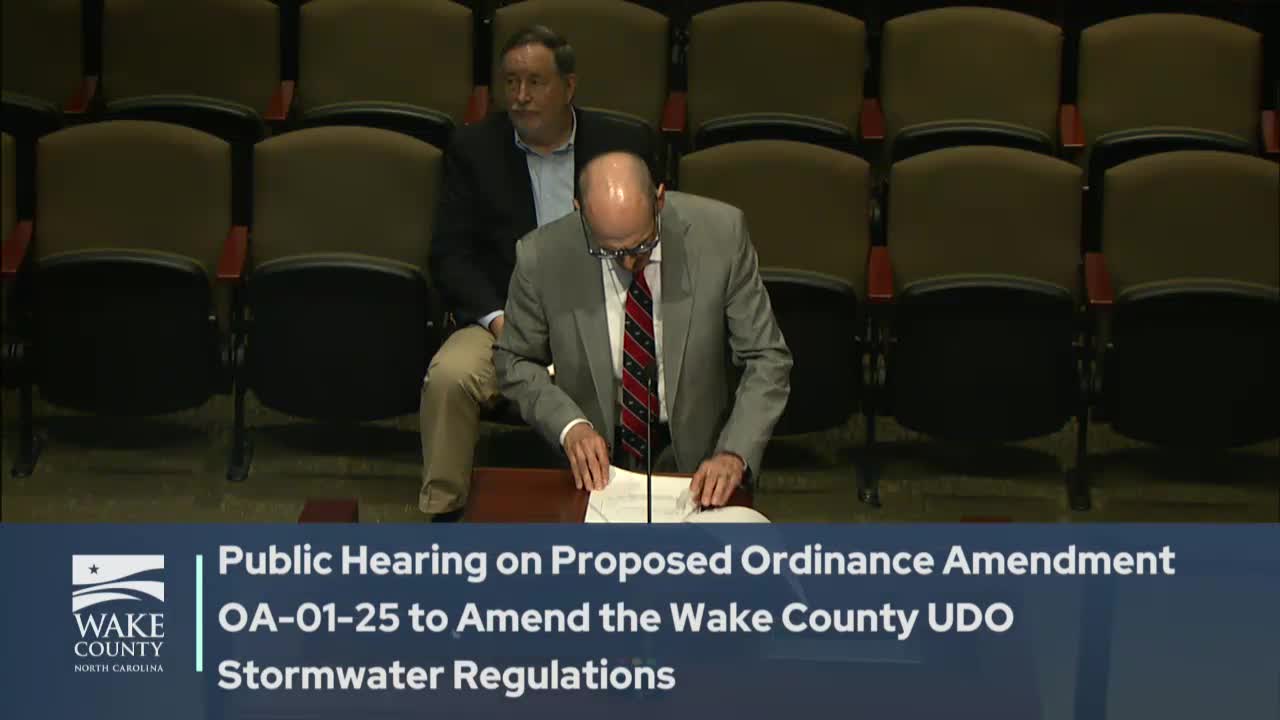
Wake County planning staff on April 7 presented proposed text changes to the Unified Development Ordinance (UDO) that would alter how the county regulates bed-and-breakfast establishments and short-term rental properties. The Board of Commissioners held a public hearing with no speakers and voted to take the item up for consideration at a future meeting.
Tim Maloney, director of Wake County Planning, Development and Inspections, told the board the changes are staff-initiated and intended to remove requirements staff considers outdated, to align local rules with national short-term rental platforms and with peer jurisdictions, and to broaden options for supplemental income. "Requirements that bed and breakfast establishments be in historic [register] and have a minimum size ... are no longer relevant," Maloney said. He also said staff proposes changing the UDO's short-term rental limit from a maximum overnight stay of seven consecutive days to a maximum of 30 days and removing the requirement that an operator live on the property.
The current UDO requires a traditional bed-and-breakfast to secure a special-use permit from the Board of Adjustment and, in Wake County's language, to be listed on the National Register of Historic Places and to have a minimum size of 3,500 square feet. Staff recommended removing the historic-listing and minimum-size requirements. For short-term rentals, staff would retitle the section to "short-term rentals," increase the maximum stay to 30 days and remove the owner-occupancy requirement.
Maloney said the county has issued very few permits for these uses in recent years (fewer than five over roughly five years) but believes some properties may be operating without proper permits. He told commissioners staff had consulted Wake County Housing, which did not view the proposed changes as a material threat to housing affordability but advised continued monitoring. He also noted pending state-level legislation (aimed at municipalities) that would restrict local bans on short-term rentals, a factor staff is watching.
Tom Wells, planning board chair, said the planning board held a public hearing with no public comment and unanimously recommended approval.
Commissioner Adamson raised concerns about nuisance impacts and asked how neighbors would be notified and who they should contact if a short-term rental becomes a problem. Maloney said that special-use permit applications include notice to adjacent property owners and that Wake County would handle enforcement if a use violated county standards. "When it goes for a special use permit, those who are adjacent property owners are notified," he said.
The board closed the public hearing with no speakers. Staff said public feedback received between the hearing and the board's next meeting would be provided to commissioners. The board did not vote on the amendment on April 7; staff scheduled consideration for the April 21 regular meeting and will return with any additional public comments and a recommendation for adoption or modification.
Why it matters: the proposal would broaden the types of dwellings that can operate as bed-and-breakfasts or short-term rentals in unincorporated Wake County and remove owner-occupancy and historic/size limits, aligning county rules with some peer jurisdictions and national short-term-rental platforms. Staff said there are relatively few permitted operations in unincorporated areas and that Wake County Housing does not expect a significant effect on affordability but will monitor outcomes.
What's next: the Board of Commissioners will consider adopting the proposed UDO text amendment at its April 21 meeting after staff compiles any public feedback received in the interim.