Get Full Government Meeting Transcripts, Videos, & Alerts Forever!
Get email alerts on the Stormwater Udo Amendment topic
No spam. Unsubscribe anytime.
Wake County adopts UDO changes to clarify stormwater maintenance, appeals and impervious-surface rules
Summary
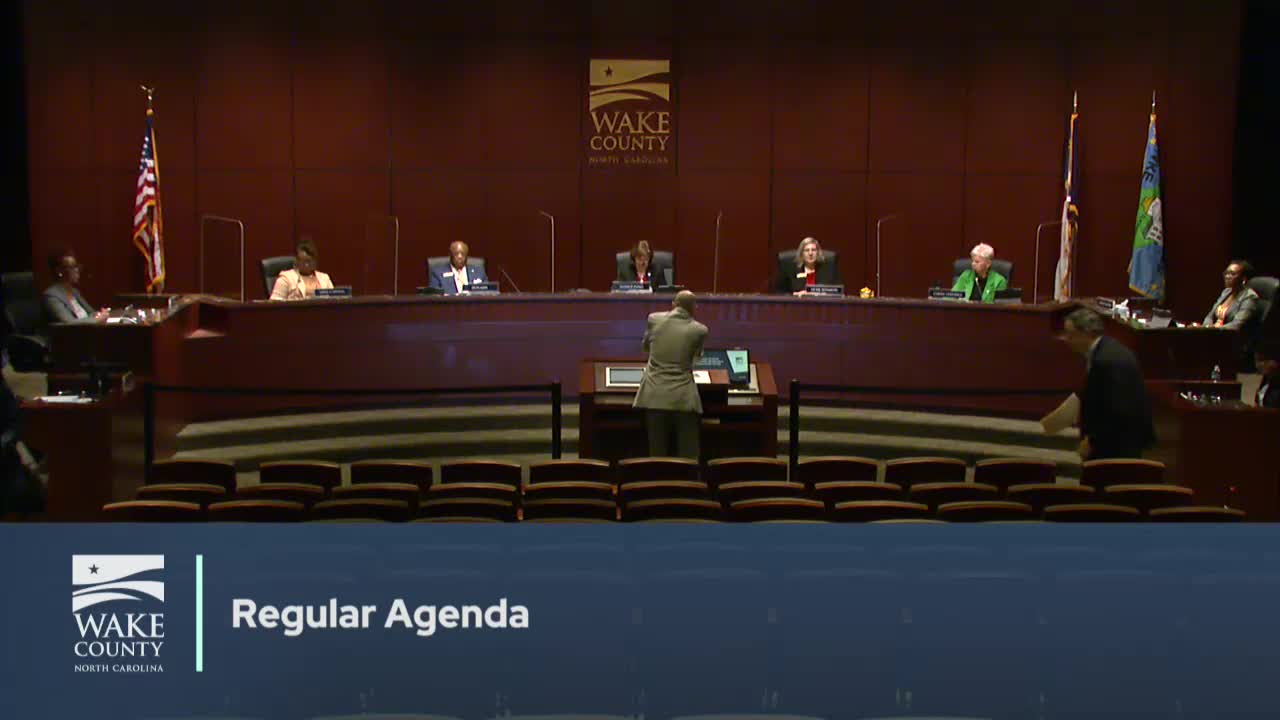
The Wake County Board of Commissioners on April 7 adopted an amendment to the Unified Development Ordinance clarifying maintenance responsibility for stormwater improvements, shifting stormwater appeals to the Board of Adjustment and updating the county's impervious-surface definition to align with state law and allow certain engineered pervious materials.
The Wake County Board of Commissioners on April 7 adopted an amendment to the county's Unified Development Ordinance (UDO) that clarifies maintenance responsibility for stormwater improvements, directs stormwater appeals to the Board of Adjustment and updates the county's impervious-surface definition to reflect 2024 state law and to allow certain engineered pervious measures.
The change, presented by Tim Maloney, director of Wake County Planning, Development and Inspections, replaces language that said stormwater improvements must be "accepted" by a homeowners association with language that makes the transfer of maintenance responsibility effective when Wake County Environmental Services deems the improvements acceptable. "That determination of acceptability is made by Wake County Environmental Services," Maloney said during the presentation. He said the amendment is also intended to "clarify the process for turning over maintenance of stormwater improvements to an HOA or a lot owner."
The amendment directs stormwater appeals to the Wake County Board of Adjustment instead of the Human Services and Environmental Services Board, aligning the UDO's appeals procedure with other parts of the code. Maloney said the county attorney's office supports the change. "The Wake County Board of Adjustment and its members are trained and experienced in conducting quasi judicial hearings," he said.
The ordinance also updates the county's impervious-surface definition to comply with a 2024 North Carolina General Assembly definition of "built-upon area" (impervious surface) effective Jan. 1, 2025, and to clarify that many stormwater control measures designed in accordance with the Wake County Stormwater Design Manual can be treated as pervious for impervious-surface calculations. Maloney said that engineered solutions such as pervious concrete pavers, when designed to filter water subsurface and built to the county's design manual, would not count toward an individual lot's impervious surface limit in many situations, helping property owners who are already at their limit while preserving water-quality protections.
Planning board chair Tom Wells told commissioners the planning board held a public hearing and recommended approval. "There is a lot of inconsistency ' from a professional standpoint ' across the county and in this region in terms of definitions of pervious and impervious, and it does have an impact," Wells said. He said the amendment will help define those restrictions.
During discussion Vice Chair Myles said the change would resolve issues he encountered in prior service on the Board of Adjustment. Commissioner Jackson described inherited maintenance problems on her property after developers left sites in poor condition and asked whether homeowners had been consulted; staff said some homeowners and situations were waiting on the amendment and that the change would provide relief where applicants had stood up against impervious-surface limits. Maloney and staff emphasized the county would continue to inspect and certify that stormwater measures meet minimum standards before transferring maintenance responsibility.
The board made two motions required by county procedures: a finding that the amendment is consistent with the Wake County Comprehensive Plan and UDO and a motion to adopt the ordinance amendment, listed in staff materials as OA-01-25. Commissioner Stallings moved the second motion to adopt and Vice Chair Myles seconded. The board approved both motions by voice vote; commissioners said "aye" and no opposition was recorded on the public audio. (Vote counts were not specified in the meeting record.)
Why it matters: the changes make the county's expectations and administrative process clearer to developers, homeowners associations and property owners, and they provide a compliance path for engineered pervious materials that may reduce runoff while allowing more flexible site design in water-supply watersheds such as Falls Lake, Swift Creek and Little River.
What's next: the ordinance amendment is adopted and will be incorporated into the UDO. Staff said they had consulted the Home Builders Association, which supported the changes as relief for developments that were near impervious-surface limits.
Speakers quoted in this article appear in the record of the April 7 meeting and include Wake County planning staff, the planning board chair and county commissioners. Direct quotations in this article come from the on-the-record remarks during the UDO public hearing and staff presentation.