Get Full Government Meeting Transcripts, Videos, & Alerts Forever!
Get email alerts on the Transportation Demand Management topic
No spam. Unsubscribe anytime.
Carlsbad staff present 2024 employer TDM survey: baseline and follow-up surveys show mixed mode-share results as office return increases
Summary
Staff reported results from the city's Transportation Demand Management (TDM) program and 2024 employer survey, including baseline and follow-up survey counts, average sustainable mode share figures and areas of concern such as declining bicycle commuting and reductions in work-from-home rates.
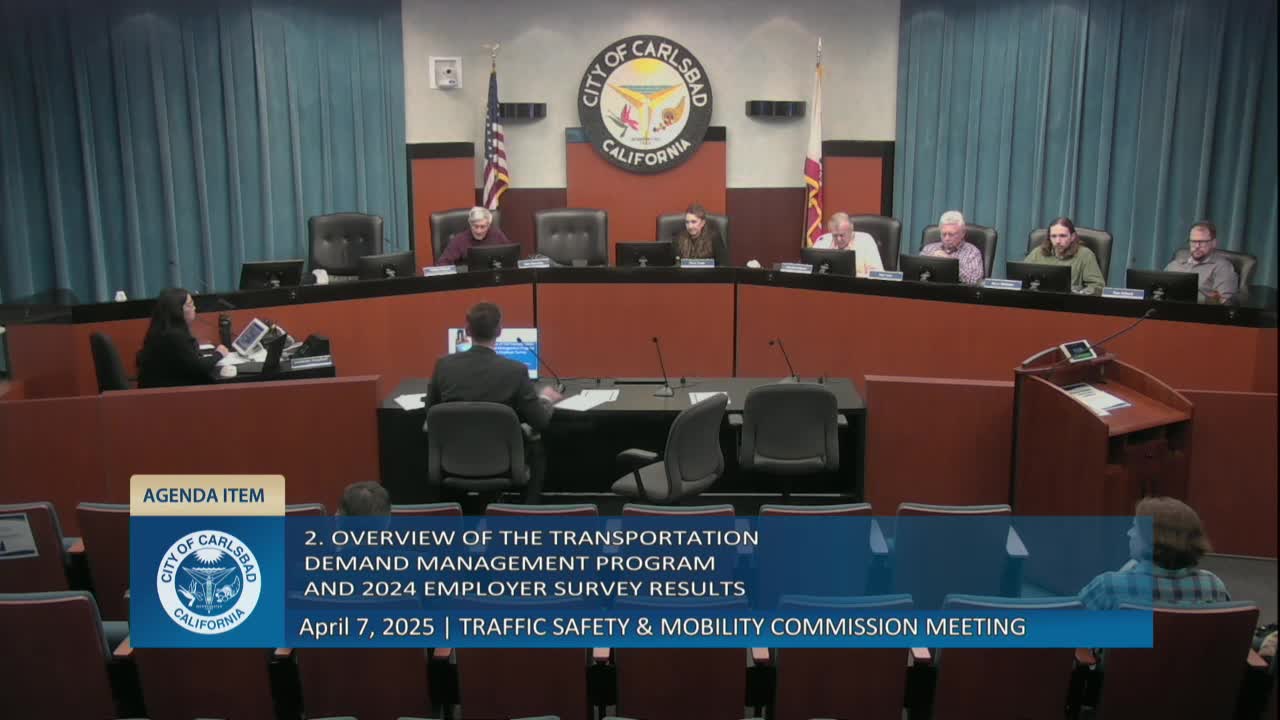
City transportation staff presented results from the city’s Transportation Demand Management program and the 2024 employer surveys, reporting that COVID-era remote work declines and commuting patterns are driving changes in mode share and vehicle miles travelled.
Nathan Schmidt, transportation planning and mobility manager, summarized the TDM program and noted the program’s legal and policy context: the TDM ordinance (adopted by the city and implemented through the building permit process), the TDM handbook and related Climate Action Plan sustainable-mode-share targets. "TDM essentially means strategies, tools, techniques, policies, and programs that are all intended to reduce demand on our roadway infrastructure," Schmidt said.
Schmidt reported the program’s recent data: 41 baseline surveys were completed, and 27 follow-up surveys had been completed to date; 9,800 commuters completed baseline surveys and 6,537 completed follow-ups. He said about 53 employers fall under the mandatory TDM ordinance, covering roughly 8,700 employees. Of 20 employers that completed both baseline and follow-up surveys, 14 increased their sustainable mode share; the follow-up average for these employers was about 38% sustainable-mode use.
Schmidt cautioned that sustainable-mode-share goals will be harder to achieve as employers call employees back to the office: the city’s Climate Action Plan sets rising targets through 2035 (roughly 25%–40% depending on development type and timeframe). He also said some active modes like bicycle commuting have declined since 2023 and attributed some of that to increased in-person work and longer commute distances for many employees.
Staff described program mechanics: the mandatory TDM requirements apply to developments or tenant improvements exceeding a square-footage threshold (staff said square-foot thresholds trigger the ordinance) and surveys are required once a site reaches occupancy thresholds; follow-up surveys occur every two years. Staff also noted coordination with SANDAG survey questions so regional credit can be applied.
Commissioners and members of the public raised questions about survey methodology, sampling, and the composition of responding employers. Commissioner feedback included requests that staff provide the raw survey instrument and disaggregated raw data so commissioners can evaluate year-to-year comparisons. Schmidt agreed to share the survey questions with the commission.
On compliance, Schmidt said staff first works with employers that fail to meet goals to revise TDM plans; if improvements do not follow, the city’s code-enforcement process could result in fees or other penalties. "If that doesn't work, then it goes through the enforcement process... that could involve fees," Schmidt said.
Staff also described the voluntary Carlsbad Commuter Program, which offers outreach, employer technical assistance, and periodic employer campaigns. Schmidt said the city itself has not enrolled in the voluntary program to date. Staff told commissioners they will return with annual updates on the handbook and survey results and provide requested materials to the commission.