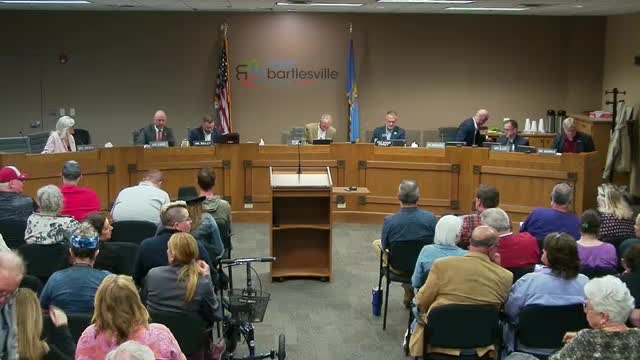
Bartlesville council adopts ordinance regulating ALPR 'Flock' cameras with audit and data‑sharing limits
Loading...
Summary
The council approved an ordinance setting rules for automatic license plate reader (ALPR) cameras, including monthly audits, a requirement to list authorized users, a ban on automatic federal data sharing and council approval for system feature additions; a proposed charter ban failed to advance.
The Bartlesville City Council voted April 7 to adopt a local ordinance regulating automatic license plate reader (ALPR) systems commonly called “Flock” cameras, approving a package of reporting, access and oversight measures while rejecting proposals for an immediate citywide ban.
Council members debated several competing options: a city‑imposed regulatory framework written by council sponsors, and a separate proposal to put a charter amendment banning ALPR use to a public vote. Councilman Sherrick urged a ballot question and framed the issue as one of civil liberties; Councilman Kirkpatrick and others favored a regulatory approach that would preserve investigative uses while addressing privacy concerns.
The ordinance the council adopted requires the police department to provide a monthly audit report about regulated ALPR usage as part of the council consent docket. The audits must include statistical data, any findings and a list of authorized users with rank/title and justification for access. Council members added an amendment prohibiting automatic data sharing with federal agencies; police said they would still comply with lawful, case‑by‑case requests from federal partners when appropriate. The council also approved a rule that no additional system features, software or hardware may be installed without council approval.
A separate amendment to shorten data retention from 30 days to seven days failed on a roll call; police testimony said a 30‑day retention window is needed for many investigations. Council discussion included examples where ALPR systems led to arrests or saved lives, and opponents cited court challenges and concerns about aggregation of location data.
The final adoption vote on the ordinance was 3–2 (Yes: Kirkpatrick, Dorsey, Mayor Kurd; No: Sherrick, East). A motion by Councilman Sherrick to send a charter amendment to the voters was discussed at length and did not result in the council calling a special charter election at this meeting.
Chief Eichelberry and police staff participated in parts of the discussion and described operational impacts of retention and audit changes. Council members said the ordinance strikes a balance between privacy safeguards and law‑enforcement needs; opponents said the city should have deferred to a public vote or sought tighter restrictions.
The ordinance will take effect after final codification and publication; staff indicated audits and reporting language will appear in the consent agenda going forward.