Get Full Government Meeting Transcripts, Videos, & Alerts Forever!
Get email alerts on the Capital Infrastructure Bonding topic
No spam. Unsubscribe anytime.
City staff outline 2026 general‑obligation bond framework and department scoring matrices
Summary
Capital Delivery Services and city departments described a front‑loaded bond development process, citywide guiding principles used to score candidate projects, and an early needs list that staff are vetting for eligibility and deliverability before summer community engagement.
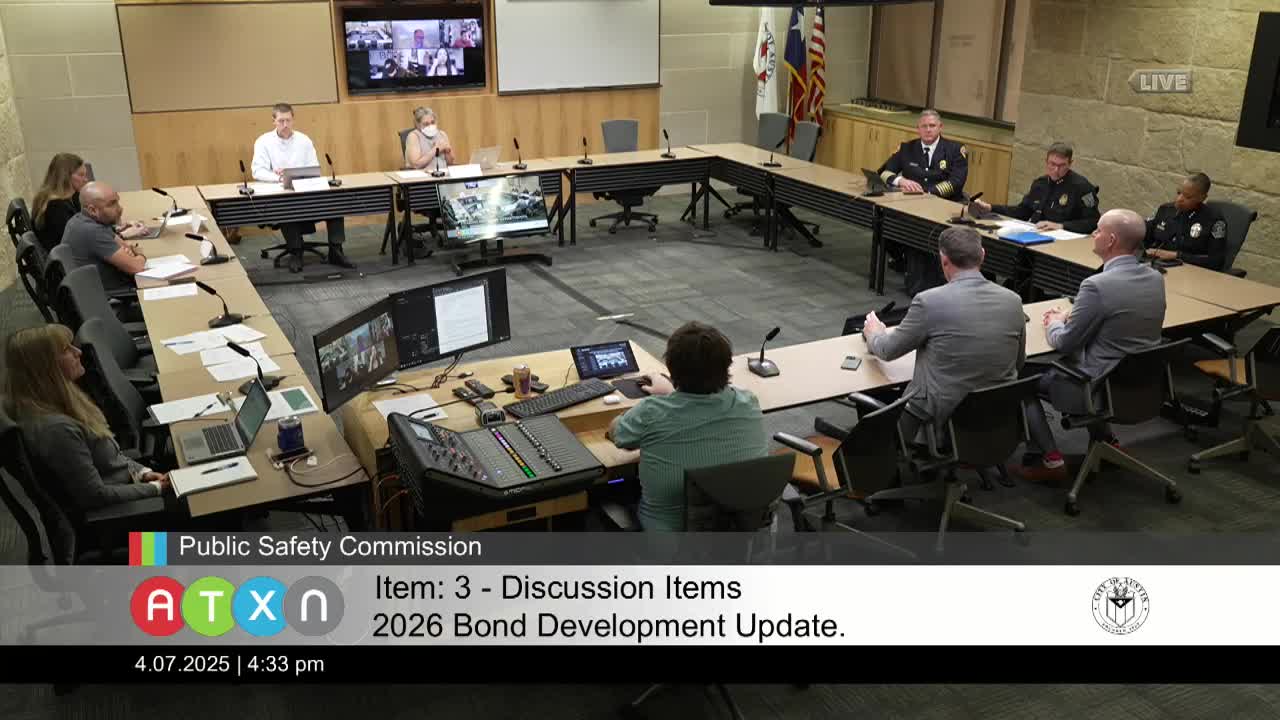
Capital Delivery Services (CDS) Assistant Director Marcus Hammer and Deputy Director Eric Bailey briefed the Public Safety Commission on the framework for the 2026 general‑obligation bond program, explaining a process shift that front‑loads project planning to shorten delivery timelines if voters approve proposals.
Hammer said CDS has convened more than 40 meetings with 20+ departments since last year, asked asset‑owning departments to submit needs, and produced technical criteria and scoring matrices tied to the citywide strategic plan. "What we're doing now is ... reshifting all of this work ... to the front end of this instead of on the back end," Hammer said, adding the aim is to begin design and in some cases construction sooner if bonds pass.
Nut graf: Staff have collected a large initial call‑for‑projects inventory and are now vetting that list for bond eligibility and whether projects are deliverable in a six‑year timeframe; the vetted project list and public engagement process will follow this spring and summer ahead of final council decisions for a potential November 2026 ballot.
Hammer and CDS said an initial call for projects produced a needs list on the order of $10 billion and about 650 project entries across departments; staff are narrowing that list by checking bond eligibility and developing project charters that define scope, schedule and preliminary budgets. Finance staff are developing an overall top‑line bond‑size recommendation; CDS noted a recent Financial Services memo referenced roughly $600 million as a working figure, but the commission was told that final top‑line numbers will be set through broader budget and council discussions.
Several public‑safety departments described how they will score candidate projects. APD Assistant Chief Jeff Greenwall, Austin Travis County EMS Assistant Chief Steven White and Austin Fire Department Assistant Chief Thayer Smith said each department aligned their technical criteria to the citywide strategic plan anchors — equity, affordability, innovation, sustainability/resiliency, proactive prevention and customer trust — and mapped metrics unique to their operations (examples included SVI and standard‑of‑coverage analytics for fire, predictive asset‑placement modeling for EMS, and equity weighting for policing projects). Greenwall emphasized the departments are not presenting specific projects at this stage: "We are not at a point where we are going to be reviewing any potential projects or potential investments. We are simply going over the process today."
Hammer described next steps: departments will continue refining project charters and scoring and then present vetted, bond‑eligible project lists during the summer public engagement process and to the Bond Election Task Force (BTIF); CDS aims to report a bond framework to mayor and council in June, then return with a recommended, community‑shaped package in early 2026 so council can call an election in summer 2026 for a November ballot.
Ending: CDS and departments asked for feedback on the scoring approach and stressed that staff will return with the vetted project list and results of public engagement before any final council recommendation.