Get Full Government Meeting Transcripts, Videos, & Alerts Forever!
Get email alerts on the Live Music Fund topic
No spam. Unsubscribe anytime.
Austin staff outlines Live Music Fund collections and grant rollout; ACME launches community engagement
Summary
City staff reported hotel-occupancy collections and the status of Austin Live Music Fund awards, and ACME leadership described a citywide community engagement plan; working group provided feedback on scoring criteria and timeline for final guidelines in May.
City staff updated the Austin Music Commission on hotel-occupancy tax collections, the status of Austin Live Music Fund grants and the office’s plan to finalize grant guidelines next month.
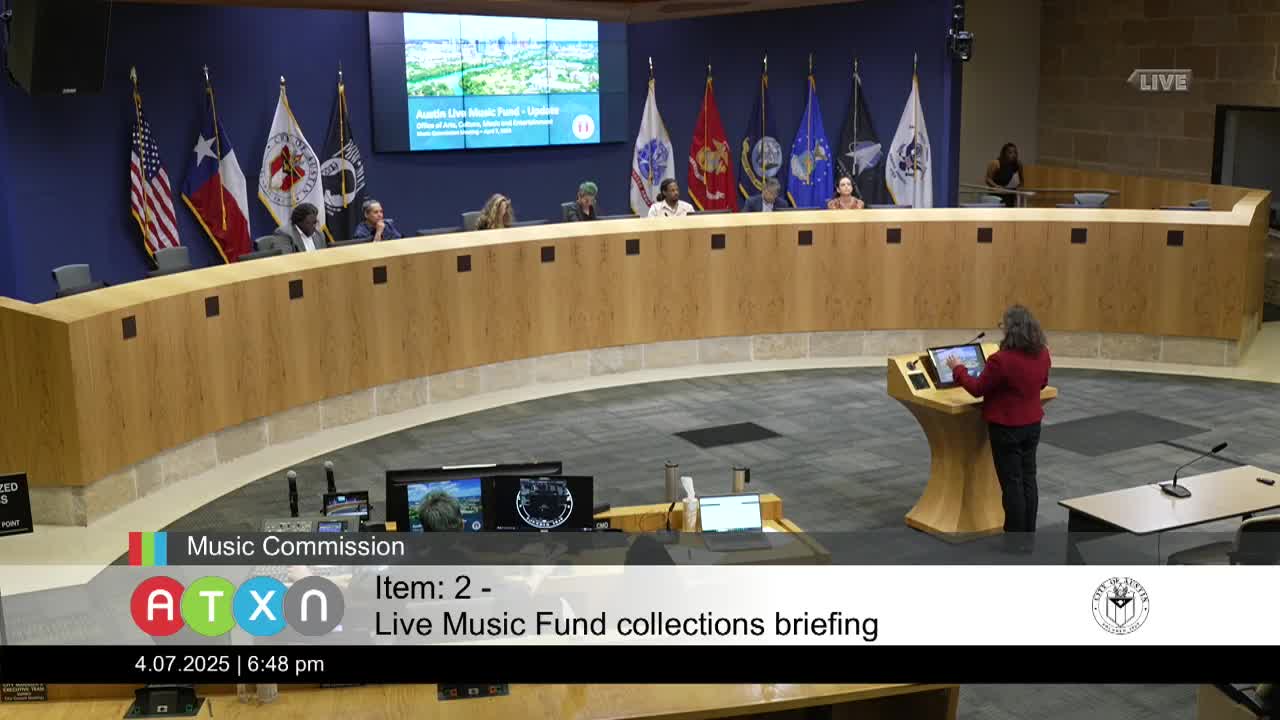
Erica Shamley, Music and Entertainment Division manager, said January collections with encumbrances reached $809,445 and February collections included an additional $306,607. Shamley said collections “have no guarantee of when they roll in—it’s when the hotels send them to the city,” and characterized February as “pretty on par with where we were last year.”
Shamley also gave a detailed accounting of the Austin Live Music Fund rollout: 136 total grant agreements were awarded, with one remaining to be signed; two orientations and four outstanding financial-information forms remain; first payments have been made to 132 awardees; 57 second payments have been made so far; and 13 awards are fully paid and complete. She said some numbers had shifted in the week before the meeting and staff would share updated figures at the May meeting.
Candace Cooper, interim chief administrative officer for ACME (Arts, Culture, Music and Entertainment), told the commission the office is building “a robust community engagement plan” that will review five years of public input and legacy documents and return to communities with a plan of action. “One of the things with community engagement is we always go out and ask questions, but we don’t necessarily come back and say, ‘this is what you all said, and this is what we’ve done with that information,’’’ Cooper said.
Shamley reminded commissioners that the Cultural Arts and Music Funding Community Engagement Survey remains open through July and that staff plans to return to the commission in May with near-final guidelines for the Live Music Fund.
Why it matters: hotel-occupancy tax revenues fund the Live Music Fund and drive the grant timeline; the city is moving to finalize program criteria this spring while ACME seeks broad public input to inform program design.
Details, staff timeline and working-group feedback
Commissioners and members of a follow-up working group reviewed a draft scoring rubric staff circulated after the commission’s prior recommendations. Working-group participants told staff they remain concerned that several rubric criteria could unintentionally disadvantage certain applicants or be difficult to verify. Key points raised by the working group and commissioners included:
- Qualified Census Tract and household language: the group recommended removing a bonus/penalty tied to residence in a qualified census tract and removing household-language criteria (for example, “non-English language spoken at home”) because members said those measures were hard to verify and risked penalizing some artists and venues.
- Accessibility: the group urged staff to replace vague accessibility scoring with specific, verifiable questions (for example, whether a venue posts accessibility information on its website, has a contact person for accessibility inquiries, provides an accessibility policy or has documented instances of ASL interpretation at events).
- Musician accomplishments and weightings: commissioners asked that musician accomplishments remain a primary weighted category. The commission’s prior recommendation favored substantial weight for accomplishments (press, touring, release activity, radio play, festival appearances); staff noted the Live Music Fund must balance tourism-promoting activities with equitable artist support. Commissioners suggested concrete accomplishment questions (recent performances in the Austin MSA, festival appearances, releases on streaming platforms, radio airplay, local press) and proposed modest numeric thresholds (for example, “three to five public performances in the past 12–24 months”) rather than high absolute figures.
- Venue definition and thresholds: the working group reiterated a preference for a clear definition of “live music venue” as a threshold for eligibility rather than allowing any applicant to enter the rubric and prove venue status afterward. Where staff keeps broader eligibility, the working group asked for strong scoring weight on governing/venue criteria (space, consistent presentation of live music, booking practice) so true live-music venues are prioritized.
- Documentation and operationalization: commissioners asked staff to specify what documentation applicants must submit for claims about income from music events, percent of local hires, internship/temporary-hire practices and past marketing activity. Staff said some verification will be operationalized in the first year with simple owner attestation or example documents and refined in future cycles.
Staff timeline and next steps
Erica Shamley said staff aims to present final guidelines for FY2025 in the May commission meeting, with a planned summer launch of grant applications and awards administration. She told commissioners that staff will consider the working group’s feedback—particularly on accessibility, the qualified census tract, and how musician accomplishments are weighed—while finalizing the rubric and required documentation. Cooper said ACME will incorporate public survey results into the final guidelines and other cultural-arts funding processes.
Ending: Staff asked commissioners to review backup materials from the prior meeting and sign up for any additional working-group sessions if they wish to help with scoring-weight recommendations before May.