
Austin Police report lower arrests, new downtown rapid response unit and mental-health pilot; sworn staffing remains strained
Get AI-powered insights, summaries, and transcripts
Subscribe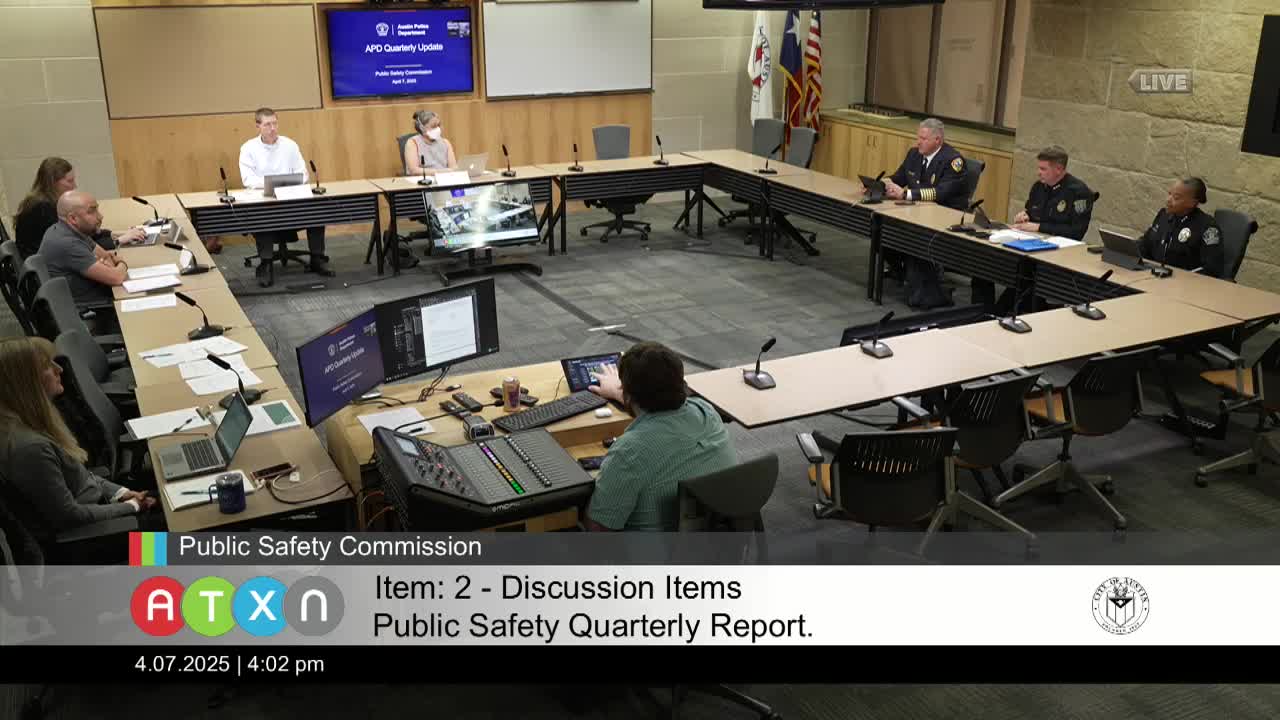
Summary
At the Public Safety Commission quarterly briefing, the Austin Police Department described a downtown safety pilot that has coincided with fewer arrests and injuries in the Sixth Street corridor, outlined a co‑response mental‑health pilot with EMS and Integral Care, and detailed continued sworn‑staffing vacancies even as cadet classes expand.
Robin Anderson, chief of staff for the Austin Police Department, delivered the department's quarterly report to the Public Safety Commission on the department's downtown safety pilot, mental‑health response plans, training and staffing.
Anderson said the department is piloting changes to the long‑running Sixth Street traffic closure and has created a downtown rapid response team (DART) to concentrate personnel in the downtown services area. "One thing that we learned is that once the congestion gets to a certain volume, we are then still closing down the streets ... there are factors and variables that dictate us shutting it down even that still remain in place on Fridays and Saturdays," Anderson said. She added that the pilot keeps primary westbound lanes open on Thursday through Saturday unless congestion or safety factors require closure.
The department has also installed temporary fencing and visual bollards to widen pedestrian pathways and is using overtime‑funded DWI officers and bike/foot patrols to increase traffic enforcement on weekends.
Nut graf: The pilot and the DART are intended to reduce harm and improve safety downtown while the department pursues a broader workload analysis to reshape deployment. The APD reported sharp declines in several measures within the Sixth Street area since the pilot began and described a multi‑agency mental‑health response to reduce arrests and use of force for people in crisis.
APD provided preliminary performance figures for the Sixth Street area: arrests are down about 40 percent, officer use of force is down about 32 percent and officer injuries are down about 57 percent. Anderson said the department interprets the arrest decline as at least partially related to changes in pedestrian flow when thoroughfares remain open: "It has created structure ... for the pedestrian traffic where you kind of have to move along. You can't just stand there and be stagnant," she said. A commissioner asked whether reduced arrests reflect fewer incidents or merely delayed reporting; Anderson said she would follow up with data to examine crimes reported or recorded after the day of incidents.
On mental‑health response, Anderson described a downtown pilot intended to bring a multidisciplinary team to scenes of mental‑health crises. "Related to mental health calls, it will be Travis County EMS and APD. We'll be working together as a team for all calls and also Integral Care will also go to the calls, as staffing allows," she said. Assistant Chief Steve White of Austin Travis County EMS added that EMS tracks patients taken to the sobering (sobriety) center and can parse whether dispositions involved substance use, mental health or both: "we do track those patients that do go to the sobriety center, and so we'll be able to kind of parse out that information," White said. Anderson said the pilot will track use‑of‑force incidents, transports and alternative destinations (jail, emergency department, diversion/alternative destinations) to align with the recently passed city mental‑health resolution.
Staffing and recruiting were a central part of the report. Anderson said sworn vacancies remain high — the department reported about 340 sworn vacancies and said its sworn vacancy rate is roughly 19 percent. By sector, APD said average sector vacancy rates are about 25 percent. Professional (non‑sworn) staffing showed lower vacancy rates (about 9–10 percent), and emergency communications had improved substantially, with nine vacancies reported in that unit. Anderson described an increase in cadet applicants after a new contract and outlined recent and upcoming academy classes: the "150 third" cadet class graduated with 29 and began patrol; the 150 fourth class currently has 51 cadets and is scheduled to graduate in August; the department has opened hiring cycles for subsequent cadet classes and expects higher application yields.
Anderson also described a new workload analysis (a targeted operational review) requested by Chief Davis to evaluate deployment, whether some work should be shifted to civilian FTEs and how investigations and other units could be resourced. Anderson said the prior Barrie Dunn (Barry Dunn) review had identified gaps and that staff would share the completed Barrie Dunn memo to mayor and council with the commission.
Several commissioners pressed APD on follow‑up metrics and on whether reductions in downtown arrests could obscure later reporting. Commissioner Nutan asked specifically whether APD is tracking crimes that may be reported after the event day; Anderson agreed to follow up. Commissioner Smith requested demographic breakdowns for sobering‑center dispositions and Anderson said APD can provide its data but noted other entities also transport to the sobering center and their data would need to be combined for citywide totals.
Ending: APD said it will return with metrics from the downtown pilot and with results from the workload analysis. The commission requested follow‑up on whether reduced on‑scene arrests correspond with lower overall crime reports or with later reporting and asked for demographic breakdowns of sobering‑center disposals when available.