Get Full Government Meeting Transcripts, Videos, & Alerts Forever!
Get email alerts on the Zoning West Innovation topic
No spam. Unsubscribe anytime.
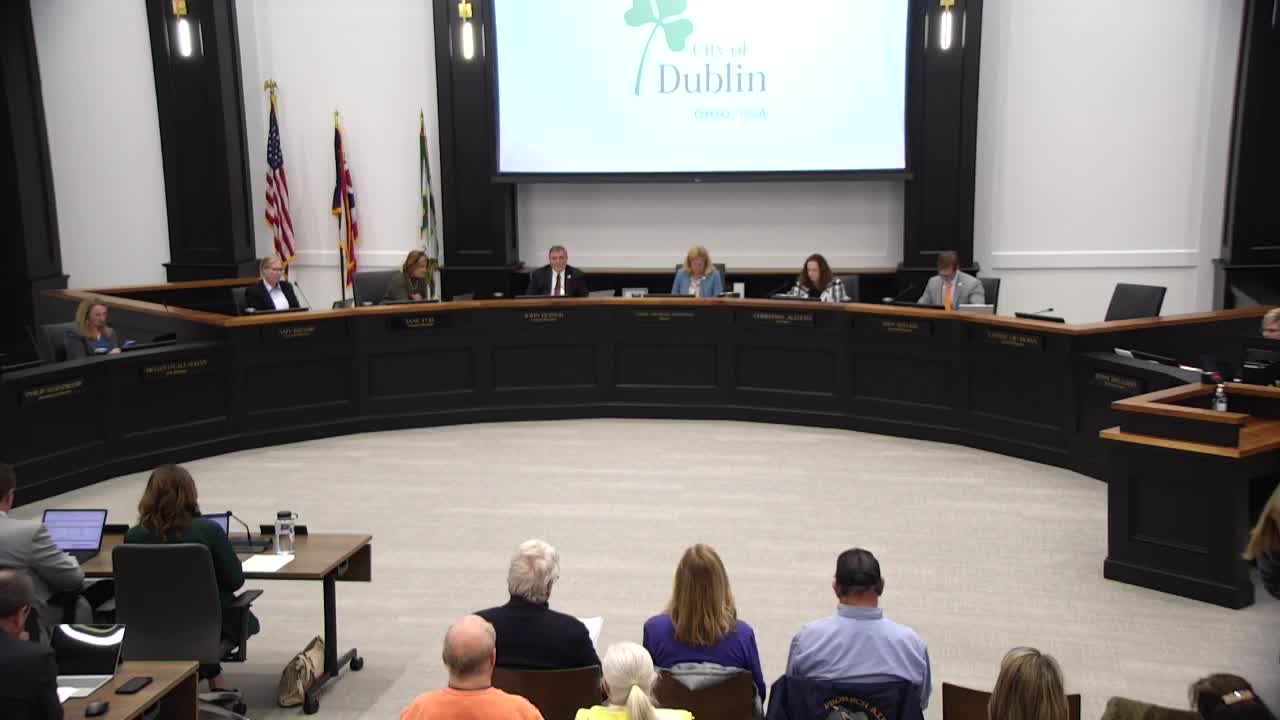
Dublin council adopts West Innovation District code changes after public debate; rezoning of nine parcels tabled
Summary
City Council approved targeted zoning-code amendments for the West Innovation District but postponed a separate rezoning of nine parcels after hours of public comment on data centers, noise, setback and buffering concerns.
Dublin City Council on April 7 adopted revisions to the cityzoning code affecting the West Innovation District (WID), including moving some industrial uses and tightening screening and setback language, but postponed action on a separate rezoning of nine parcels after sustained public concern about data-center noise, traffic and neighborhood impacts.
The ordinance the council approved (Ordinance 07-25) aligns code language with the Envision Dublin Community Plan and the West Innovation Special Area Plan. The changes keep research-support buffers, add evergreen screening and clarified mounding and setback requirements adjacent to residential zones, and shift certain uses between conditional and permitted categories. Council also approved a late amendment moving data centers from a permitted use to a conditional use in the ID-3 district so those proposals would require Planning & Zoning review.
Why it matters: the amendments change how development proposals will be reviewed in a swath of west Dublin that lies near longstanding neighborhoods. Residents pressed council that without stronger controls on noise, setbacks, building height and notification, industrial and data-center uses could harm quality of life and property values. Council members said the code changes are a step toward implementing the community plan but agreed additional outreach and technical studies are warranted before rezoning decisions move forward.
Most important facts: Council Member Jenny Rausch, presenting the staff report, said the proposed changes were intended to "better align" the zoning code with the community plan and economic development strategy. The adopted text requires larger building and pavement setbacks where ID-2 or ID-3 parcels abut residential zoning (50 feet minimum in some instances, with a 150-foot setback required in many abutting cases and the community planrecommended 200-foot buffer where applicable). The code now requires mounding and mixed deciduous/evergreen screening adjacent to homes, with mounds described in staff materials as varying between four and 14 feet with a typical height of about 12 feet.
Public commenters, many from Ballantray/Ballantree-area neighborhoods, urged the council to delay broader rezoning and to add explicit noise standards for data centers. Curt Smith, a Ballantray resident, said: "I'm particularly concerned that there isn't specific language in the codes regarding, more specifics around noise. And, that is a concern to me, especially when we begin to talk about data centers." Planning staff (Jenny Rausch) told the council the city does have an existing noise ordinance and that data centers reclassified as conditional uses would be reviewed by Planning & Zoning where noise and other site-specific mitigation could be required. She noted: "The code that we're looking at tonight is existing code. This is not new code created for this rezoning." (Transcript)
Council action and next steps: Council approved the ordinance updating the WID code (Ordinance 07-25) but after extended public comment tabled the rezoning of nine parcels (Ordinance 06-25) that would have converted roughly nine properties totaling about 370 acres from rural zoning into ID-2/ID-3. Council asked staff to hold follow-up meetings with residents and to continue work on the West Innovation Integrated Implementation Plan (utilities, transportation and infrastructure) before proceeding. Mayor Ambrose Grooms and a majority of council supported the code changes as an incremental improvement; some members said they would like added noise protections to be returned as soon as possible.
What stayed the same and what changed: Staff reported that some uses in ID-2 (Innovation 2) will be changed so assembly and manufacturing move from conditional to permitted uses, while data centers are treated more restrictively in parts of the district (moved from permitted to conditional in the ID-2 concept and, by council amendment, are conditional in ID-3). Building heights remain governed by the base code; the existing threshold that sends taller buildings (68 feet and higher) to conditional-use review remains in place.
Public response and council context: Residents repeatedly raised noise, light and traffic impacts; several cited nearby Amazon operations as an example of persistent fan noise and urged more precise code language on acoustics and setbacks before rezoning. Several residents also said they had not received or found clear notice of the plan changes on the city website. Council members and staff said the city conducted the Envision Dublin process across multiple formats, but acknowledged communications could be improved and offered to hold targeted briefings for neighbors.
Bottom line: The council moved forward with code tweaks meant to align zoning with the community plan and the economic development strategy, and added an amendment making data centers subject to additional review in one district. Council also paused a separate rezoning of nine parcels so staff can return with additional outreach and infrastructure planning — especially studies on utilities, transportation, and noise implications — before final land-use changes are adopted.
Ending: Staff said the West Innovation Integrated Implementation Plan is ongoing and will address utilities and transportation needs; council members urged neighbors to participate in follow-up briefings that staff will schedule.