Get Full Government Meeting Transcripts, Videos, & Alerts Forever!
Get email alerts on the Parking topic
No spam. Unsubscribe anytime.
Dallas committee debates citywide parking reform; sends matter to full council for briefing
Summary
The Economic Development Committee on April 7 received a City Plan Commission briefing on a proposed overhaul of parking and loading rules in Dallas and debated whether to endorse the commission's recommendations or send the item to full City Council for a fuller briefing.
The Economic Development Committee on April 7 received a presentation from City Plan Commission staff on a multi-year effort to amend Dallas's parking and loading provisions and debated whether to endorse the commission's recommendation or send the item on to full City Council for a full briefing.
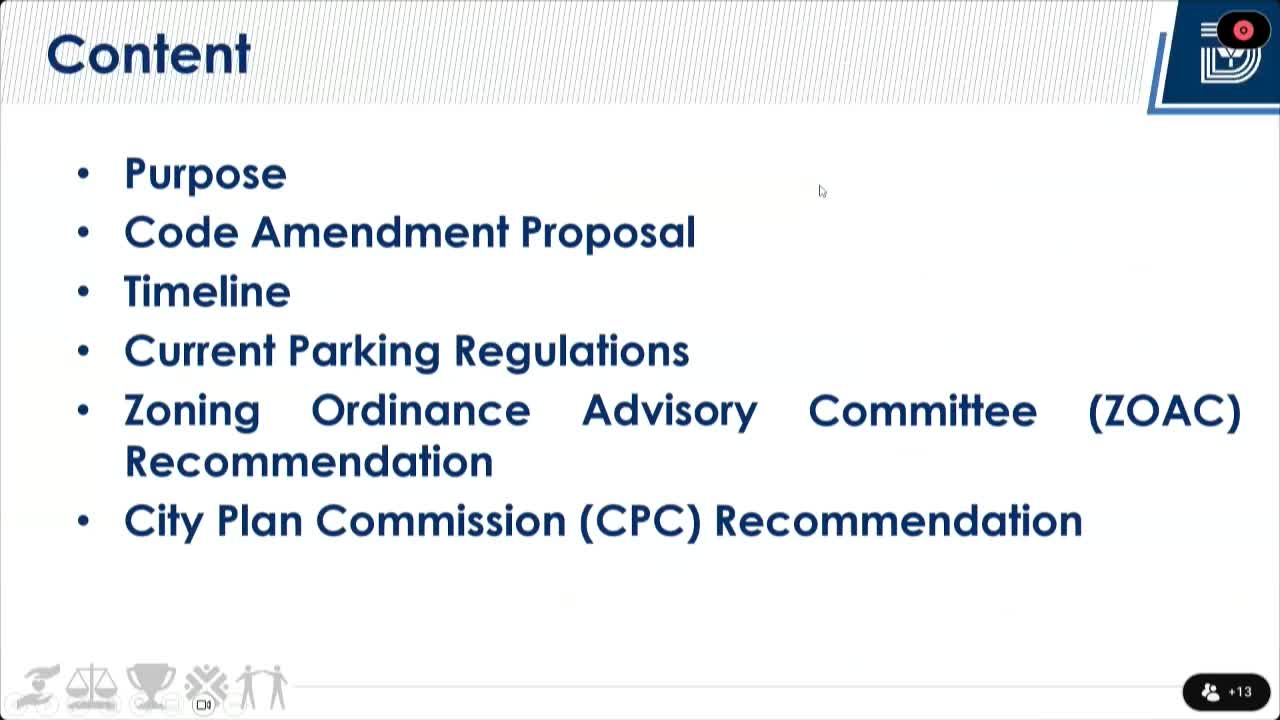
Andrea Woodrea, speaking for the City Plan Commission, summarized the proposed amendment as a shift "from requiring quantity of parking spaces and shift it into the quality of public space or quality of built space" and said the work traces to a CPC authorization in 2019 and extensive Zoning Ordinance Advisory Committee (ZOAC) deliberations.
Why it matters: The proposed rewrite would change how developers, schools, restaurants and others comply with off-street parking and loading requirements across Dallas. Supporters said the reform would reduce permitting complexity and lower housing costs by avoiding construction of unneeded parking. Critics warned that reduced minimums could create curbside spillover that would affect single-family neighborhoods and strain enforcement.
Key elements of the CPC recommendation outlined in the briefing: - Amend chapters 51 and 51A of the Dallas Development Code; do not automatically change existing Planned Development (PD) districts that already set parking ratios (examples named included Deep Ellum, Uptown, Oak Lawn and Bishop Arts). - Move toward citywide flexibility: ZOAC recommended removing parking minimums citywide (no required minimums for uses across most areas), while the City Plan Commission recommended a scaled-back approach that keeps minimums for some uses and districts. - Downtown and transit-oriented areas (half-mile around light-rail and streetcar) would have no parking minimums under the CPC recommendation. - Multifamily: CPC proposed reducing required parking by roughly one-half space per dwelling unit and adding a guest-parking requirement (10% unassigned guest parking for developments over 20 units, to be clearly marked). - Single-family: CPC recommended retaining minimums for single-family attached and detached units, but in some residential districts the ratio would be reduced to 1 space per dwelling unit. - Bars, restaurants and commercial amusements: CPC kept reduced minimums (1 space per 200 sq. ft.) but recommended no minimums for bars/restaurants under 2,500 sq. ft.; staff and CPC language differed on the threshold and possible impacts. - Loading: CPC recommended keeping loading requirements but simplifying some design standards; ZOAC had not changed loading rules. - Affordable-housing bonus: CPC recommended a no-minimum parking option when applicants provide an affordable-housing bonus (code-referenced minimum affordability threshold applies). - Other measures discussed: scaled design standards (curb-cuts, pedestrian access), higher bicycle-parking minimums and a proposed lower threshold that would require a traffic/engineering review for developments that generate more trips (Z O A C recommended lowering the permitting-engineering review threshold from 6,000 to 1,000 trips per day; committee discussion favored retaining the 6,000 threshold or reviewing that change further).
Committee discussion and concerns Committee members pressed staff for local evidence, enforcement plans and financial context. Several council members asked whether developers financing and lenders (including Low-Income Housing Tax Credit rules) typically require parking and whether market forces would still cause most new multifamily projects to provide parking even if minimums are removed. Woodrea replied that for LIHTC the state often requires about 1.25 parking spaces per unit and that developers typically provide parking because of market expectations.
Other recurring themes in committee remarks: - Spillover: multiple members asked how curb overflow into single-family neighborhoods would be prevented and whether police, code compliance and public works had been consulted on enforceability and curb management. - Management vs. supply: supporters emphasized management tools (parking districts, residential permit parking, curb re-striping) more than minimums; several council members said the city must pair any ratio changes with an enforceable curb-management plan and resources for enforcement. - Data and costs: multiple members requested clear local numbers on how parking minimums affect development cost and rent, and more local parking studies rather than national guidance.
Motions and committee outcome - A motion to approve the CPC recommendation with a set of technical amendments (mover identified in the record as Adam Baladu) was offered and seconded during the committee meeting; that motion did not receive sufficient support and failed in committee (the recorded tally in the transcript shows only two yes votes during that attempt). - A separate motion was made on the floor to refer the parking code amendment to the full City Council without a committee recommendation so the entire council could receive a full briefing and technical follow-up. That motion was moved and seconded during the meeting; staff and the committee then requested that councilmembers send written questions so staff could prepare a comprehensive briefing memo for the full-council session.
Next steps Committee members and staff agreed to schedule a full-council briefing ahead of any vote. Staff told committee members they will prepare a detailed briefing memo that addresses the cost impacts, enforcement plans (including curb-management tools), the traffic-review thresholds, and comparisons to existing PD provisions where parking ratios are already set. No binding code change occurred at the committee level; the item will proceed to City Council for further briefing and eventual public hearing if council directs it forward.
Ending Committee members repeatedly asked staff for local analyses and clearer enforcement plans before any vote. The committee closed the parking discussion by asking staff to compile written responses and to include the CPC report, ZOAC history and examples of how similar reforms have performed in peer cities.