Get Full Government Meeting Transcripts, Videos, & Alerts Forever!
Get email alerts on the Committee Roundup topic
No spam. Unsubscribe anytime.
Senate committee advances telehealth, small-business, contractor, Salton Sea and other bills; votes at a glance
Summary
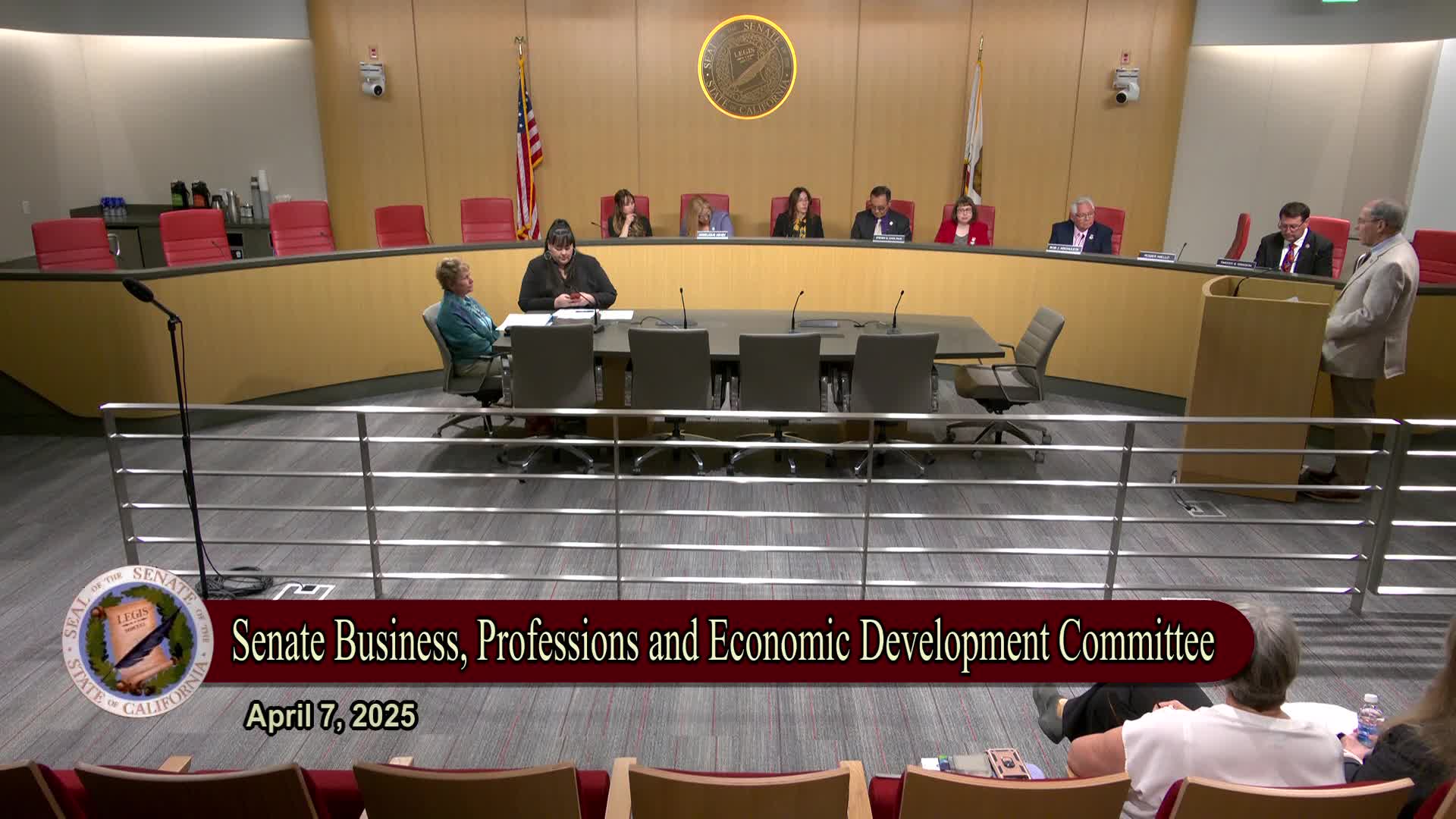
The Business, Professions and Economic Development Committee on April 7 advanced a slate of bills addressing telehealth access, small‑business contracting, contractor enforcement, regional economic zones and consumer protections tied to disasters, animal imports and travel sales.
The Business, Professions and Economic Development Committee on April 7 advanced a slate of bills addressing telehealth access, small-business contracting, contractor enforcement, regional ‘‘green empowerment’’ economic zones, protections for consumers and disaster recovery, and arts and animal‑welfare measures.
The committee proceeded despite a delayed quorum and heard extended testimony on several measures, including SB 508 (telehealth continuity), SB 781 (small‑business utilization plans), SB 779 (minimum contractor fines), SB 534 (Salton Sea Green Empowerment Zone), SB 456 (muralist licensing exemption), SB 312 (puppy import health certificates), SB 95 (ticket consolidators), SB 387 (medical faculty permits for City of Hope), and SB 641 (wildfire consumer protections).
Why it matters: the group moved legislation aimed at expanding patient access to out‑of‑state specialty care via telehealth, protecting small businesses’ access to local government contracting, strengthening the Contractor State Licensing Board’s enforcement tools against unlicensed and harmful construction activity, and creating regional structures intended to coordinate public and private investment for lithium development in the Salton Sea region. The committee also considered consumer and public‑health protections tied to animal imports, travel fraud, and post‑disaster contracting and licensing.
Telehealth continuity for patients who previously qualified under AB 1369 (the David Hall Act) SB 508, presented by Senator Nilo for Senator Valadares, would allow patients who once qualified for out‑of‑state telehealth services under AB 1369 (the David Hall Act) to continue care with those out‑of‑state providers if they later enter remission and no longer meet the original eligibility criteria. Patient testimony emphasized clinical continuity and access: Robin Clow, a patient who described receiving a targeted therapy at MD Anderson after care at Cedars‑Sinai, said, “Telehealth visits are truly a lifeline.” Committee members pressed about physician training and credentialing; the California Medical Association said it had no formal position at the hearing but was continuing to work with the author on language. The committee voted to pass the bill to the next committee.
Small‑business utilization and technical assistance funding (SB 781) SB 781, carried for Senator Reyes by Senator Archuleta, would encourage cities and counties to adopt small‑business utilization plans and clarify state support for local small‑business technical assistance programs (the TAP network) amid federal policy changes that have created uncertainty for some federally designated assistance centers. Pat Fong Kushida (California Asian Pacific Chamber of Commerce) and Anthony Butler Torres (California Hispanic Chamber) testified in support, saying the measure would help local governments retain procurement dollars in region and preserve access to minority business development technical assistance. The committee moved the bill forward.
Contractor enforcement: raising minimum citation fines (SB 779) Senator Archuleta presented SB 779 to raise statutory minimum enforcement fines administered by the Contractors State License Board (CSLB). Rebecca May of CSLB said statute currently sets maximum fines ($8,000 for general violations; $30,000 for major violations including unlicensed activity) but has very low or obsolete minimums (for example, a $200 minimum for some unlicensed activity that dates to 1990). SB 779 would set higher minimums (CSLB testified to proposed ranges such as $500–$8,000 and $1,500–$30,000, depending on violation class) to improve deterrence and help the board recover enforcement costs. Members asked about restitution to consumers; CSLB confirmed citations can include restitution and that the board may order consumers be made whole as part of a citation, but civil remedies (bonds, court actions) remain available for consumers. The committee advanced the measure.
Salton Sea Green Empowerment Zone (SB 534) and regional lithium planning Senator Padilla presented SB 534 to establish a Salton Sea Regional Green Empowerment Zone aiming to coordinate investments, workforce training and community benefits tied to lithium‑value and geothermal development in the Salton Sea/Southeastern California region. Community organizations Alianza Coachella Valley and Comité Cívico de la Valle, both represented at the hearing, described the measure as implementing a Blue Ribbon Commission recommendation to create a formal designation that helps the region compete for and coordinate state, federal and private investments while protecting disadvantaged communities. Committee members asked about local jurisdictional buy‑in, CEQA and infrastructure needs; proponents said the designation is intended to help assemble projects, workforce pipelines and investments rather than override local permitting.
City of Hope and academic medical recruitment (SB 387) SB 387, authored by Senator Rubio and presented by a City of Hope physician witness, would modify the volume requirement in the state’s special faculty permit program that allows internationally licensed physicians to practice under certain academic sponsorship. City of Hope meets program criteria except for the original annual trainee number (250); the bill would lower the required annual trainee threshold to better reflect specialized cancer fellowships and allow recruitment of international clinical researchers and faculty to California. Supporters said that change would let California cancer centers bring expertise and clinical trial capacity into state programs.
Muralist exemption from contractor licensure (SB 456) SB 456, presented by Senator Ashby, would exempt commissioned muralists who paint works of fine art from requirements that would otherwise classify them as contractors under Section 7050 (Business and Professions Code). City arts managers and several Sacramento muralists testified the change is meant to protect community mural programs and festivals that have been chilled after regulatory notices prompted local agencies to pause mural projects. Labor representatives from painters’ unions said they appreciated the author’s outreach and raised concerns about existing muralists employed by licensed contractors and about safety and scaffold/rescue standards; the author and sponsors said the bill preserves all Cal/OSHA and permitting requirements while clarifying licensure scope.
Puppy‑import health certificates (SB 312) SB 312 would require certificates of veterinary inspection (CVIs) for dogs imported into California for resale be submitted to the California Department of Food and Agriculture and made accessible to authorities. Animal‑welfare groups and municipal humane‑law enforcement agencies urged the change, saying centralized records will help trace sources, detect large‑scale breeders and support enforcement following reporting of sick animals or deceptive online sales. Witnesses said other states already maintain such records and California’s current decentralized filing has limited enforcement.
Ticket consolidators and consumer refunds (SB 95) SB 95, presented by Senator Umberg, would require so‑called ticket consolidators that resell airline seats to register under the state’s seller‑of‑travel law; proponents described repeated scams and the difficulty of enforcing offshore operator fraud. Airline representatives said they support enforcement but objected to proposed direct refund requirements on carriers and said they will continue to work with the author on enforcement language that targets fraudulent consolidators while accounting for operational realities.
Wildfire consumer protections and emergency licensing (SB 641) SB 641 — part of the Senate’s wildfire response package — would give the Department of Consumer Affairs and the Department of Real Estate authority to waive licensing deadlines during declared emergencies, strengthen oversight of predatory conduct in real‑estate transactions after disasters, and set baseline safety and training standards for private debris‑removal contractors. Proponents said the steps aim to protect survivors from opportunistic misconduct while preserving licensed professionals’ ability to work during recovery. CSLB and industry witnesses expressed support for enforcement tools and safety requirements.
Votes at a glance (committee action and disposition) - SB 387 (medical faculty permit; City of Hope) — Passed to Appropriations (current recorded committee vote 8–0 at first call; later recorded as passed). Mover: Senator Choi. Outcome: passed/ordered to next committee. - SB 508 (telehealth continuity for David Hall Act patients) — Passed to Appropriations (committee recorded votes in favor; moved). Mover: Vice‑Chair Choi. Outcome: passed/ordered to next committee. - SB 534 (Salton Sea Green Empowerment Zone) — Passed to Local Government (moved). Outcome: passed/ordered to next committee. - SB 781 (small business utilization) — Passed to Local Government. Outcome: passed/ordered to next committee. - SB 779 (contractor citation minimums) — Passed to Judiciary. Outcome: passed/ordered to next committee. - SB 95 (sellers of travel; ticket consolidators) — Passed to Judiciary (committee recorded a smaller roll call). Outcome: passed/ordered to next committee. - SB 312 (puppy import CVI database) — Passed to Agriculture. Outcome: passed/ordered to next committee. - SB 227 (Contra Costa Green Empowerment Zone expansion / SB 227 series) — Passed to Local Government. Outcome: passed/ordered to next committee. - SB 456 (muralist exemption) — Passed to Appropriations. Outcome: passed/ordered to next committee. - SB 641 (wildfire consumer protection / licensing relief) — Passed to Public Safety. Outcome: passed/ordered to next committee.
Discussion and next steps Committee members generally supported advancing the bills while asking for clarifying amendments or follow‑up language on enforcement, consumer restitution, worker safety and intergovernmental coordination. Several authors and witnesses committed to continue negotiations with stakeholder groups — for example, the California Medical Association on SB 508 and labor and arts groups on SB 456.
The committee put several bills “on call” to secure votes from members who had not yet arrived and directed staff and authors to return with technical or clarifying amendments as the measures proceed to Appropriations or policy committees.
Speakers quoted in this report include Robin Clow (patient/witness), Pat Fong Kushida (California Asian Pacific Chamber of Commerce), Rebecca May (Contractor State License Board), Donald Gensler (City of Sacramento art manager) and Jennifer Fearing (San Diego Humane Society). For example, Clow, who described traveling and telehealth care for anaplastic thyroid cancer, told the panel: “Telehealth visits are truly a lifeline.”
Ending The committee’s actions set multiple bills on the path to fiscal review or additional policy scrutiny. Authors and stakeholders will continue technical negotiations before fiscal committee deadlines. The panel adjourned after a final roll call and directed staff to schedule remaining on‑call votes later in the week.