Get Full Government Meeting Transcripts, Videos, & Alerts Forever!
Get email alerts on the Regional Housing topic
No spam. Unsubscribe anytime.
Benton County planning commissioners press housing subcommittee on process, rural water and outreach
Summary
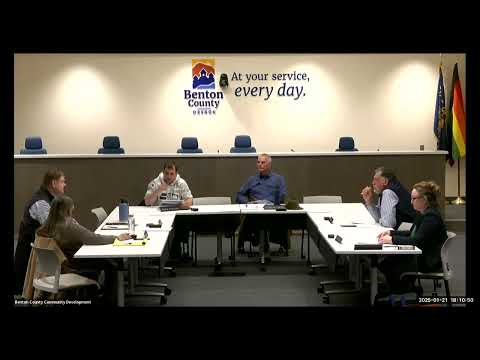
At a Jan. 14 work session, the Benton County Planning Commission heard a regional housing update and debated whether subcommittee actions, project endorsements and outreach have adequately represented the full commission and rural jurisdictions — particularly water-limited areas.
The Benton County Planning Commission on Jan. 14 received an update from its regional housing subcommittee and spent the bulk of a two-hour-plus meeting debating subcommittee process, outreach scope and the limits of county jurisdiction — most notably water availability in rural areas.
Ed Fulford, a planning commissioner and chair of the regional housing subcommittee, summarized a two‑phase effort that he said began with outreach to “some 50 different leaders in and around the region” and is moving toward a second phase to form a community committee, hire consultants and identify near‑term, shovel‑ready projects. Fulford said the group has asked the county and the governor’s office for two years of funding and that the subcommittee has requested roughly $12,000,000 in infrastructure funding that could be used to advance projects such as wastewater infrastructure for Adair Village. He also said the subcommittee is seeking private contributions and aiming for about $1,000,000 from local employers in year one.
“Phase 1 was really a socialization of the regional housing,” Fulford said. “A lot of people have a piece of the puzzle, but we need to kind of bring it together.” He said the governor’s office and the offices of U.S. Sen. Merkley, U.S. Sen. Wyden and a local representative participated in a recent briefing, and that the subcommittee presented a draft budget and program rationale to the county Board of Commissioners on Dec. 17.
Commissioners who represent rural areas pushed back on the subcommittee’s outreach and proposals. Commissioner Evelyn Lee said the county’s unincorporated jurisdiction is overwhelmingly rural and faces unique constraints — especially water. “Rural communities are an endangered species,” Lee said. She urged the commission to ensure any housing focus for unincorporated Benton County is paired with a “coequal focus on water, water availability, surface water, groundwater.”
Multiple commissioners and several members of the public also raised transparency and public‑meeting concerns. Commissioner Catherine Biscoe said she had not seen meeting notices or minutes for subcommittee work and asked how the public and other commissioners could follow outreach to cities and potential project partners. "I do have some concerns about the process of which we have engaged," Biscoe said. She and others asked whether city housing efforts and water issues in Philomath, Monroe and North Albany had been meaningfully included in the subcommittee’s conversations.
Fulford and other planning commissioners said the subcommittee has produced notes and interview summaries and that staff have posted transcripts and minutes to the county folder. Chair Nick Fowler and other commissioners repeated that any formal recommendation or endorsement “representing the planning commission” must come before the full commission at a publicly noticed meeting.
Several speakers described Adair Village’s proposed wastewater infrastructure as a shovel‑ready, early‑win project the subcommittee flagged in interviews and outreach. Commissioners said Ed Fulford provided a letter of support and staff coordinated with county leadership to route a board endorsement; several commissioners stressed that the planning commission itself had not formally adopted the project as a planning commission recommendation. “The Planning Commission has not made an endorsement to this infrastructure project,” Chair Fowler said during the discussion.
Commissioners also reviewed the timetable for a comprehensive plan update and related code reconciliation. Greg Haman, who co‑chairs the comprehensive planning work, said the county expects to begin community engagement soon and estimated an 18‑month schedule for the comprehensive‑plan process subject to funding. Staff reported preliminary grant and budget support that would allow the county to purchase consultant facilitation and to bolster staffing for implementation and outreach; staff estimated a county backstop of about $350,000 in the budget to advance the work if grant timing shifts.
The commission discussed procedural constraints imposed by public‑meeting law and the need for clearer practices for subcommittee notices, distribution of draft materials and “serial meeting” avoidance. Commissioners asked staff to make meeting materials available earlier; staff said their goal is to circulate packets seven days before meetings and to post committee notes and interview transcripts online. Several commissioners requested training on public‑meeting rules and on how commissioners should engage with community partners without triggering a quorum or a serial meeting.
The meeting closed with commissioners agreeing to improve clarity about when subcommittee updates are informational and when they are intended as proposed recommendations that would be forwarded to the Board of Commissioners or be subject to decision by the full planning commission. The commission did not take formal action on any housing project at the Jan. 14 meeting.