Get Full Government Meeting Transcripts, Videos, & Alerts Forever!
Get email alerts on the Stormwater Policy topic
No spam. Unsubscribe anytime.
Stormwater staff explains state CGP rules, 80% TSS standard and plans to adopt Metro‑style infill templates
Summary
Ryan Fort of the City of Gallatin stormwater division presented to the Planning Commission on stormwater policy, explaining state CGP requirements, the 80% TSS standard and plans to adopt Metro‑style infill templates for small projects.
Ryan Fort of the City of Gallatin stormwater division gave a detailed presentation to the planning commission explaining the city’s stormwater review role, the statutory and regulatory drivers behind stormwater comments, and planned clarifications to local policy.
Fort reminded commissioners that the stormwater ordinance is codified in Gallatin Municipal Code Chapter 18 and that many comments the stormwater division makes as conditions of approval derive from the Tennessee Department of Environment and Conservation (TDEC) Construction General Permit (CGP) and MS4 (Municipal Separate Storm Sewer System) requirements. “The stormwater ordinance was adopted into the Gallatin Municipal Code, or chapter 18… all of the comments, were conditions, approval that stormwater makes from the ordinance are part of municipal code,” Fort said.
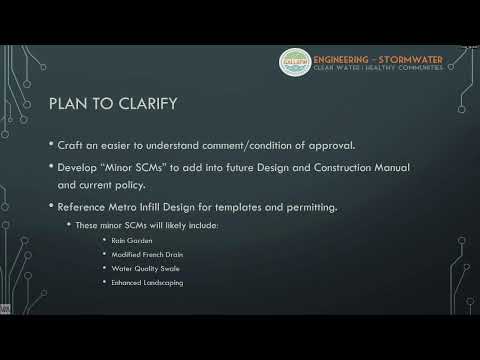
He explained two central regulatory requirements that commonly affect local projects: water quality (an 80% total suspended solids, or TSS, removal target now defined in the 2021 CGP) and water quantity (detention to manage post‑development flows, commonly designed at a minimum to the 10‑year storm and sometimes to the 100‑year event). Fort said ambiguity in the city’s current ordinance language about “common plan of development” has created confusion; staff has been treating individual plat lots within a recorded plat as part of a larger common plan. To reduce uncertainty, Fort said staff plans to draft clearer ordinance language and to adopt an approach that mirrors Metro Nashville’s infill design rules: an easy‑to‑use template for “minor SCMs” (stormwater control measures) such as rain gardens, modified French drains, vegetated swales, or enhanced landscaping that a homeowner or small developer could implement without a civil engineer stamp for small projects.
Commissioners asked technical questions about how the 80% TSS metric is applied and about whether gravel/crusher‑run surfaces should be treated as impervious. Fort said the 80% TSS removal target is achieved by the design of the structural measures (for example, certain rain garden dimensions and planting specifications can be expected to meet the TSS target). He also said the city treats gravel and compacted aggregate as impervious area for stormwater calculations because such surfaces can be asphalted without permitting and compacted gravel does not readily infiltrate.
Fort said staff will propose ordinance revisions and minor‑SCM templates to provide predictable, lower‑cost compliance options for small residential and infill projects. He encouraged applicants and commissioners to view change‑of‑use reviews as opportunities to improve site conditions and noted staff’s willingness to work with applicants on practical solutions rather than imposing unnecessary burdens.