Get Full Government Meeting Transcripts, Videos, & Alerts Forever!
Get email alerts on the Driver License Suspensions topic
No spam. Unsubscribe anytime.
Maine committee hears bill to end five‑year driver’s‑license suspensions following certain drug convictions
Summary
Supporters at a public hearing told the Legislature the suspension policy hampers reentry, employment and recovery in rural Maine; the Bureau of Motor Vehicles said the bill would not change road‑safety enforcement and will supply data for the work session.
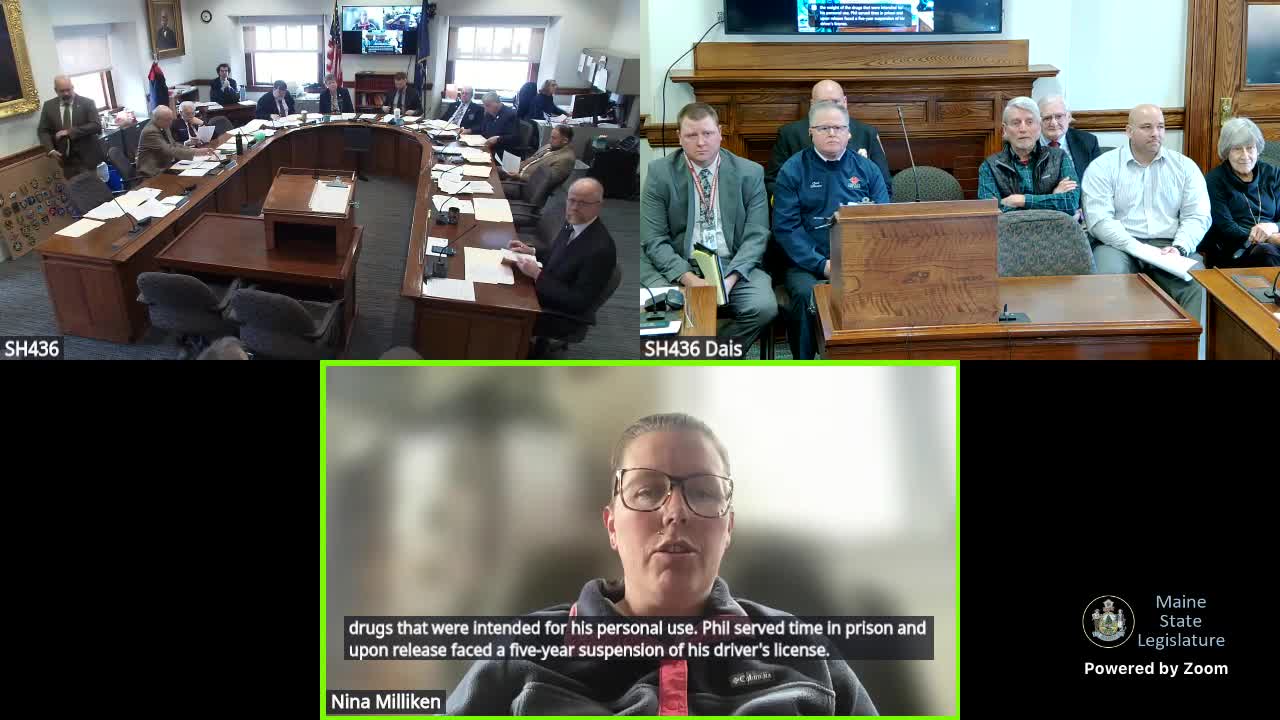
A Maine legislative committee heard extensive testimony on LD 421, a bill to repeal courts’ ability to suspend a person’s driver’s license for up to five years after a conviction for certain drug offenses, during a public hearing of the Joint Standing Committee on Criminal Justice and Public Safety. Representative Nina Milliken presented the bill and urged lawmakers to remove a penalty that she and witnesses described as a barrier to reentry.
“This bill is about giving our returning neighbors a fair shot at rebuilding their lives,” Representative Nina Milliken said, describing a constituent known as “Phil” whose license was suspended for five years after a conviction tied to possession for personal use. “Without a driver’s license, even basic things like attending a job interview, seeing a doctor, or buying groceries become major obstacles.”
Supporters — including people who recently returned from incarceration, reentry organizations and recovery advocates — said suspensions commonly begin when people leave incarceration, when they most need transportation for work, medical care and treatment. Witnesses described rural Maine’s limited public transit as a key factor that makes license loss especially harmful.
“My license is revoked and I’m currently employed, but getting to work and medical appointments without a license has been extremely difficult,” said Norman Hightower, who testified he recently reentered the community. “Not everybody who gets out of prison has the supports I had.”
The bill would remove the state statute that permits courts to include up to five‑year suspensions of driving privileges as part of sentences for certain drug offenses. Under current law, a suspension tied to a drug conviction does not begin while a person is incarcerated; it begins after release.
Sheena Bellows, Maine’s Secretary of State and Chief Motor Vehicles Officer, testified in favor of LD 421 after the Bureau of Motor Vehicles reviewed the proposal. She told the committee the bill would not change the BMV’s authority to suspend driving privileges when there is a driving‑related safety threat, nor would it alter the bureau’s medical functional‑ability review process for conditions that impair driving.
“The bill removes punishment in a law that may inhibit someone’s ability to operate a vehicle for a non‑driving offense,” Bellows said. “It doesn’t change enforcement mechanisms when there’s an imminent threat to road safety.”
Bellows also said the bureau would work to provide the committee with data at the work session about how often courts impose these suspensions and whether vehicles were used as tools in trafficking cases when courts ordered license suspensions.
Representatives and senators on the committee asked multiple questions about data. Senator Scott Searway and others asked how often courts impose the suspension, whether data exist on when a vehicle was used as an instrument of trafficking, and how suspensions intersect with administrative suspensions the BMV imposes after driving incidents. Bellows said the bureau will try to provide those figures for the work session and explained there are two separate tracks: administrative suspensions under Title 29‑A for imminent road threats, and court‑ordered suspensions the bill would modify.
Several advocacy groups testified in support. Peter Layman of the Maine Prisoner Advocacy Coalition said suspensions “essentially doom reentry” by making it impossible to get to work, probation appointments and counseling. Tess Parks of Maine Recovery Action Project described the suspension as “among the most damaging collateral consequences” of convictions in a rural state where driving is often the only viable transportation option. Dorothy O’Dell of Restorative Justice Project Maine told the committee her organization has helped people transition from incarceration and that losing driving privileges makes employment and stable housing much harder.
No witnesses appeared in opposition during the hearing. Committee members asked frequently for more data: how many suspensions are imposed under the statute at issue, how many involve vehicles used in trafficking, and whether the BMV’s medical functional‑ability rules would remain in place. Bellows said the bureau’s OUI and medical sections are unchanged by LD 421 and offered to bring more detail to the work session.
What happens next: The committee closed the public hearing and indicated it will continue the bill at a later work session. Committee members said they want BMV and other state agencies to provide the numbers and clarifications requested before any recommendation vote.
The testimony focused on balancing public safety and road‑safety enforcement with the potential collateral harms of removing driving privileges after non‑driving convictions. Supporters framed LD 421 as a targeted change to remove a reentry barrier without weakening mechanisms that address drivers who are an immediate threat to road safety.