Get Full Government Meeting Transcripts, Videos, & Alerts Forever!
Get email alerts on the Energy Omnibus Sf2393 topic
No spam. Unsubscribe anytime.
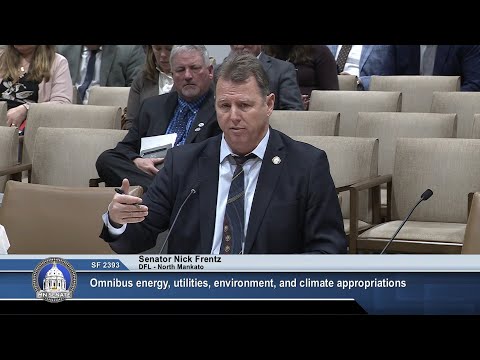
Senate energy omnibus bill (SF2393) advanced after amendment; committee hears testimony on net metering, community solar, data centers and RDA projects
Summary
The Senate Energy Committee reviewed Senate File 2393, adopted an A3 delete‑all amendment, and laid the bill over for markup. Testimony focused on net metering and community solar changes, data‑center exemptions and environmental review, carve‑outs for biodiesel in the carbon‑free standard, and RDA project funding.
Senator Laura France presented Senate File 2393, the Senate energy omnibus bill, to the Minnesota Senate Energy, Utilities, Environment, and Climate Committee and walked members through budget and policy provisions, including appropriations from the Renewable Development Account (RDA), transfers to geothermal planning, and policy changes affecting net metering, community solar, data centers, and the carbon‑free standard.
The committee adopted the A3 delete‑all amendment offered with the bill and laid the measure over for a Wednesday markup. Senator France said the package reflects bipartisan negotiation and singled out the committee's 100% clean energy by 2040 framework as a central goal, asking members to “consider, what is the way to reduce carbon emissions the most and the fastest?”
Why it matters: SF2393 combines budget adjustments and multiple policy changes that affect utility customers, renewable project funding, and regulatory review. Testimony from state agencies, utilities, clean‑energy advocates, local governments and industry highlighted competing priorities: protecting ratepayers and low‑income customers, sustaining community solar and net‑metering access, enabling large data‑center development, and directing limited RDA dollars to selected projects.
Major budget and program items
Staff described two categories of fiscal change. A transfer reduced the ongoing general fund appropriation for pre‑weatherization workforce training from a base of $3,199,000 per year to $1,199,000 per year, a $2,000,000 annual reduction that staff described as producing net savings of about $4,000,000 in fiscal 2026–27 and in the tails. A forecast adjustment to interest income reduced the RDA by roughly $8.831 million (staff noted an approximate $13,000,000 reduction overall carried into FY26). The amendment also shows about $20,000,000 of new spending and transfers from the RDA versus base.
Selected RDA and related project amounts listed in the bill include: - University of St. Thomas microgrid: $1,200,000 (including $400,000 base + $800,000 new) - Green hydrogen project (St. Cloud): $2,000,000 - Anaerobic digester project: $4,000,000 - Como Zoo geothermal system: $2,200,000 - Minnesota Energy Alley: $1,000,000 - Green ammonia research (University of Minnesota): $5,000,000 - Emerald ash borer disposal/processing facility (Pollution Control Agency): $3,000,000 - Geothermal planning transfer (SF2454 referenced): $2,000,000 - State building energy revolving loan fund (base): $92,000 per year
Staff also explained that extraordinary‑event bonds created in separate legislation (SF999) would no longer rely on a general fund appropriation; instead, Commerce and the Public Utilities Commission (PUC) would assess actual and anticipated costs into a new special revenue account and recover costs from assessable entities only if the program is activated.
Policy provisions and points of debate
Net metering and community solar: The bill includes language from Senator Rehrig (net metering) and from other sponsors that would change how excess generation is compensated and would sunset the Community Solar Garden (CSG) program under certain terms (a sunset provision was described as sunsetting the CSG program in 2028). Supporters such as the Minnesota Rural Electric Association argued the changes make the program “more equitable” and prevent oversized systems from generating profits that shift costs to non‑solar customers. Opponents including Solar United Neighbors, Cooperative Energy Futures, Vote Solar, and multiple environmental and consumer advocates urged preserving the CSG program and warned that the bill’s changes would reduce access for renters and low‑income households. Logan O'Grady, executive director of the Minnesota Solar Energy Industries Association, said the industry would be “negatively impacted” by the bill.
Data centers and environmental review: Article 3 contains multiple data‑center provisions that define emergency backup generators and clarify when environmental review can be considered complete. Several speakers urged fuller regulatory guardrails: 100% (a clean‑energy advocacy organization) opposed “carve‑outs to the carbon free energy standard” and “exempt[ing] data centers from obtaining a certificate of need for their backup generation.” Staff said the data‑center language was incomplete and would also be considered in the Environment Committee.
Carbon‑free standard carve‑outs and biodiesel: The bill would allow certain peaking facilities using biodiesel (B100) for up to 400 hours per year to qualify under the carbon‑free standard in the bill text. Multiple health, environmental and clean‑energy groups opposed labeling biodiesel as “carbon free,” citing lifecycle emissions, nitrous oxide impacts and land‑use concerns. Fresh Energy and others noted industry analyses do not characterize biodiesel as fully carbon free.
Other technical and definition changes: The bill revises definitions for emergency backup generator, data center, qualifying facilities, and updates the large energy facility threshold (including a proposal to increase the storage threshold from 100,000 gallons to 1,000,000 gallons of liquefied natural or synthetic gas in one section). Provisions also modify eligibility for certain environmental review procedures and add tribal governments as eligible recipients for geothermal planning grants.
Agency budget items and administrative authority
Minnesota Department of Commerce Commissioner Grace Arnold testified in support of many appropriations and opposed arbitrary caps on grant administration funding, saying the department typically administers grants using “about 5% or under of the funding, typically far less, dedicated to administration.” Staff described PUC change items (operating adjustment, technology/maintenance, tribal liaison, and natural gas utility planning and coordination) that together increase assessed costs in the biennium, with those increases to be recovered from ratepayers through utility assessments per existing practice. Counsel noted the PUC staff increases included 3 FTEs for natural gas planning, 5 FTEs for technology staffing, and 1 tribal liaison FTE as included in the governor’s budget materials; the committee discussion noted those costs would be assessed back to ratepayers.
Testimony summary
Eighteen listed testifiers provided oral testimony representing state agencies, municipal utilities, industry trade groups, environmental organizations and local governments. Proponents of RDA projects and targeted funding (green hydrogen, geothermal, emerald ash borer disposal site) described local economic and environmental benefits and asked the committee to include the projects proposed. Opponents of net‑metering and CSG changes urged preserving access for renters and low‑income households and warned about premature changes to the carbon‑free standard and data‑center exemptions. Several organizations asked for additional consumer protections, including technical changes to ensure low‑income utility programs remain operable if federal programs change, and for data centers to contribute offsets such as investments in income‑eligible weatherization.
Actions and next steps
The committee adopted the A3 amendment by voice vote and then laid Senate File 2393 over for a scheduled markup on Wednesday. Senator France and staff said the bill remains open for amendment and negotiation before markup. The committee indicated plans to review language and proposals provided in the interim and to reconvene to consider final votes and amendments.