Get Full Government Meeting Transcripts, Videos, & Alerts Forever!
Get email alerts on the Human Services Omnibus topic
No spam. Unsubscribe anytime.
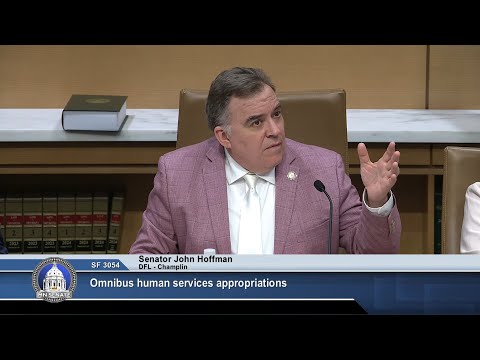
Senate committee advances human services omnibus framework; A‑1 adopted, major nursing‑home and waiver changes remain under review
Summary
The Senate Human Services Committee adopted the A‑1 amendment to its human services omnibus (Senate File 3054) April 7 and laid the amended bill over for further markup; the package includes significant changes to nursing facility payment formulas, disability waiver rate mechanics, EIDBI licensing and numerous grants and cancellations.
On April 7 the Senate Human Services Committee reviewed a comprehensive human services omnibus draft (delete‑all/A‑1 amendment to Senate File 3054) that reorganizes and modifies numerous policy and budget items affecting long‑term care, disability waivers, behavioral health, and grants. Committee counsel and fiscal staff walked members through the spreadsheet of proposals and the A‑1 author’s amendment; the committee adopted the A‑1 amendment by voice vote and laid the amended Senate File 3054 over for markup and potential inclusion in later packages.
Major topics discussed and the committee’s action overview:
Nursing facility payment system and VBR modifications: Committee fiscal staff described differences between the governor’s proposal and the A‑1. The A‑1 limits operating growth to 4% per year (the governor proposed a 2% operating cap) and also changes the formula used in value‑based reimbursement (VBR) that links care‑related payment limits to a facility’s quality score. Committee counsel described the change as an alteration to the slope of the quality‑limit formula: lower‑quality facilities would see a reduced limit, with the policy intended to incentivize quality improvements but also creating concerns about cash flow and the timing of reimbursement for facilities that have already incurred costs.
"Think of a graph with a sloped line on it. The lower your quality, the lower your limit," counsel said. "The proposal changes the slope of the limit, so that lower quality facilities... their limit is reduced. The point is to drive them to higher quality because if they're driven to higher quality, their limit will go up."
Committee members raised concerns that tightening care‑related spending limits and capping operating growth could unintentionally worsen finances for small or struggling facilities that already operate with thin margins. Several members requested lists of affected nursing facilities and additional analysis on the cash‑flow and timing implications of VBR changes.
Disability waiver rate system and indexing: The draft modifies several disability waiver rate mechanics. One proposal in the A‑1 would move future inflation adjustments to a Consumer Price Index (CPI)‑based mechanism for the Disability Waiver Rate System (DWRS) rather than other indices used previously; committee staff said a CPI mechanism could produce substantial forecast differences over time. Other DWRS‑related changes in the draft include limits on rate exceptions and revised residential share proposals; some of the governor’s original residential proposals were reduced in the A‑1.
Waiver Reimagine and home care nursing: The draft pauses waiver reimagine for one year and would add home care nursing to individualized budgets. Members said adding home care nursing to individualized budgets could materially affect the viability of the reimagine constructs and might obviate some concerns raised by families during prior reimagine discussions.
EIDBI provider licensing: The A‑1 includes a provisional licensing structure for Early Intensive Developmental and Behavioral Interventions (EIDBI) providers; provisional licenses would begin 01/01/2026 and a comprehensive licensing structure was targeted for development by 01/01/2028. The bill funds administrative oversight and associated systems work but does not assume direct savings from utilization change; committee members asked DHS to revisit whether licensing could capture savings by reducing fraud or improper billing.
Miscellaneous grants, cancellations and reallocations: The A‑1 contains many line‑by‑line grant appropriations and some cancellations/transfers of previously authorized balances. Examples included community care hub grants, age‑friendly councils, targeted recovery and peer support grants, and cancellation/transfers of existing special‑fund balances into the general fund. Committee staff emphasized some reversals were cleaning up prior authorized but unspent balances and repurposing limited funds within the committee’s budgetary target.
Process and next steps: Committee counsel and fiscal staff noted the spreadsheet presented to members had a timestamped version and that additional fiscal notes remained outstanding for several items. Committee leadership said mark‑up and amendment work would continue on Wednesday, with the committee aiming to produce a package for inter‑chamber negotiations.
Disposition: The A‑1 amendment to Senate File 3054 was adopted by voice vote; the amended bill was laid over for further markup and omnibus negotiations. Members requested additional lists of affected facilities and outstanding fiscal notes before final decisions.