Get Full Government Meeting Transcripts, Videos, & Alerts Forever!
Get email alerts on the Hazmat Pipeline Rail Safety topic
No spam. Unsubscribe anytime.
Committee weighs change to railroad-pipeline assessment split after pipeline industry testimony
Summary
Senate File 3161 would change how the annual assessment that funds railroad and pipeline safety programs is apportioned; pipeline industry representatives urged that pipeline funds be used for pipeline-specific safety and pointed to federal training grants and industry programs.
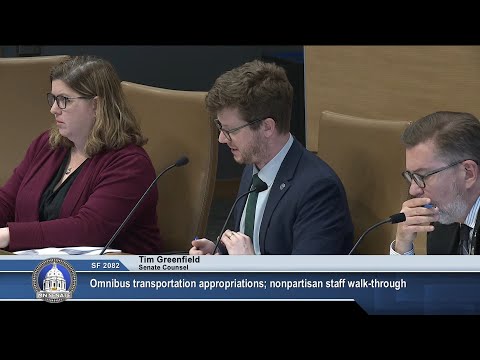
The Minnesota Senate Transportation Committee on April 7 reviewed Senate File 3161, a proposal to revise how the annual assessment that funds railroad and pipeline safety activities is allocated between railroads and pipeline operators.
Senator Kupik, the bill's author, told the committee the current statutory split assigns 70% of certain assessment costs to railroads and 30% to pipelines. "That is how it is written in the law," she said, and noted litigation by two major railroads challenging parts of the current law. Kupik said the bill would change which portions of preparedness and response costs pipelines are required to pay so that pipeline money funds pipeline-specific preparedness while railroad funds cover railroad-specific response and safety activities.
Dave Frazier, Midwest region associate director for the American Petroleum Institute, testified in favor of reevaluating the assessment split. He said pipeline operators already conduct extensive planning and training with state, local and tribal responders and must maintain PHMSA‑approved spill response plans and equipment. "Pipeline operators and refiners actively exercise those response plans throughout the region," Frazier told the committee, and he flagged a federal Pipeline Emergency Response Grant Program—funded by pipeline user fees—as a potential duplicative source of training funds.
Frazier said the industry offers free HAZMAT responder training and an online pipeline emergency response course taken by 190 Minnesota first responders. He urged the committee to consider that pipelines fund many response activities now and that assessment money should be directed to pipeline safety needs.
After questions and brief discussion the committee laid Senate File 3161 on the table for possible inclusion in the omnibus transportation bill.
No roll-call vote on the bill was recorded in the transcript; committee action at this hearing was to lay the bill on the table for further consideration.