Get Full Government Meeting Transcripts, Videos, & Alerts Forever!
Get email alerts on the Municipal General Assistance topic
No spam. Unsubscribe anytime.
Lawmakers, advocates and municipalities clash over proposed changes to Maine's municipal general assistance program
Summary
The Joint Standing Committee on Health and Human Services heard hours of testimony on multiple bills that would change how Maine's municipal general assistance (GA) program is administered and funded, including proposals to raise state reimbursement, restrict eligibility and expand what counts as a reimbursable basic need.
The Joint Standing Committee on Health and Human Services heard hours of testimony on multiple bills that would change how Maine's municipal general assistance (GA) program is administered and funded, including proposals to raise state reimbursement, restrict eligibility and expand what counts as a reimbursable basic need.
Proponents of higher state support and expanded shelter reimbursements said the current structure leaves service centers and emergency shelters unable to keep up with growing homelessness and rising costs; state officials warned that expanding eligibility or increasing reimbursement without offsetting funding would rapidly increase pressure on the state general fund.
The bills before the committee included LD 453 (state pay 90% of municipal and tribal GA costs), LD 637 (directing the Department of Health and Human Services to evaluate the feasibility of a statewide GA database), LD 657 (designating broadband Internet or wireless access points as a GA-eligible basic necessity), LD 1017 (allowing food provided at emergency shelters to be reimbursed), LD 1029 (a package to raise reimbursement from 70% to 90%, prevent housing assistance from crowding out other basic needs, and extend presumptive eligibility for shelter residents from 30 to 180 days), LD 1046 (a 180-day residency requirement before receiving GA), LD 1066 (limits on municipal GA including caps on housing assistance and mandatory municipal work programs), LD 1081 (flexibility on when municipalities must accept GA applications during regular business hours), LD 1178 (expedited review and penalties when municipalities illegally move people to avoid GA responsibility), and LD 1274 (cap state GA reimbursement to any municipality at 50% of the program's state funds in a year). Sponsors, municipal representatives, shelter operators, advocates and the department offered sharply different views on costs, fairness and operational feasibility.
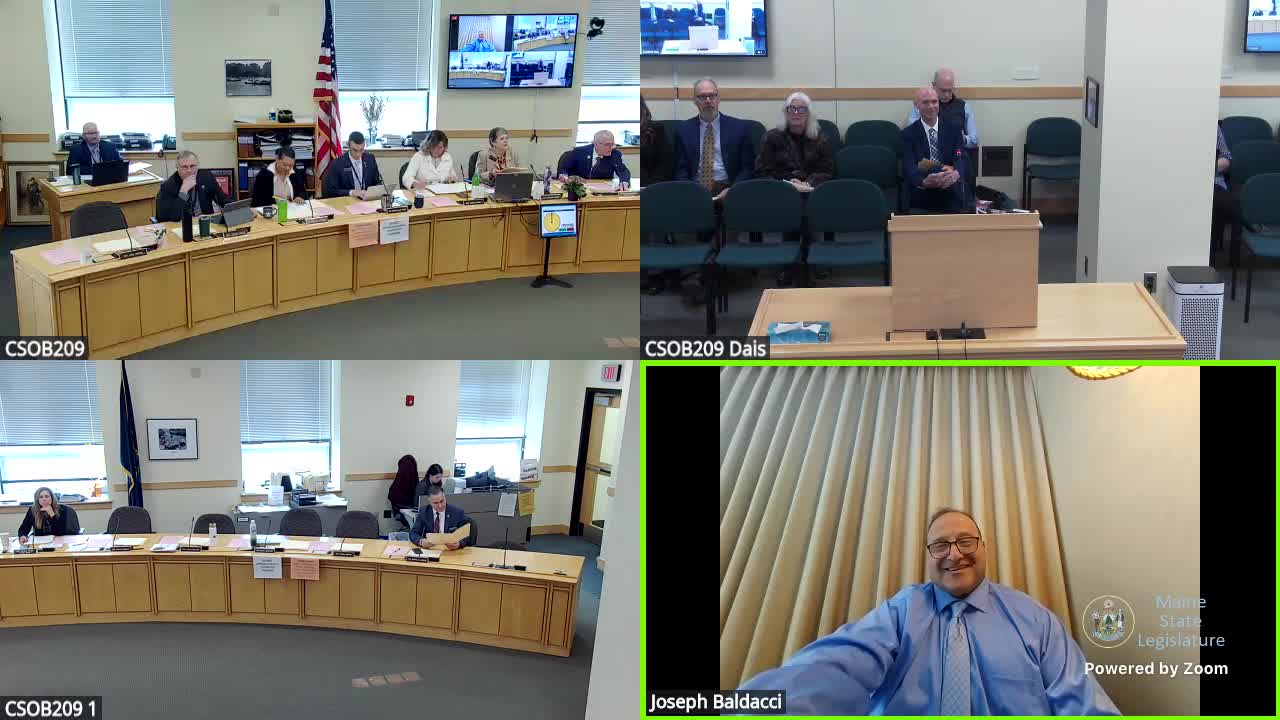
"This bill is important because of the property taxpayers," said Senator Joseph Baldacci, sponsor of LD 453. Baldacci told the committee Bangor has carried a high GA burden and said returning to a 90% state reimbursement would relieve local property tax pressure: "This bill would have meant an extra $500,000 to $600,000 that we would have been able to stabilize or reduce property taxes in Bangor," he said. Baldacci said Bangor's GA program is professionally run and that the statute's historical principle was that the state should carry the majority of reimbursable GA costs.
Representative Rachel Henderson, sponsor of LD 637, told the committee her district's towns found people applying for GA in multiple towns and asked DHHS to evaluate whether a statewide database could record approvals, denials and cumulative assistance amounts so municipalities can coordinate eligibility determinations. "Creating a general assistance program database that communicates with all municipalities is an important step to ensuring that resources are provided to the individuals that absolutely need it the most," Henderson said.
Advocates and shelter operators urged the committee to adopt LD 1029 and related measures. Senator Rachel Talbot Ross, sponsor of LD 1029, said three modest changes'raising reimbursement to 90%, ensuring housing assistance does not eliminate other benefit categories, and extending presumptive eligibility to 180 days for emergency-shelter residents'would keep people in their home communities and help emergency shelters remain open. "Increasing the GA reimbursement rate to 90% will allow municipal general assistance programs throughout Maine improved financial capacity," Talbot Ross said.
Shelter and service providers described immediate financial strain. Katie Spencer White, president and CEO of Mid-Maine Homeless Shelter & Services in Waterville, said the shelter had to draw on a $100,000 line of credit just to keep operating: "If we don't keep our doors open, there's nobody who's focused on serving people who are experiencing homelessness," she said. White and other shelter witnesses said full reimbursement for certain shelter costs and a longer presumptive eligibility period are necessary to stabilize operations and enable shelters to hire staff to prepare reimbursement claims.
Local governments and service-center officials urged stronger accountability alongside any funding increases. Ryan Buono, assistant social services director for the City of Portland, told the committee Portland supports measures to ensure housing and basic needs can be covered and to raise reimbursement but opposed durational residency requirements. "Improving the accountability for municipalities that send their residents elsewhere is more effective than establishing a residency requirement," Buono said. Bangor and other municipalities asked for stronger enforcement when smaller towns or police depart ments relocate people to service centers to avoid local GA responsibility; Bangor Councilor Michael Beck and others urged passage of LD 1178 to shorten administrative timelines and add penalties and interest to discourage that practice.
The Department of Health and Human Services, represented by Director Ian Yaffe, opposed many of the bills primarily on fiscal grounds. Yaffe told the committee the GA program baseline is $10.4 million and that program costs grew from $13 million in FY2019 to $43 million in 2023 (state and municipal share combined). "Absent additional reforms, the GA program is expected to grow beyond $20,000,000, double the current baseline, in the next fiscal year," Yaffe said. He said returning the reimbursement rate to 90% or expanding reimbursable items (for example, declaring broadband as a GA basic necessity or making shelter food reimbursable) would require substantial new state funding, and that the department could not absorb the cost of a statewide database within existing resources. Yaffe described an RFP process for a GA technology platform with bids ranging from $752,000 to $5.8 million for an initial 2-year build, and said the department would instead pursue lower-cost alternatives and report to the committee as required by statute.
On broadband, sponsors and local officials argued limited, targeted GA support for Internet would address medical, education and work access needs for low-income residents. Representative Abden Simmons, sponsor of LD 657, said adding broadband as a basic necessity could help people make medical appointments and reduce missed care. Several witnesses, including the Maine Broadband Coalition and the town of Bremen, described local pilot efforts and warned that losing federal subsidies (noted testimony said the federal Affordable Connectivity Program funding lapsed in April 2024) leaves vulnerable households at risk of losing service.
Opponents of residency-duration measures and other limits warned of constitutional and practical challenges. Director Yaffe cited U.S. Supreme Court precedent and other federal court decisions that have struck down or limited durational residency requirements for basic subsistence benefits and said several proposals could create legal risk for the state. The department also said municipal workfare mandates would be administratively burdensome and could expose municipalities to liability.
Next steps: the department said it will submit a statutory proposal and additional reporting on the database work and a statutorily required report by January 30; committee members asked for examples of municipal GA eligibility criteria, copies of municipal procedures, and more data from cities about where applicants originate. No formal committee votes were taken during the hearing.
(Quotes in this article are taken from public testimony before the Joint Standing Committee on Health and Human Services and attributed to speakers listed in the meeting record.)
Ending note: The committee held an extended public hearing on the slate of bills and indicated it will work with sponsors, DHHS and municipal groups before work sessions; hearings and written testimony remain part of the record for any bill the committee advances.