Get Full Government Meeting Transcripts, Videos, & Alerts Forever!
Get email alerts on the County Budget topic
No spam. Unsubscribe anytime.
Cochise County supervisors review preliminary FY26 budget projections as tax-rate choice looms
Summary
Cochise County supervisors on April 7 reviewed preliminary FY26 budget projections and revenue scenarios at a work session in the county hearing room, with staff warning that a forthcoming property‑tax rate decision will determine department budgets and spending authority for the coming year.
Cochise County supervisors on Monday, April 7, heard preliminary fiscal year 2026 budget projections at a work session in the Board of Supervisors hearing room, where staff outlined timeline expectations, revenue mixes, expense pressures and a looming decision point on the county property‑tax rate.
The presentation, led by County Manager Sharon and county finance staffer Stacy, set out the schedule: departmental work sessions through April, a final work session in mid‑May, tentative budget adoption on June 10 and final adoption in July; the board’s formal tax‑rate adoption typically occurs in August and tax bills are mailed in September. Stacy noted the county must plan a budget that accounts for the adopted tax rate because the tentative budget adopted in June cannot be increased later.
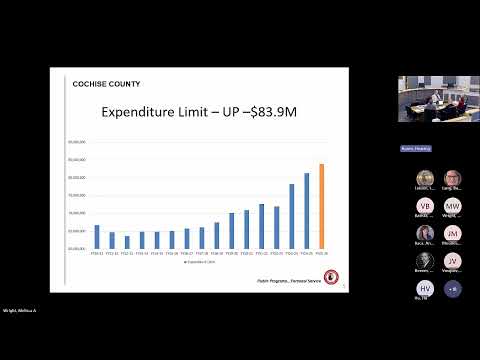
Why it matters: the board must balance lower state and federal funding with rising local expense drivers while remaining within Arizona’s aggregate expenditure limit. That limit increased this year, and the board must set a property‑tax rate that both funds county operations and provides department heads with realistic spending guidance before detailed departmental budgets are finalized.
Key figures and projections discussed
- Expenditure limit: staff reported the county’s aggregate expenditure limit rose to about $83,900,000 (staff presentation). - Revenue mix (general fund): property tax ~45%, county sales tax ~39%, other fees/fines/miscellaneous ~16%. - Assessed valuation: total FY26 assessed valuation reported as $1,160,000,000; new construction ~2.3% and property improvements/increases ~2.0%. - Personnel cost scenarios: a 1% cost‑of‑living adjustment (COLA) for general‑fund employees was estimated at roughly $285,000 for salaries and wages; a 2% COLA was estimated at roughly $570,000 (health‑benefit impacts were not final and were to come after open enrollment). - Market compensation options: applying a market adjustment would increase costs in a range presented by staff (estimates shown as broad ballpark figures while HR completes its market study in mid‑May). - State/contract shifts: staff said a “state shift” item in the budget would increase expenses by roughly $3,400,000 in FY26 versus the current budget (the presentation noted the assessed increase was larger but staff only budgeted the $3.4 million increase at this stage). - Retirement liability (PSPRS): the county is continuing extra payments toward the Public Safety Personnel Retirement System (PSPRS) unfunded liability; staff urged continuing the extra‑payment plan while noting bond transactions have materially altered funding profiles for some counties.
Tax‑rate discussion and levy impact
Board members emphasized the practical need to tell department heads the intended tax rate before departments finalize requests. Supervisor Crosby (District 1) recommended reverting to the FY21 rate and said, “I believe it's gonna be 2.6747 is what I believe the rate should be.” Staff presented two levy scenarios — maintaining the current rate and reducing back to the FY24 rate — and noted a near‑term revenue difference the board could expect if it lowered the rate (staff dialog in the session referred to a roughly $622,000 difference for the coming year in one projection scenario).
Sales tax and other revenue trends
Staff reported the county’s sales‑tax collections are “slow‑growing” relative to peer counties but tracking close to Cochise County’s own historical trend. County sales tax budget was set at $8.89 million with collections at roughly 82.1% of budget through February; proration projected a year‑end collection nearer $10 million. State‑shared revenues were also running ahead of a simple pro‑rata expectation (the presentation showed the state‑shared line at ~84% of budget and a projected $20 million year end in one scenario).
Several supervisors questioned a Department of Revenue breakdown that showed only about 11% of the county’s taxable sales attributed to remote/online sales; staff said they would follow up with ADOR and the reporting data.
Elections and other cost drivers
Supervisors and staff flagged increased elections costs for a special election tied to a vacancy (cited as the Grijalva vacancy) and preparation for the 2026 cycle: additional machines, staffing and training remain potential budget pressures. The board also discussed hand‑count validation percentages and statutory constraints for election procedures.
CECOM, mosquito monitoring and other departmental requests
Stacy said cumulative departmental funding requests, if fully approved, would increase general‑fund expenditures by about $2,270,000 for FY26. Early projected increases for the consolidated communications (CECOM) operation were approximately $135,000. Health‑department costs include a pre‑negotiated multi‑year increase for the mosquito monitoring contractor (Arboviral), which staff described as an anticipated recurring increase; the meeting transcript did not include a firm dollar figure for that contract line item in the slides shown.
Flood control reserves and recharge projects
Supervisors discussed the flood control district’s reserves (one supervisor said the district held about $9 million) and suggested those funds could be directed toward recharge and flood‑control projects rather than continuing high‑cost concrete flood‑lining projects. Staff said they would explore options and report back.
Next steps
Staff will continue departmental and elected‑official budget work sessions through April; the board will revisit firm numbers in mid‑May before the June 10 tentative budget. Staff repeatedly cautioned that some figures (health benefit rates, HR market study, and final state/federal allocations) remained preliminary and could change as additional data arrives.
Discussion versus decision
The session was a staff‑driven informational meeting; no formal motions or votes were taken. Board members directed staff to return with more detailed, department‑level budget materials and to follow up on data questions (for example, sales‑tax composition from ADOR and final health‑benefit rates).