Get Full Government Meeting Transcripts, Videos, & Alerts Forever!
Get email alerts on the Voter Residency topic
No spam. Unsubscribe anytime.
Hopkinton canvassers hear residency challenge against Scott “Bill” Hurst; decision set for April 14
Summary
The Hopkinton Board of Canvassers held a public hearing April 7 on a complaint that Scott “Bill” Hurst is no longer a resident of Hopkinton and therefore not eligible to vote or hold appointed office. Complainants presented documents and witnesses; the board closed the hearing and scheduled a written decision for April 14.
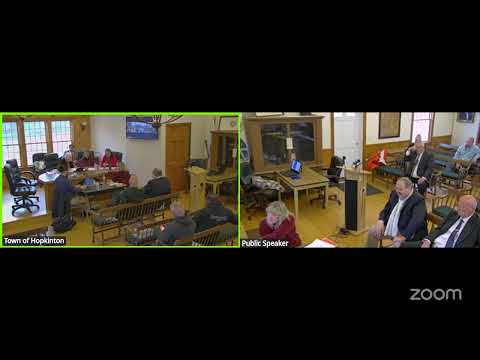
The Hopkinton Board of Canvassers on April 7 held a contested hearing on whether Scott “Bill” Hurst remains a resident of Hopkinton and therefore qualified to vote in town elections.
Complainant Robert Burns opened the hearing, saying the town charter requires six months’ residency for elected or appointed posts and that he had submitted documents he said showed Hurst no longer lived in Hopkinton. "You cannot be on a board or a commission in our town unless you reside in our town and are a resident of over 6 months," Burns said.
The hearing folded in sworn testimony, documentary exhibits and legal argument. Witnesses for the complainants described steps by the town and neighbors after 20 Maple Court was declared unsafe for human occupancy; witnesses said the property was condemned by the town in August 2024 and later sold, and that Hurst had been staying at nonpermanent locations since leaving the house in August. Joseph Moreau and Carolyn Light testified that, in their view, Hurst had not been resident in Hopkinton for months. The complainants placed documents into the record, identified during the hearing as the complaint form; a no‑trespass/condemnation order for 20 Maple Court; photos of the property; a Westerly Sun article; a Facebook post; and a district committee filing form.
Respondent Scott “Bill” Hurst testified under oath and acknowledged a period of homelessness after the house at 20 Maple Court became uninhabitable. "Because I'm homeless," Hurst said when asked where he had slept. He also described efforts he said he is making to regain stable housing in town, including working with a local realtor on a possible rental and completing applications at local housing providers. Hurst said he intends to return to Hopkinton and to continue voting there.
Attorney Goldberg, counsel for the respondent, framed the dispute as a narrow eligibility challenge under state voting law: "You're either eligible to vote or you're not," he said, arguing the board should apply the statutory questions that govern voter challenges.
Board counsel read Rhode Island law on domicile for voting purposes to the record, quoting that a voter's domicile is "the place to which, upon temporary absence, he or she has the intention of returning," and that a domicile continues until another is established. The statute cited by board counsel was Rhode Island General Laws 17‑1‑3.1, which the board said it relied on in weighing whether Hurst's absences were temporary and whether he retained intent to return.
The board formally entered the complainant's submitted documents into the record after discussion and objections from counsel about procedure and opportunity to examine exhibits. The hearing record also includes town meeting minutes and a special‑council summary describing condemnation activity at 20 Maple Court on Aug. 9, 2024.
After testimony and argument, the board voted to close the hearing and to convene an open meeting to render a written decision. The board scheduled the decision to be finalized and publicly announced on April 14, 2025, at 9:30 a.m. The board chair directed staff to prepare a draft findings document based on the record for the members to approve at the April 14 meeting.
The board did not render a final decision at the April 7 hearing. Members noted that any decision could be appealed to the State Board of Elections. The board also emphasized that the legal test focuses on domicile and intent to return, and that the statute provides limited examples of absences that do not terminate domicile.
The board’s determination will decide whether Hurst remains eligible to vote in Hopkinton for upcoming town business and elections and whether his name remains on the town registry for voting purposes. The board said its written decision will detail its findings of fact and legal conclusions based on the sworn testimony and exhibits entered at the hearing.