Get Full Government Meeting Transcripts, Videos, & Alerts Forever!
Get email alerts on the Policy Omnibus Sf1098 topic
No spam. Unsubscribe anytime.
Committee staff walks through policy omnibus; commissioners highlight corrections and public‑safety provisions
Summary
Senate staff and agency officials on April 7 walked the Minnesota Senate Judiciary and Public Safety Committee through the delete‑everything amendment to Senate File 1098, a policy omnibus that combines criminal law, corrections, courts, data practices and other provisions.
Senate staff and agency officials on April 7 walked the Minnesota Senate Judiciary and Public Safety Committee through the delete‑everything amendment to Senate File 1098, a policy omnibus that combines criminal law, corrections, courts, data practices and other provisions.
Committee staff emphasized the DE contains many provisions previously considered this session and is intended as the chair's policy package to be adopted midweek and moved into a larger omnibus budget and policy bill by Friday. Chair Ron Latz told members the plan was to try to close the DE Wednesday and move it into the larger omnibus on Friday.
Staffers gave a section‑by‑section summary. For criminal provisions they said the DE includes measures to address AI‑generated child sexual abuse material, modifications to felony murder and accomplice liability, new crimes relating to obstructing first responders and expanded definitions related to swatting and damage to energy/telecommunications equipment. Article titles and origins were presented throughout the walkthrough.
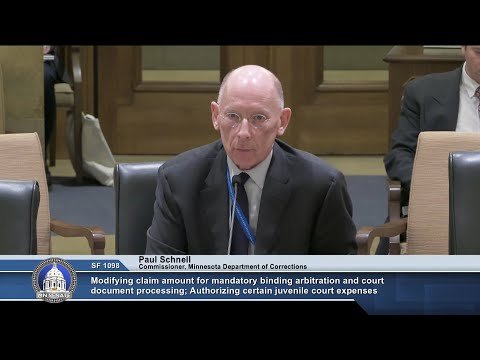
Department of Corrections Commissioner Paul Schnell told the committee the package includes several corrections proposals he supports, including modernization of American Indian cultural programming, a licensing improvement and simplification act for DOC‑licensed facilities, and an extension of the Mental Health Unit pilot that would allow placement at the Oak Park Heights 24‑hour mental‑health unit for certain incarcerated people. Schnell said the current pilot struggled to enroll people because transfer required volunteer consent; the proposed change would permit transfer based on a qualified practitioner's recommendation so more people could access treatment. He described a single case the department transferred to Oak Park Heights that resulted in stabilization and said counties and sheriffs have generally supported changes such as interstate compact cost‑sharing.
On the hearings and release unit, Schnell said the language in the DE would repeal outdated provisions and codify core due‑process elements in statute, reducing duplication with agency rulemaking while retaining statutory due process protections; he said the ombuds office had been consulted and raised no concerns.
Department of Public Safety Commissioner Bob Jacobson described provisions that affect his agency, including a new BCA Financial Crime and Fraud Unit that would consolidate fraud work with the former Department of Commerce Fraud Bureau; statutory changes to require fraud reporting from state agencies to the BCA; and a plan in the governor's revised budget for one‑time funding to MnDOT and the statewide radio system to repair and upgrade aging radio towers and infrastructure. Jacobson also noted the governor's revised budget included a one‑time $2,000,000 allocation for the Philando Castile Memorial Training Fund, and he supported provisions narrowing which use‑of‑force videos the BCA must publish online to improve operational efficiency.
Senate staff described many other sections of the DE: data‑practice classification changes for telephone numbers and email addresses, court filing fee exemptions for certain tribal family offices, technical amendments to business and trust law, mortgage foreclosure and lien changes, and civil‑law updates affecting marriage officiants, guardianship visitation limits, and an order for protection against financial exploitation of a vulnerable adult.
A member of the public, Rick Keller, offered testimony asking the committee to enshrine plain‑language text complexity standards for education forms to better serve people with print disabilities; he cited Minnesota statute language on plain language and suggested use of Lexile reading metrics used by the Minnesota Department of Education.
No formal committee vote was taken on the DE during the walkthrough. Chair Latz said members should be prepared to consider the DE and any amendments at a Wednesday meeting and that the committee aims to finalize budget and policy work by noon Friday, April 11. Agency staff present in the room were available to answer technical questions.
Next steps: staff will post details and some provisions may be added or dual‑tracked as stand‑alone bills; the committee anticipated amendment debate when the DE is formally offered for adoption.