Get Full Government Meeting Transcripts, Videos, & Alerts Forever!
Get email alerts on the Covid Federal Relief topic
No spam. Unsubscribe anytime.
Minnesota budget officials detail $76 billion in COVID relief, warn of canceled federal grants and ongoing audits
Summary
For the record: Erin Campbell, commissioner of Minnesota Management and Budget, told the House fraud prevention and state oversight committee on April 7 that Minnesota received an estimated $76,000,000,000 in federal COVID-related funds and about $13,000,000,000 of that “went through our state government.”
For the record: Erin Campbell, commissioner of Minnesota Management and Budget, told the House fraud prevention and state oversight committee on April 7 that Minnesota received an estimated $76,000,000,000 in federal COVID-related funds and about $13,000,000,000 of that “went through our state government.”
The presentation to the House committee outlined how flexible federal resources — chiefly the Coronavirus Relief Fund (CRF) from the CARES Act and the State Fiscal Recovery Fund from the American Rescue Plan Act (ARPA) — were spent, the audits that covered those programs, and recent federal actions that have interrupted some ongoing work. The session included several follow-up questions from members about unobligated balances, potential clawbacks, and how agencies managed one-time funds that created multi‑year obligations.
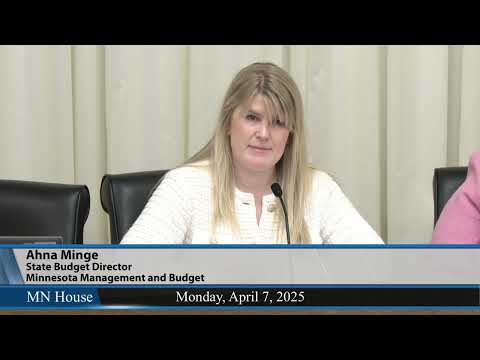
Minnesota Management and Budget (MMB) staff, led by Commissioner Campbell and Anna Minghe, assistant commissioner and state budget director, identified the five major federal bills that provided pandemic relief and summarized the flows into the state. “FFIS estimates that Minnesota will receive about $76,000,000,000 in federal COVID relief funding,” Minghe said, referring to Federal Funds Information for States. Of that total, she said, roughly $13,000,000,000 came to state government while about $63,000,000,000 flowed directly to other recipients such as businesses, individuals and health providers.
Minghe gave specific totals for several major buckets: Minnesota received roughly $2.2 billion through the CARES Act Coronavirus Relief Fund (CRF) and $2.8 billion through the ARPA State Fiscal Recovery Fund. Of the ARPA allotment, the legislature appropriated about $2.3 billion to replenish the state’s unemployment insurance (UI) trust fund, she said. MMB’s slides described roughly $3.9 billion in “flexible funding mechanisms” administered by the state and about $3.8 billion to health and human services, including enhanced Medicaid matching funds.
On audits, Commissioner Campbell said MMB has served as lead agency for the single-audit work on the large flexible funds and that both the CRF and the ARPA State Fiscal Recovery Fund “received unmodified opinions or clean audit reports for our single audit for all years to date with no material weaknesses or required repayments.” Minghe added that the single audit’s scope is prescribed and does not include every federal award that reached Minnesota.
Several committee members pressed MMB for details about awards that remain unspent or unobligated. Minghe said many COVID-era grants were structured to permit spending into future years and that “all of our major COVID era grants have been fully obligated with the federal government,” meaning an approved use plan exists. She also noted that some federal awards have longer allowable expenditure periods, and that, in at least a few cases, federal agencies have since canceled awards.
“However, on March 20th of this year ... we were notified by the Federal government that more than $220,000,000 of those grants would be canceled effective immediately,” Minghe told the committee. She said the cancellations affected CDC grants administered by the Minnesota Department of Health and required immediate actions including asking grantees to stop work and issuing layoff notices to about 170 staff. MMB staff said a federal court has issued a temporary restraining order against those cancellations and the state is monitoring the legal proceedings.
Committee members also asked about smaller, structured programs such as the State Small Business Credit Initiative; Devin Bowdre, government relations director, explained that federal disbursements have come in tranches and additional tranches are typically triggered as the state spends down earlier tranches. Members queried whether those later tranches remain payable given federal rescissions; Bowdre said the state expected to receive subsequent tranches when prior tranches approach the required spend-down thresholds.
On the policy implications of one-time federal funds, MMB staff said the programs were generally excluded from the state general fund forecast and that the legislature decided, in some instances, to appropriate state dollars to continue specific initiatives begun with federal funds (for example, some childcare supports). Commissioner Campbell and staff urged that agencies use the usual internal tools — attrition, temporary appointments, contractors and other workforce measures — to taper programs when federal funding sunsets, but they acknowledged that abrupt federal cancellations, such as the March notices, complicate orderly transitions.
The committee asked MMB to provide more granular lists of unspent or unobligated grant balances by program area; staff agreed to follow up with details.
Ending: The committee received the MMB presentation and followed with questions about specific federal cancellations, the single-audit scope, and agency plans to wind down activities paid with one-time federal resources. MMB invited committee members to request additional, agency-specific briefings and said it would provide the committee with the requested itemized lists of unspent awards and the single-audit scope documentation.