Get Full Government Meeting Transcripts, Videos, & Alerts Forever!
Get email alerts on the Energy And Environment Siting topic
No spam. Unsubscribe anytime.
Committee concurs with House changes to allow certain parallel transmission lines in designated wildlands with strict conditions
Summary
The Education, Energy, and the Environment Committee concurred with House amendments to Senate Bill 399 that allow certain overhead transmission lines to be excluded from three named wildlands only if strict siting, mitigation and public‑participation conditions are met.
The Education, Energy, and the Environment Committee voted to concur with House amendments to Senate Bill 399, a natural-resources bill that, as amended, allows specified overhead transmission lines to be excluded from designated state wildlands only under strict conditions.
Under the amended language described to the committee by staff, a NextEra transmission line would not be considered part of Big Savage Mountain Wildland, Bear Penn Wildland, or Dans Mountain Wildland if it parallels an existing Potomac Edison transmission right-of-way and does not disturb any area more than 200 feet from the nearest point of that right-of-way. The 200-foot limit can be exceeded if federal law or regulation requires a greater separation or if the Department of Natural Resources (DNR) determines a larger separation is necessary to minimize effects on resources. The project must be designed in consultation with DNR to minimize forest loss, fragmentation, and habitat impacts.
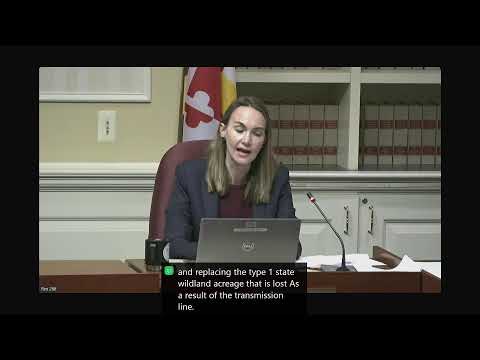
The House amendments also require the transmission applicant to assist DNR in replacing type-1 state wildland acreage lost to construction with acreage twice the size and suitable for designation as wildland. The amendments add a codified requirement for a public, 120-day stakeholder and public-participation process that includes at least one advertised in-person meeting within 25 miles of each affected wildland area, at least one virtual meeting option, outreach to organizations with expertise in wildland and wildlife stewardship, a public comment portal forwarded to DNR, and a 90-day deliberation period by DNR before the Secretary makes a recommendation to the Public Service Commission regarding a certificate of public convenience and necessity.
Why it matters: The underlying bill had previously passed the committee without these additional conditions. The House changes add specific siting limits, mitigation duties, and an expanded public-participation requirement; those changes narrow the permissive effect of the exemption and increase environmental protections and public engagement requirements.
Committee members described the House amendments as additional environmental safeguards. The sponsor moved to concur with the House amendments and the motion carried after a vote; committee staff confirmed that the bill had passed the committee in its original 9-0 posture earlier in the session.
Speakers and staff appearing in discussion included April (staff who explained the House changes), Senator Augustine (moved to concur), Senator Washington (second on the motion), and others who took part in the concurrence vote. The transcript records the committee taking up the motion to concur and approving it; the bill will proceed in the legislative process with the House amendments attached.