Get Full Government Meeting Transcripts, Videos, & Alerts Forever!
Get email alerts on the Economic Forecast topic
No spam. Unsubscribe anytime.
Maine economists say outlook unchanged amid unusually high federal-policy uncertainty; CEFC flags tariffs and federal austerity
Summary
State economists told the Appropriations Committee the Maine Consensus Economic Forecasting Commission left its near‑term forecast largely intact but warned of unusually high uncertainty driven by federal policy shifts and tariffs.
State economists told the Appropriations Committee that the Consensus Economic Forecasting Commission (CEFC) left most of its outlook unchanged on April 1 while emphasizing elevated uncertainty tied to federal policy changes and international tensions.
“Maine may be at greater risk from federal funding and tariff policy changes,” Amanda Rector, Maine’s state economist and CEFC staff, told the committee. She said the commission described the environment as unusually uncertain and flagged rapidly changing tariff policies and likely federal fiscal austerity as principal downside risks to Maine’s outlook.
The CEFC’s spring update made relatively small near‑term changes because uncertainty—particularly about the scope and timing of federal policy shifts—limited the commission’s ability to change long‑range projections. Rector said the commission considered revisiting its forecast before the next scheduled update if conditions warranted.
Rector summarized several headline numbers from the April forecast and related federal data releases: U.S. Bureau of Economic Analysis preliminary estimates showed Maine personal income growth of 5.3% in 2024, matching the commission’s November forecast; the CEFC trimmed its personal‑income growth projection to 4.1% for 2025–26 (from a prior 4.4% in some years) and left later years essentially unchanged. Wage and salary growth in Maine was 5.4% in 2024; the CEFC projects roughly 4% annual growth in wages and salaries from 2025 through 2029.
Rector also warned that federal policy changes could reduce federal grants and contracts that flow through the state and local economies. She noted that Maine received roughly $4.3 billion in federal grant funding in 2023—about $2.8 billion of which was for Medicaid—and that disruptions to federal support would ripple through services, nonprofits and local employers. “Without knowing whether any particular federal funding will be available in the future, organizations are left having to assume that those funds may not be available and cut back accordingly,” she said.
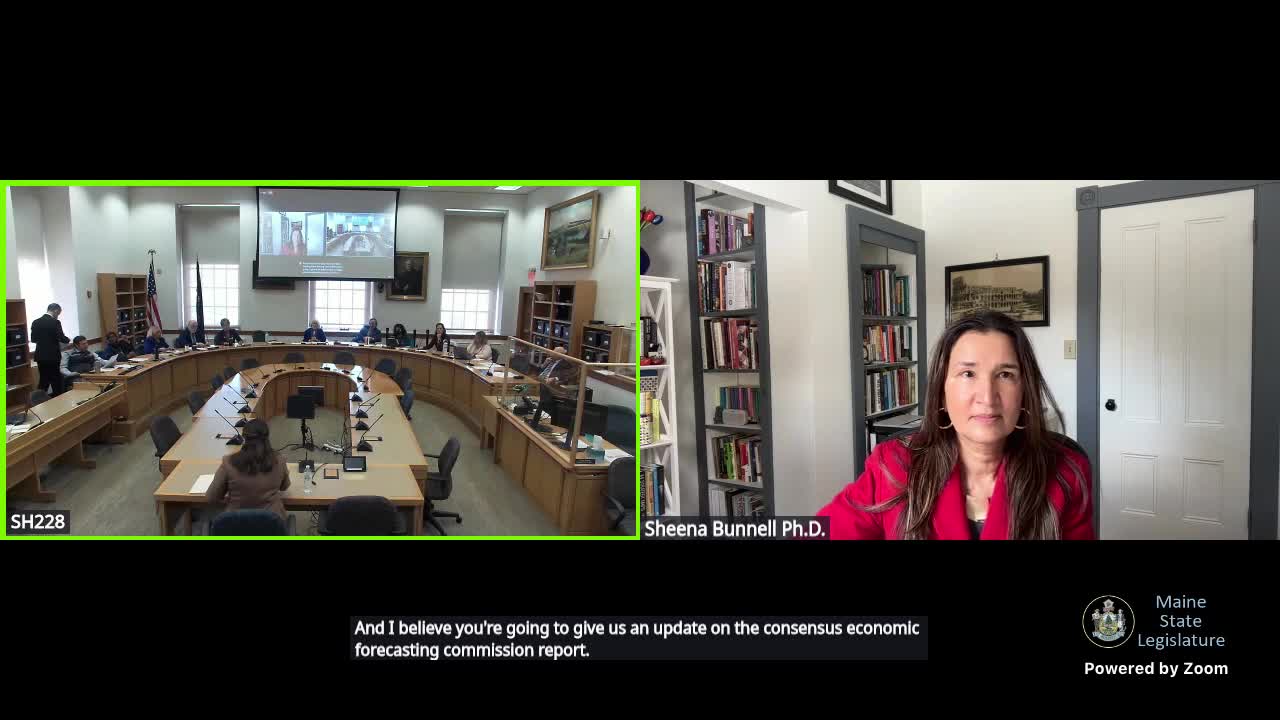
Dr. Sheena Bunnell, chair of the CEFC and an economics professor at the University of Maine at Farmington, told the committee the fundamentals of the U.S. economy remain sound but that short‑term effects of shocks such as tariffs could produce “pain” in markets and consumer sentiment until uncertainty resolves. The commission revised down its forecasts for dividends, interest and rent (DIR) and nonfarm proprietor income in near years and raised near‑term inflation assumptions (CPI forecasts for 2025 and 2026 were adjusted upward).
The CEFC also reported labor‑market data showing stability through February 2025: nonfarm employment grew about 1% in 2024 (657,900 jobs) and the commission trimmed its employment growth outlook for 2025–29 to very modest rates reflecting demographic constraints and uncertainty.
Ending: The CEFC’s forecast update gives the revenue forecasting committee an economic baseline as it prepares revenue estimates. Economists told Appropriations members the greatest near‑term fiscal risk for Maine is federal policy uncertainty—both tariffs and potential changes to federal spending priorities—and asked the Legislature to monitor federal developments as it prepares budget decisions.