Get email alerts on the Government Oversight topic
No spam. Unsubscribe anytime.
Senate panel advances bill to create independent state Inspector General with bipartisan selection process
Summary
The Minnesota Senate Rules Committee adopted amendments and approved Senate File 856 to create an independent Office of the Inspector General housed in the executive branch, with a bipartisan selection committee, a five-year term, and a three-fifths Senate confirmation requirement. The measure was re-referred to the Finance Committee.
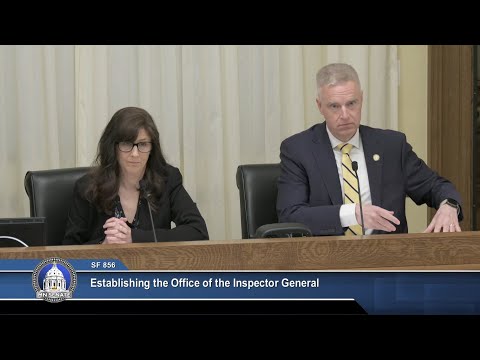
Senator Gustafson introduced Senate File 856 on April 7, 2025, proposing creation of an independent Office of the Inspector General to investigate fraud and misuse across state agencies and publicly funded programs. "It's a bill to establish an independent office of the inspector general in Minnesota," Gustafson told the Rules Committee, saying the office would help restore public trust and safeguard taxpayer dollars.
The bill, presented with Senator Crowein as co-presenter, would place the inspector general in the executive branch, grant investigative tools including the ability to issue reports and refer cases to law enforcement, and direct the office to focus on providers and recipients of public funds. "I think having an independent office of inspector general is critically important to combat fraud in Minnesota," Crowein said.
Committee members debated two floor amendments agreed in bicameral talks. The A47 amendment added governance safeguards including a conflict-of-interest code, ethics requirements, disclosure and removal processes, qualification refinements (including suggested education changes), a five-year term to stagger with election cycles, and a waiting period for certain elected officials. The amendment also removed a clause that would have limited disclosure except when it would knowingly impede ongoing criminal investigations; the sponsor said the change was intended to avoid duplicating law-enforcement roles and to clarify the office would not itself be a law-enforcement agency at creation.
Senators questioned appointment and removal thresholds. The bill as amended calls for an eight-member legislative selection committee (two from each chamber and party) to vet candidates and hold public hearings, followed by an executive appointment (the chief judge of the Office of Administrative Hearings or the governor under a later amendment) and a three-fifths Senate confirmation. Removal before term expiration would require approval by both the House and Senate by a simple majority. Senator Limmer flagged the asymmetry between a higher threshold to appoint and a lower threshold to remove; committee counsel and other senators discussed preserving consistency but did not change the adopted language.
The A48 amendment changed the selection step so that candidates recommended by the legislative selection committee would go to the governor for appointment, with the governor allowed to nominate outside the recommendations but subject to three-fifths Senate confirmation. Committee counsel offered an oral amendment to A48 to prevent the statute that automatically confirms appointees by lapse of time (section 15.066, subdivision 3) from applying; the committee adopted that oral amendment.
Committee counsel and members also clarified operational details: the bill anticipates interagency agreements and sets an initial effective appointment date of January 1, 2026, with the first OIG term scheduled to run five years from that appointment timeline. Members noted the schedule is ambitious given the need to conduct interviews and negotiate interagency agreements before that date.
After discussion and technical oral amendments on selection and chair rotation for the advisory commission established in the bill, Senator Frentz moved the bill as amended. The committee adopted Senate File 856 as amended and re-referred it to the Committee on Finance.
The committee record shows extensive back-and-forth about constitutional concerns, the proper balance of legislative input and executive appointment authority, and safeguards intended to preserve nonpartisanship and independence.
Votes at a glance: A47 amendment — adopted; A48 amendment as amended (including the oral amendment exempting section 15.066 subdivision 3) — adopted; Senate File 856 as amended — adopted and re-referred to Finance.
AI generated
The text on this page is AI generated. Summaries, highlights, analysis, and video transcripts are all produced from the original source material.
AI can make mistakes, so if you spot one, and we will fix it for everyone.
Note: the source content is unaltered by us. Any content source we link to, be it a video, an audio recording, or a document, is presented exactly as its publisher released it. That publisher is usually a government body, sometimes an individual official or another organisation.