Get Full Government Meeting Transcripts, Videos, & Alerts Forever!
Get email alerts on the Education Finance Crowley Act topic
No spam. Unsubscribe anytime.
House bill would rewrite Crowley Act funding rules, add fiscal overseer; commissioners, advocates clash
Summary
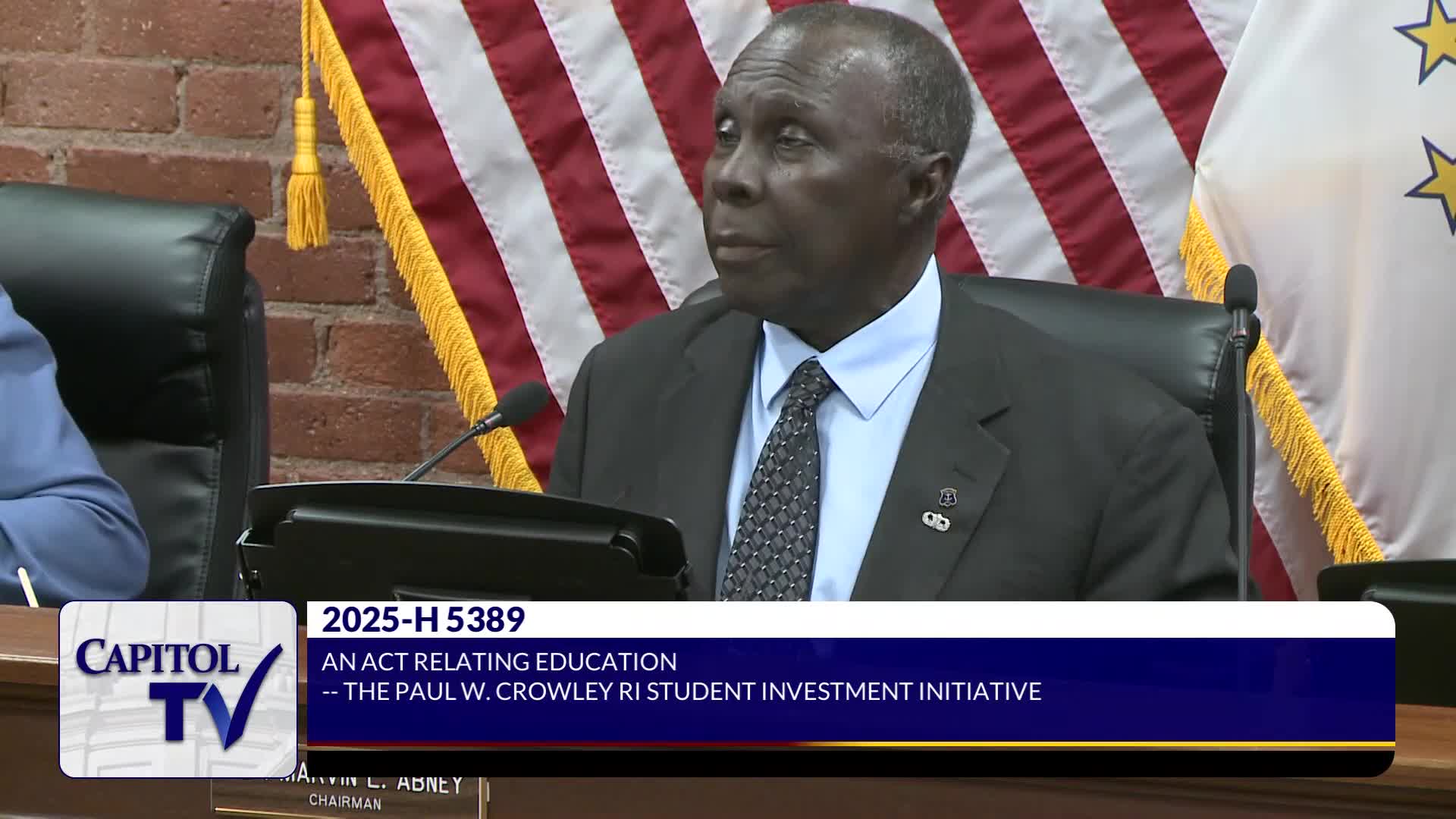
House Bill 5389, introduced at the request of Providence, would rewrite the Crowley Act's maintenance‑of‑effort calculation for school takeovers, curtail the education commissioner's authority to withhold other state aid, and create a state fiscal overseer to monitor spending during interventions.
House Bill 5389, introduced at the request of the city of Providence, would change how the state's Crowley Act calculates a host community's required local contribution during a school takeover, remove the education commissioner's broad authority to withhold other state aid, and create a role for a state-appointed fiscal overseer to monitor takeover spending.
Rep. Slater, the bill sponsor, told the House Finance Committee that the measure "would change the funding calculation and commission's withholding power" and would also "call for the state to appoint a fiscal overseer ... to ensure that no municipality has to go through what Providence did last fall." He testified that the existing maintenance-of-effort rule under the Crowley Act scales a local obligation by the statewide percentage increase in education aid, which he called unfair to distressed communities like Providence.
Mayor Brett Smiley of Providence backed the bill and described the proposal as learned from the city's multi‑year takeover process. The mayor said the measure would "define what the host community's contribution is" and "take away the commissioner's ability to withhold funds," adding the bill sets the local contribution at "20% of levy growth" so municipalities face a predictable pace of increases rather than the prior open-ended calculation.
Anthony Catone, chief legal counsel at the Department of Education, urged caution. He told the committee that the commissioner's authority under R.I. Gen. Laws § 16-5-30 to order the treasurer to withhold public money is one of the few statutory tools to ensure observance of education laws and to deter violations. Catone said similar withholding powers exist in other states and warned that the proposed language changing how maintenance of effort is calculated could be ambiguous without additional definitional clarity.
Drew Eccleston, deputy commissioner for system transformation at the Rhode Island Department of Education, also opposed the changes, saying Crowley is typically used in contexts of "persistent and historical student underachievement" where municipalities have historically underfunded schools. Removing the commissioner's leverage, he said, could reduce the state's ability to compel legally required local investment and might require the state to shift resources from other communities to cover obligations.
Community advocates and Providence residents who testified opposed the bill as well. Dr. Shonda Womack and several youth speakers said the proposal would reduce protections that tie local funding obligations to statewide education funding increases and could allow taken‑over districts to fall further behind.
Procedural note: at the start of the hearing the committee voted by voice to "hold all bills ... for further study," a procedural motion the chair said would not kill the measures but place them in study status.
The bill remains in committee; supporters said they will work on clarifying language and technical details raised by state agencies.