Get Full Government Meeting Transcripts, Videos, & Alerts Forever!
Get email alerts on the Government Finance topic
No spam. Unsubscribe anytime.
Auditor General Tells House Subcommittee 2024 financials were ultimately accurate but flagged major reporting gaps and compliance problems
Summary
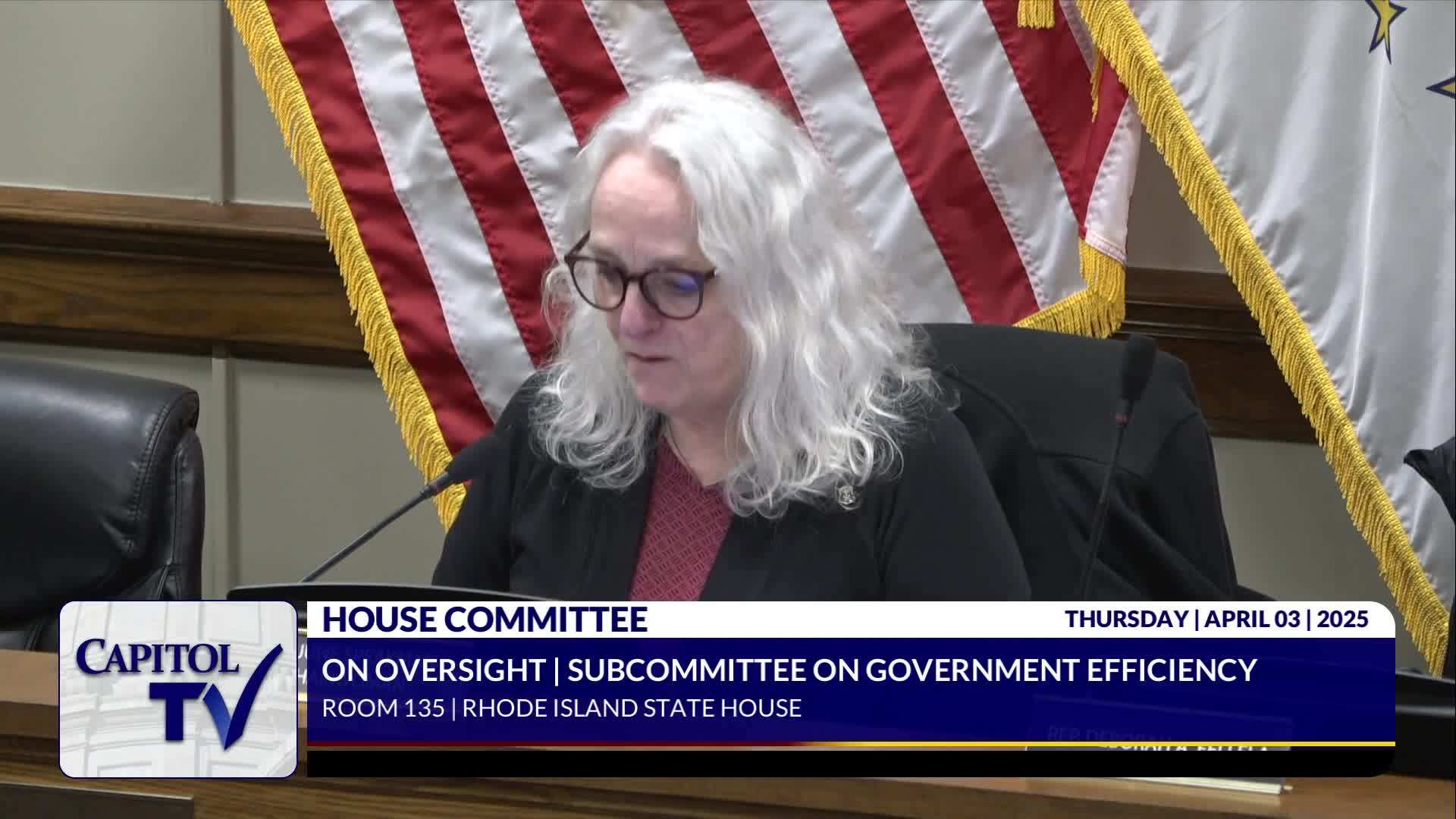
At the first meeting of the House Committee on Oversight Subcommittee on Government Efficiency on April 3, 2025 in Room 135 of the State House, Rhode Island Auditor General David Bergantino presented the office’s 2024 financial audit, the state single audit and related performance and municipal oversight work and urged the legislature to follow up on recurring control and reporting problems.
At the first meeting of the House Committee on Oversight Subcommittee on Government Efficiency on April 3, 2025 in Room 135 of the State House, Rhode Island Auditor General David Bergantino presented the office’s 2024 financial audit, the state single audit and related performance and municipal oversight work and urged the legislature to follow up on recurring control and reporting problems.
Bergantino told members the state’s 2024 financial statements received an unmodified (clean) opinion from his office but that auditors found significant errors and internal-control weaknesses during the audit process that required numerous adjustments before the final statements were issued. "The good news is it did result in an unmodified audit opinion," Bergantino said, but he warned the draft financials contained material misstatements that had to be corrected.
The audit team identified 28 findings across the state reporting entity, many tied to internal-control and reporting weaknesses, Bergantino said. Notable adjustments and errors he cited included about $83.6 million in general-fund audit adjustments; an approximately $10.4 million adjustment to the Intermodal Surface Transportation (ICT) fund’s operating results; and the omission from the draft statements of about $93 million in state debt related to Central Falls’ new high school. He described many of those issues as coordination and documentation failures rather than evidence of misappropriation.
On the annual state single audit — the federally required review of approximately $6.8 billion in federal awards the state spent in 2024 — Bergantino said auditors reported material noncompliance in eight of the 21 audited programs. The single-audit work focuses on federal compliance areas specified in the federal compliance supplement, including eligibility, allowable costs, cash management and subrecipient monitoring. Bergantino said subrecipient monitoring was a recurring weakness: the state must better track funds passed to local governments and nonprofits to ensure federal rules are met.
Bergantino described several program-level compliance concerns in health and human services: automated interfaces did not always remove deceased individuals or people who had moved out of state from benefit rolls, and the audit identified instances of Medicaid premiums paid for people no longer residing in Rhode Island. He cited a joint performance audit with the U.S. Department of Health and Human Services Office of Inspector General that found roughly $38.4 million paid over three years for Medicaid premiums for individuals not residing in the state. "Those are problems you want to address," he said.
The presentation also covered the state’s major financial audits: the statewide financial statement audit, the Rhode Island Lottery, the Employees’ Retirement System of Rhode Island and the state OPEB plan. Bergantino described the variety of standards and technical work those audits require — from IT-control testing for complex lottery systems (sports betting, iLottery and table games) to audits of large investment portfolios for the pension system.
Bergantino attributed part of the recent erosion in draft financial quality to turnover among experienced agency CFOs, a legacy financial system that required significant manual intervention and the diversion of experienced staff to implement a new enterprise resource planning (ERP) system. The state expects to implement the ERP in the next fiscal year; Bergantino said a modern, integrated platform should help but carries implementation risk and will not be a cure unless agencies also strengthen documented internal controls and coordination.
On municipal oversight, Bergantino described a new five-year financial trend analysis the auditor’s office produced for all 39 cities and towns in Rhode Island to highlight structural risks — including school-fund deficits and underfunded OPEB — and to give local officials a short, comparable dashboard they can use in budget planning.
Bergantino said his office is prioritizing more data analytics and performance audits to complement the statutory financial work and to identify issues across populations rather than by sampling alone. He urged legislative committees to use audit reports actively: "Significant findings should be presented by the auditors," he said, offering to brief the full legislature or particular committees and to follow up on management corrective actions.
Lawmakers on the subcommittee pressed for stronger follow-up and accountability. Leader Chippendale said the dollar amounts cited were material to the state budget and argued they warranted broader, higher‑priority performance audits and legislative action. "These aren't decimal errors. These are substantial percentages of our overall annual budget," Chippendale said, and asked what would bridge the gap between findings and implementation of corrective actions. Bergantino said the answer often comes down to project management and accountability at the agency and executive levels, combined with adequate staffing and clear oversight from the legislature.
The meeting ended with a routine procedural motion to adjourn. A member moved to adjourn and the chair called for and recorded a voice vote in favor.
The auditor’s office provided detailed draft reports to management in advance and said most issues were corrected before final issuance; Bergantino emphasized that audit reports are tools that produce value only when the executive branch and the legislature use them to drive corrective action and stronger internal controls.