Get Full Government Meeting Transcripts, Videos, & Alerts Forever!
Get email alerts on the Wage And Hour topic
No spam. Unsubscribe anytime.
Small-business exemption for Sunday/holiday premium pay draws split testimony
Summary
House Bill 5944 would exempt employers with fewer than 15 employees from required Sunday/holiday premium pay under specified conditions. Business groups urged the change as relief for small firms; unions opposed the shift and warned it would remove premium pay for some workers under the bill as drafted.
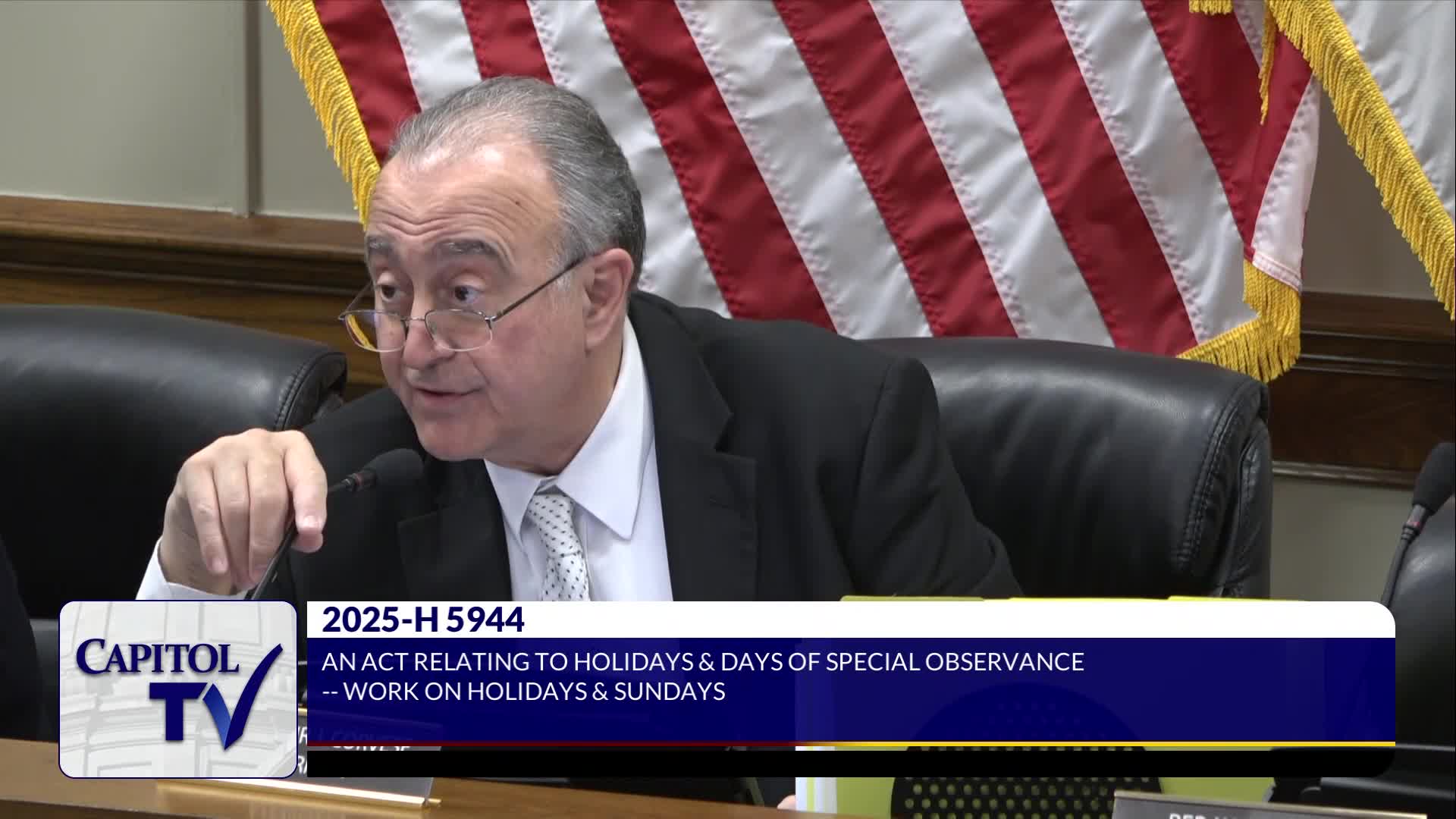
Representative Casey presented House Bill 5944, which would change the definition of “employer” so that businesses with fewer than 15 employees would be exempt from paying Sunday/holiday premium pay when Sunday work is part of an employee’s regular schedule. Casey said the measure is intended to make it more feasible for very small local businesses to open on Sundays or holidays in the face of rising costs.
Melissa Travis of the Rhode Island Business Leaders Alliance, who said she spent two decades working with the Small Business Administration and currently represents small-business leaders, urged lawmakers to support the bill as a lifeline for neighborhood restaurants, retail shops and service providers. She said the measure would allow very small businesses to open on Sundays without the same premium-pay burden large employers face.
Labor witnesses strongly opposed the bill as drafted. Erica Hammond, legislative director of the Rhode Island AFL-CIO, said that the bill’s language, as written, would exempt employees covered by collective bargaining agreements and municipal employees — outcomes the witness said were “not the intention” but could be read from the draft. Hammond and Jim Cinerini of AFSCME Council 94 said the measure would in effect reduce or remove premium pay for workers and could erode collective-bargaining protections, including weekly-pay provisions.
Representative Casey acknowledged a drafting error in the bill that he said would be corrected with a subsequent filing and said the intent was to exempt only certain small private businesses. The committee heard both pro-business and pro-labor testimony and did not take a final vote.
The committee will continue to reconcile the bill language with stakeholders to reflect the sponsor’s stated intent.