Get Full Government Meeting Transcripts, Videos, & Alerts Forever!
Get email alerts on the Payments Interchange Fees topic
No spam. Unsubscribe anytime.
Committee hears rival bills to bar swipe fees on taxes and tips as merchants, banks clash on feasibility
Summary
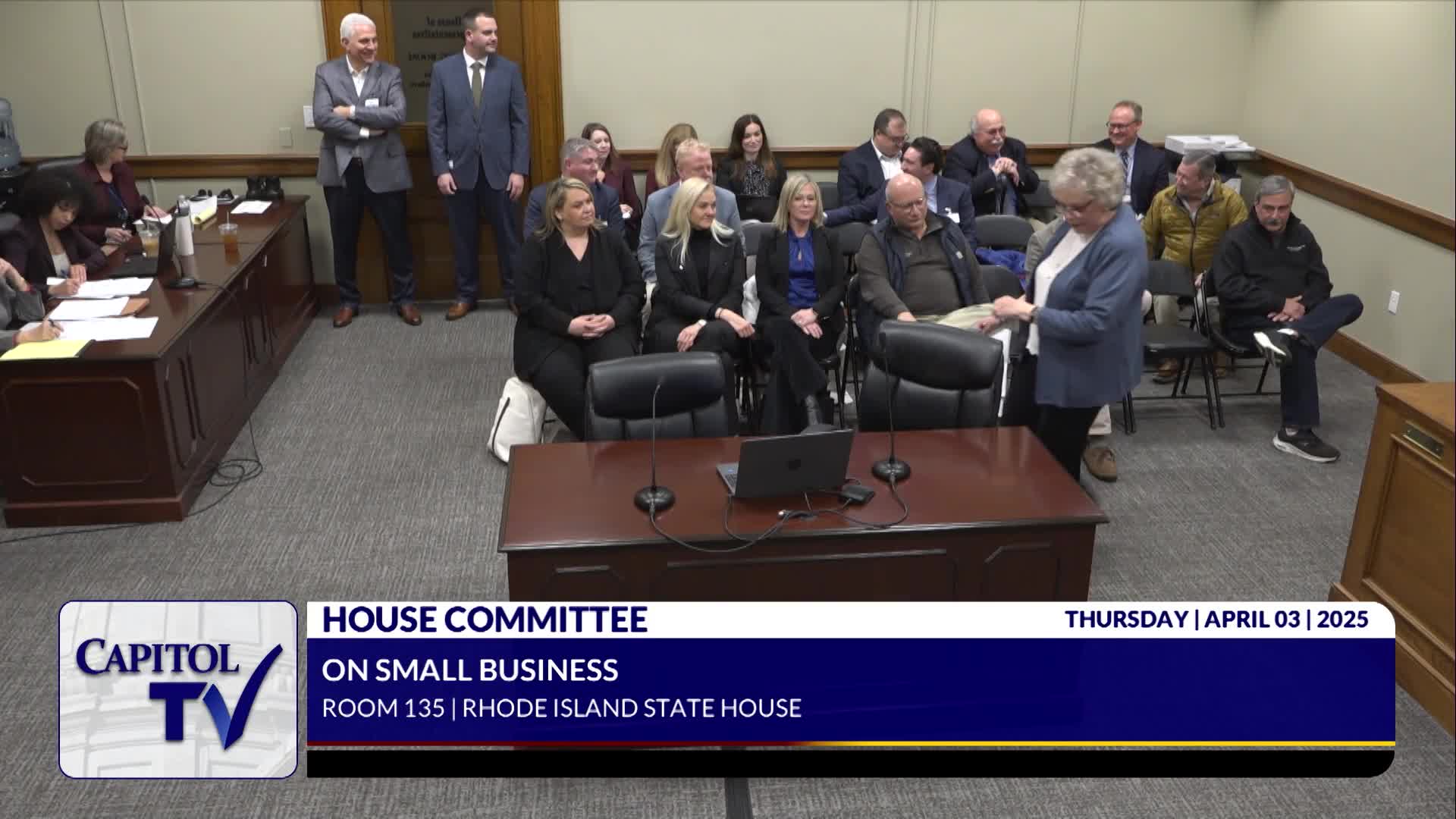
The House Committee on Small Business met April 3, 2025, in Room A135 to hear testimony on two bills aimed at limiting card interchange fees: House Bill 5582 (which would restrict interchange fees on sales and excise taxes) and House Bill 5554 (which would prohibit interchange fees on taxes and gratuities).
The House Committee on Small Business met April 3, 2025, in Room A135 to hear testimony on two bills aimed at limiting card interchange fees: House Bill 5582 (which would restrict interchange fees on sales and excise taxes) and House Bill 5554 (which would prohibit interchange fees on taxes and gratuities).
Supporters told the committee the bills would give immediate relief to small merchants who currently pay a percentage fee when customers use credit or debit cards on amounts the merchant does not retain. Bill Walsh, testifying for the Rhode Island Hospitality Association, described the issue as "a fairness issue," saying the fees erode already thin restaurant margins and noting that a growing share of transactions are by card. Written and oral testimony from hospitality and retail groups argued the savings could range from several thousand dollars a year for small operators to six figures for large venues.
The sponsor-backed presentation explained the two bills differ only in scope: HB 5582 focuses on state and local taxes remitted to government, while HB 5554 would also exempt gratuities and service charges. Testimony cited National Restaurant Association data estimating a typical Rhode Island full-service restaurant could save roughly $7,600 a year if gratuities and taxes were excluded from interchange calculations; witnesses said the bills would not end interchange fees on merchants' retained sales proceeds.
Opponents pushed back on legal and technical grounds. Deb Peters of the Electronic Payments Coalition said the interchange fee is one element of a three-part merchant fee and that the federal payment infrastructure currently reports only a single total amount for each card transaction. "The technology does not exist yet for processing transactions at that level," she told the committee, arguing that building a system to split tax and tip from the base sale would be complex, time-consuming and likely to slow transaction processing.
Peters also referenced litigation arising after Illinois passed a broadly similar measure: she said a federal court issued a preliminary injunction in December 2024, and expanded that injunction in February 2025, limiting the reach of that state action. She warned that, if Rhode Island enacted a similar law before industry systems were ready, financial institutions could refuse to process the affected portion of transactions rather than risk civil penalties.
Will Ferrell of the Rhode Island Bankers Association said federal law already caps some debit-card fees and that, based on IRS data, an average effective interchange rate in Rhode Island is roughly 2 percent. He framed interchange charges as part of fraud protection and risk coverage the card-issuing bank provides. "We're used to the luxuries of having a card," he said, describing how banks detect fraud and make merchants and consumers whole in many cases.
Retail and hospitality witnesses disputed that merchants fully benefit from card-enabled sales. Nick Feede Jr., representing independent liquor retailers, said effective erosion of tax receipts occurs: "For every $100 of sales tax collected on a credit card... we're only really capturing around $97 of that," he said, characterizing the shortfall as coming from merchants' pockets.
Committee members asked several technical and data questions. Representative Phillips asked whether data exist showing the rate of card fraud; witnesses said that fraud rates vary across institutions and that some of the requested data would need to be provided later. Members also asked about timeframes and practical effects if the law took effect immediately; opponents warned of infrastructure gaps and potential refusal by some processors to accept tax/tip amounts on cards while systems are built.
Procedural action: the committee voted, at the start of the hearing, to "hold all bills for further study" — a procedural motion the chair said does not indicate a position on the merits. The motion passed on a voice vote.
The hearing record includes written testimony filed by both supporters and opponents; committee members requested additional technical information and data on fraud and processing options before further consideration.