Get Full Government Meeting Transcripts, Videos, & Alerts Forever!
Get email alerts on the Wildfire Forestry topic
No spam. Unsubscribe anytime.
Support grows for 10 forestry positions as lawmakers and witnesses warn of rising wildfire risk
Summary
Sponsors and witnesses told the Senate Finance Committee that additional forestry staff are needed to address wildfire risk, insect‑driven tree mortality and invasive plants; proponents urged funding for 10 FTEs to expand prevention and response capacity.
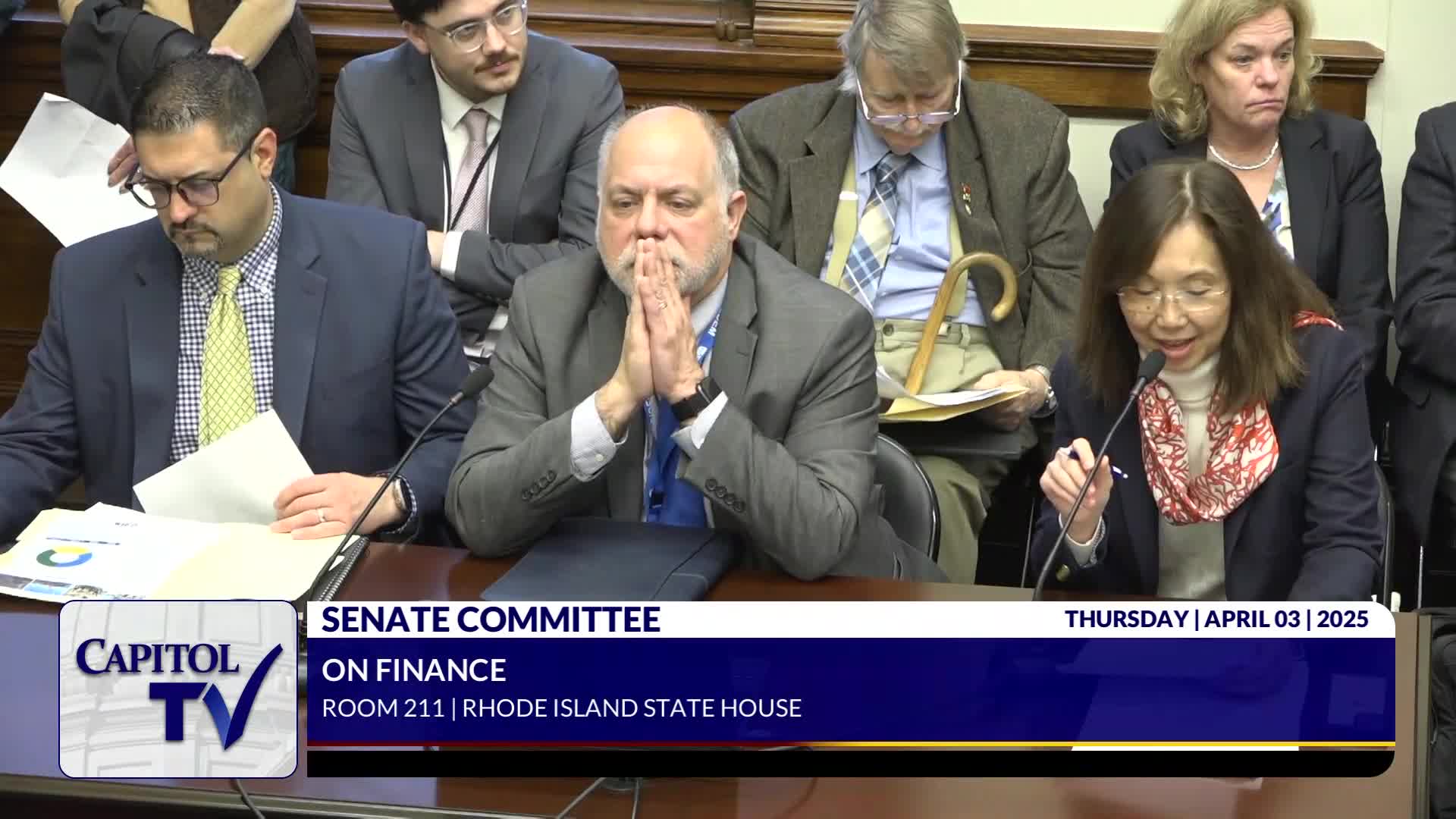
Senators and witnesses at the April 3 Senate Finance Committee hearing voiced support for a bill (S108) that would fund 10 full‑time equivalent positions in the Department of Environmental Management to strengthen forestry and wildfire prevention efforts.
Sponsor remarks: Senator Ujifusa, sponsor of S108, described historical wildfires in Rhode Island — notably major conflagrations in 1942 and 1951 — and pointed to recent events in Exeter (2023) and West Greenwich (2024) as evidence of ongoing wildfire risk. He said DEM’s forestry workforce has declined since 1990 from roughly 43 employees to 13 while the state’s conserved land holdings have grown by more than 23,000 acres.
Witness testimony: Supporters included volunteer fire officials from Prudence Island, conservation groups, land trust representatives and multiple foresters and farmers. Henry Wright, a volunteer and long‑time forester, told senators the state’s road and trail access, water holes and other fire‑suppression infrastructure have deteriorated and argued additional personnel and resources are urgently required to prevent catastrophic fires. Former DEM forester Catherine Sparco urged investment in trained forestry staff to perform silvicultural management, interagency coordination and on‑the‑ground work.
DEM position: Director Gray and DEM staff told the committee the department has added forestry capacity in recent years (two FTEs added) and is training non‑fire staff and volunteers to help respond to wildfire events, but said the scale and frequency of risk make additional resources appropriate.
Committee action: After testimony the committee moved to hold the bill for further consideration; committee members asked for details on how the new positions would be distributed across prevention, response and stewardship activities and for projected cost estimates.
Speakers quoted here are restricted to the witness list in the registry below; this article summarizes testimony and the committee’s disposition.