Get Full Government Meeting Transcripts, Videos, & Alerts Forever!
Get email alerts on the State Budget topic
No spam. Unsubscribe anytime.
Rhode Island attorney general asks Senate for six FTEs, cites federal litigation and public-health recoveries
Summary
The attorney general told the Senate Finance Committee that six new full-time positions are needed and proposed funding them from the office's legal fee recovery fund; testimony highlighted recent federal lawsuits, a $31 million public-health recovery and cybersecurity and software needs.
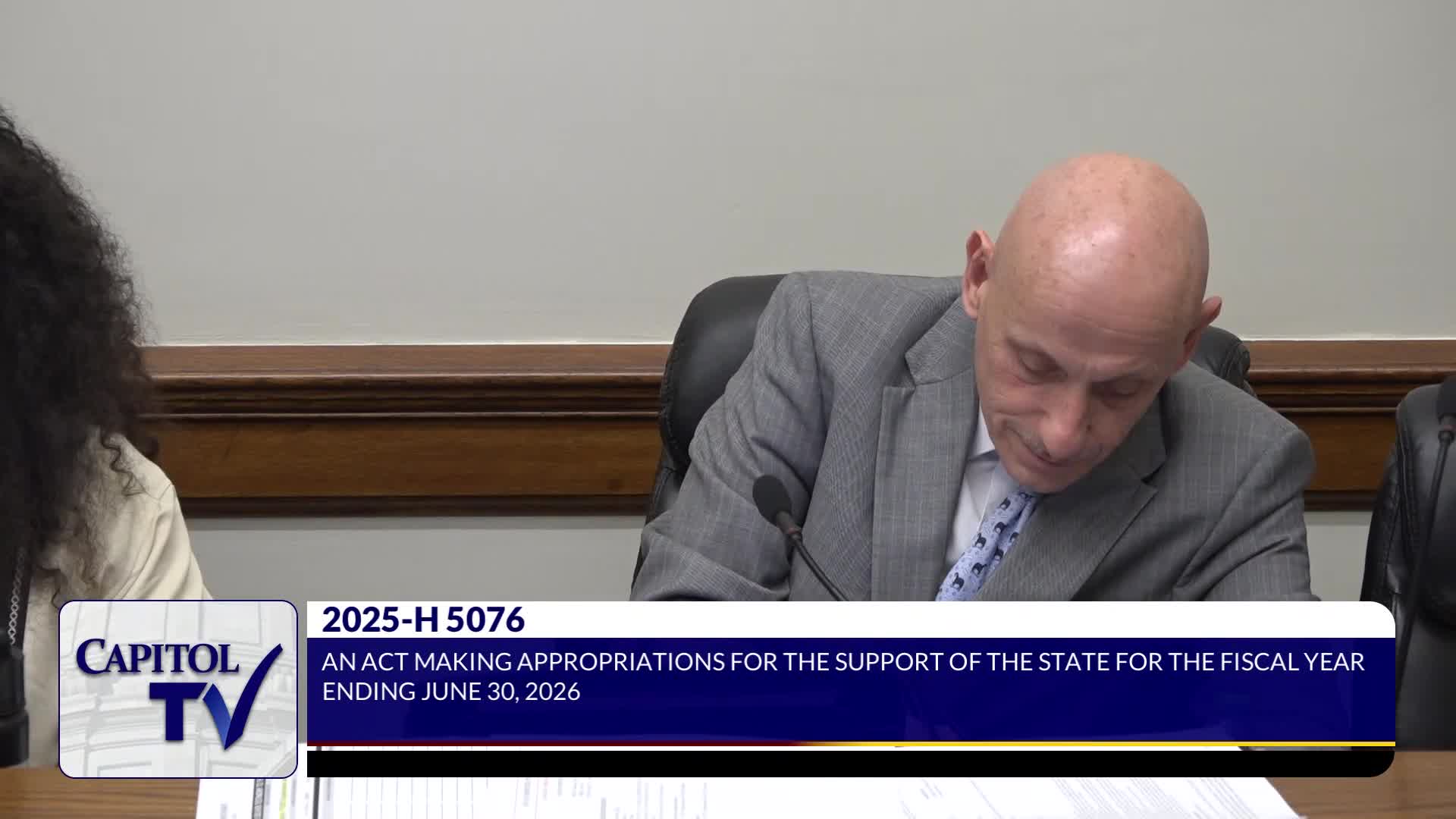
The attorney general appeared before the Senate Committee on Finance on April 3 to present the Office of the Attorney General's FY2025 supplemental and FY2026 budget request, focusing on a proposal to add six full-time equivalent positions funded from the office's legal fee recovery fund.
The attorney general told senators the request is not for general-revenue dollars and said, "The $1,200,000 will come from our legal fee recovery fund," adding the office will cover the cost itself if necessary. He said the additional lawyers are needed to handle ongoing federal litigation and other work that protects the state's fiscal health, health care access and consumer protections.
The request is part of House Bill 5076, the omnibus appropriations measure for FY2026 that the committee had on its agenda for the hearing. The committee recorded the bill as up for hearing; no vote on HB 5076 was taken during this session.
Why it matters: the attorney general described recent, high-profile litigation that he said required extra staff and resources. He recounted that the office helped obtain a temporary restraining order after an Office of Management and Budget memorandum briefly paused federal funds, an action he said threatened roughly one-third of the state's budget. He also said his office secured $31,000,000 in public-health funding the federal administration had terminated and that the work required lawyers, court filings and expert support.
Details of the budget requests and staffing
The attorney general asked the committee for six FTEs funded from the office's legal fee recovery fund (an amount he said would total roughly $1.2 million). He said the office previously received $15 million in legal-fee recoveries from opioid litigation and that 10 FTEs were added to his office in a prior budget cycle supported by that fund. He told the committee the recoveries are available to his office pursuant to court order and do not go to general revenue.
The attorney general also outlined four non-personnel package requests that he said the governor did not include in the executive budget: $400,000 for cybersecurity and protection of sensitive data, funding for a rediscovery platform to support civil litigation, and $1,000,000 for expert witnesses and other litigation support for complex cases.
Staffing, vacancies and how the office is deployed
The attorney general acknowledged roughly 10 current vacancies in the office and said recruitment pipelines existed for those positions. He described the civil division as carrying a heavy workload and said roughly 10 attorneys are working at least part time on federal litigation against the administration, with four senior attorneys doing the bulk of the court work.
On the use of staff assigned to the Division of Public Utilities and Carriers (DPUC), the attorney general said his office moved attorneys away from direct DPUC control after disagreeing with positions taken in a major utility-sale matter. He cited the National Grid sale to PPL (now referred to as Rhode Island Energy) and an appeal to Superior Court before Judge Stern; he said the office's intervention produced approximately $50 million in benefits (credits or avoided charges) for customers and that split responsibilities had created a conflict of advocacy.
Cybersecurity and discovery tools
The attorney general said the office is not connected to the state's general IT system because it maintains highly sensitive criminal-justice data, including fingerprint transmissions to the FBI. He urged funding for cyber protections and software tools, saying, "We have to be able to protect that information from an intrusion," and warned that degraded software or discovery tools would hinder litigation and court compliance.
Health-care access and other recoveries cited as justification
The attorney general raised immediate health-care concerns, saying a major primary-care practice was at risk of failure and that losing it would affect an estimated 25,000 to 30,000 patients within weeks. He also highlighted his office's work to preserve services at Roger Williams and Fatima hospitals, saying the office's intervention and negotiation secured $50 million from a private-equity owner to support those facilities.
Questions from senators
Senator Acosta asked about the nature of current vacancies and the funding source for the new FTEs; the attorney general explained how legal-fee recoveries are held in a court-ordered fund for his office and said he preferred not to rely on a model in which the office must pay for itself but was prepared to do so if necessary. Senators asked about the shift of attorneys previously funded through the DPUC, cybersecurity funding decreases in the governor's budget and whether additional staff might be organized into a unit to handle federal-administration litigation.
The attorney general said he favored keeping senior lawyers distributed across several types of work so the office retains institutional capacity after the current wave of federal litigation subsides.
What was not decided
No formal vote was conducted on HB 5076 during the hearing. The attorney general said the request for six FTEs had been submitted to the House previously and would be delivered to the Senate leadership within 24 hours.
Ending note
The hearing moved to the judiciary budget after the attorney general completed his presentation and took questions. The attorney general emphasized that his office's work on litigation and consumer- and health-care matters would continue irrespective of budget negotiations and said he would seek resources from the legal-fee recovery fund if legislative support for the positions was not provided.