Get Full Government Meeting Transcripts, Videos, & Alerts Forever!
Get email alerts on the Historic Tax Credit Reform topic
No spam. Unsubscribe anytime.
Advocates urge reforms to Rhode Island historic tax credit as program faces funding and administrative strains
Summary
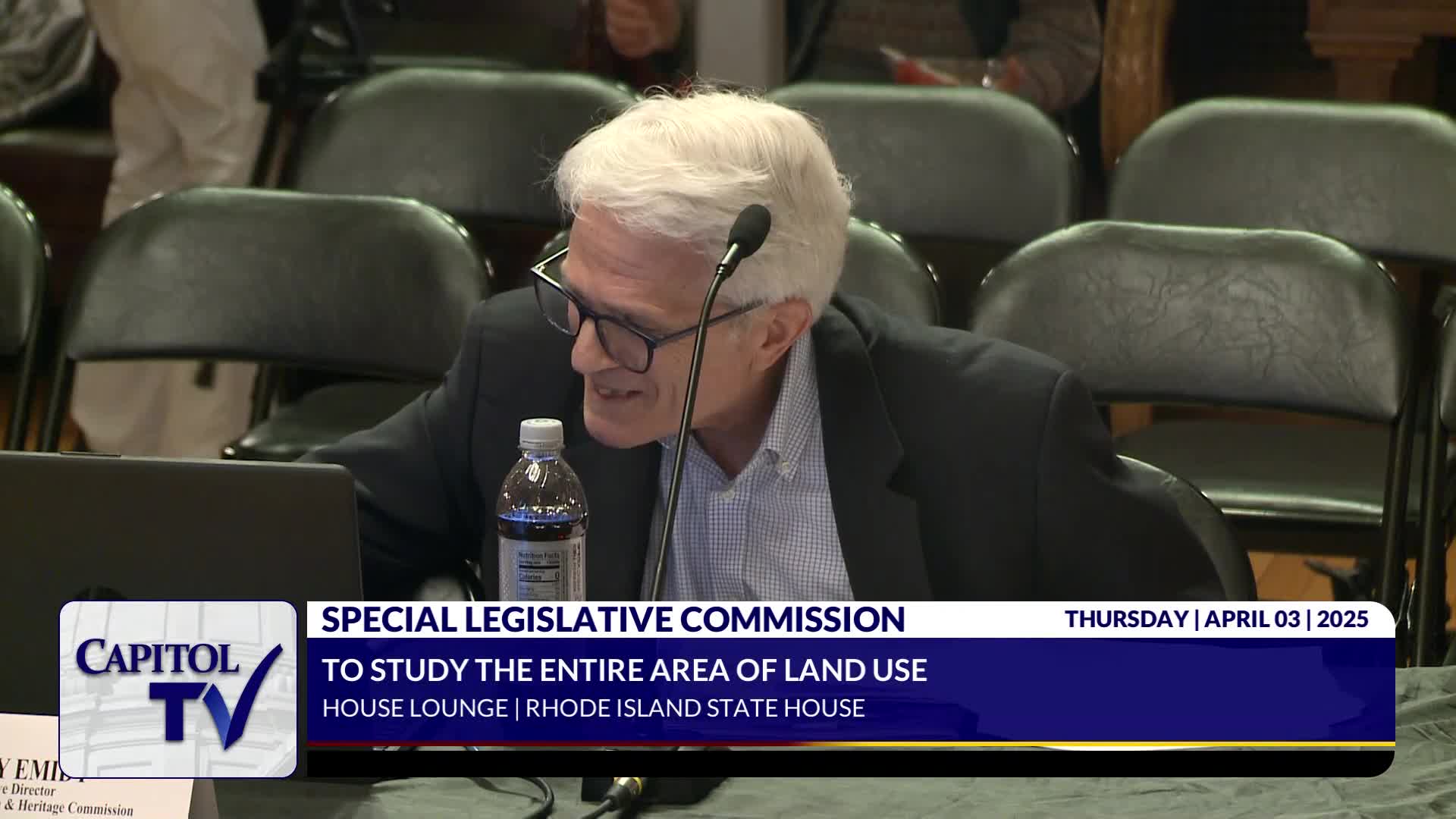
Scott Wolf, executive director of GoSmart Rhode Island, told the commission the state historic tax credit has produced hundreds of rehabilitations and roughly $2 billion in investment since 2002 but is now "operating on fumes" and needs administrative and funding reforms.
Scott Wolf, executive director of GoSmart Rhode Island, told the commission that the Rhode Island state historic tax credit has been a major engine of economic and housing development since its creation in 2002, but that the program is financially strained and needs administrative reform. "This program has been the single best community economic development and, in many ways, housing incentive the state ever put out there," Wolf said.
Wolf summarized program results and concerns: since 2002 the state program supported more than 300 historic rehabilitation projects, produced roughly $2 billion in investment, and has financed projects in 24 of the state’s 39 municipalities. He said the program catalyzes housing production — Wolf estimated roughly 20% of housing units built in recent years were associated with projects using the state credit — and has spurred brownfield cleanup, downtown revitalization and larger municipal tax bases.
Key administrative and policy problems Wolf identified:
- Processing fees: the program currently charges a 3% nonrefundable processing fee on qualified rehabilitation expenses (QREs). Wolf said that makes a $10 million project pay roughly $300,000 up front and is far higher than processing fees in neighboring states.
- Credit structure: the state offers a lower credit (20%) for projects that are primarily residential and a higher credit (25%) for projects with stronger commercial components. Wolf called the lower residential credit counterproductive to current housing needs and noted other states often favor residential projects.
- Prevailing wage threshold: prevailing-wage requirements apply to projects above a $10 million threshold; Wolf and allies propose raising that threshold to $20 million to keep more projects financially feasible while retaining prevailing-wage protections for very large projects.
- Program predictability and waiting list: Wolf said the credit has operated with short sunsets and limited funding windows that make planning difficult; he reported a waiting list of 54 projects seeking roughly $90 million in state credits and projecting nearly $467 million in private investment.
Wolf proposed a package of reforms: reduce the processing-fee burden, adjust the prevailing-wage threshold, reconfigure the credit to better support residential rehabs, increase transparency of the waiting list, and pursue renewed funding once administrative fixes are in place. He said state-level investment would likely yield larger municipal and private returns and that making the program more competitive with neighboring states is important because capital and developer talent are mobile.
Commission members asked about potential downsides, including displacement and gentrification. Wolf responded that rehabilitated properties typically include a mix of price points and that community development corporations use the tax credit for affordable units; he also clarified that projects generally increase municipal property tax revenue, which can reduce fiscal pressure and create options such as homeowner exemptions or rate adjustments.
Wolf and others discussed prior changes to the program: caps introduced after the program’s initial uncapped period, a per‑project cap previously set at $5 million, and a prior pause that restricted new applicants. He said a bill incorporating many of the proposed reforms was expected to be introduced in the legislature soon.
Ending: Wolf urged lawmakers and agency staff to treat the credit as a strategic state tool for housing, downtown revitalization and brownfield cleanup and to pursue reforms and funding to restore the program’s competitiveness. "We need to play to our strengths and advantages," he said.