Get Full Government Meeting Transcripts, Videos, & Alerts Forever!
Get email alerts on the Driver Education Virtual Pilot topic
No spam. Unsubscribe anytime.
Senate committee hears wide-ranging debate on two-year pilot to allow virtual instructor-led driver education
Summary
Supporters told the Senate committee virtual, instructor-led driver education would expand access and match pandemic-era outcomes; teachers and driving-school operators warned online classes reduce accountability and testing integrity. The committee held Senate Bill 832 for further study.
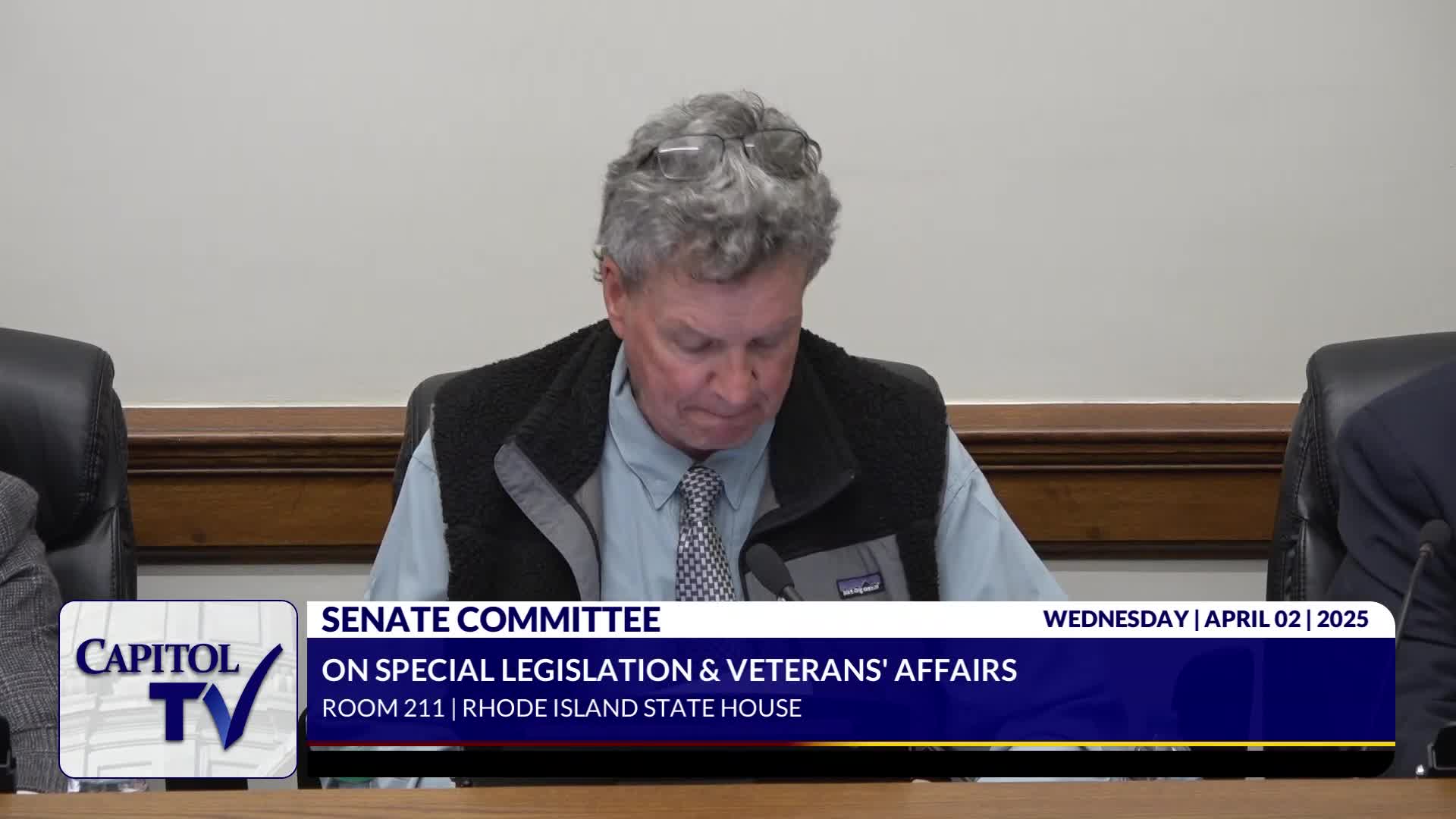
The Rhode Island Senate Committee on Special Legislation and Veterans Affairs heard competing testimony on Senate Bill 832, a proposal to authorize a two-year pilot allowing virtual instructor-led driver education as an optional alternative to in-person classroom courses.
The bill’s sponsor, Senator Lou DePalma, told the committee the measure would create a two-year pilot and require a report to the General Assembly assessing the pilot’s effectiveness and safety. "We are not looking to supplant that. We're looking to provide families and students an option," DePalma said.
Supporters, led by Mary Maguire, vice president of public and government affairs at AAA Northeast, said the virtual option increases access for students with scheduling, transportation or learning challenges and produced similar test scores during the pandemic. "During the pandemic, we taught almost 100 virtual classes to more than 2,300 Rhode Island students," Maguire said, noting AAA’s pre-pandemic classroom average score of 90.94% compared with 89.58% for virtual learners.
Rick Phelan, a retired certified teacher who taught AAA’s virtual classes during the pandemic, described a method he said preserved engagement online: the chat function. "Students needed to answer a minimum of 60 questions in 3½ hours to get credit for the class," he said. "I could print out a report of each student's answer and questions for the date and the time they sent them… I could tell if they were on task or inattentive."
But a large contingent of teachers and driving-school operators opposed the change. Rick Sullivan, president of driver education teachers at the Community College of Rhode Island (CCRI), said many CCRI instructors will not teach virtually again. "This isn't about test scores," Sullivan said. "What we are hoping to do is to maybe get you to understand that this is the most important task that you're ever gonna do. I we believe the kids belong in school." CCRI representatives told the committee the college runs roughly 8,000–9,000 students a year through driver education and that the pandemic virtual classes were smaller because federal funds allowed smaller cohorts.
Newport County Driving School owner John Leeds, who marked his 30th anniversary teaching driver education, urged caution and pointed to rising crash counts. "Pre-COVID there were 538 crashes in the state of Rhode Island in which a teenage driver was involved. In 2023, we had over 2,095 crashes," Leeds said. "Hands on is the best remedy to teach a kid how to drive a car properly. Not watching something on a video screen."
Proponents answered concerns about engagement, testing integrity and technology outages. Mary Maguire and other supporters said certified instructors would lead virtual classes, that platforms such as Zoom or Teams could capture attendance and participation, and that the pilot would be time-limited and evaluated with a required report.
Committee members sought better data. Senator Leonidas Acosta asked the DMV to provide crash and licensing data that could distinguish students who took virtual classes from those who attended in-person programs. "We don't have good data on this," Acosta said, noting that voluntary choice of format would make causal comparisons difficult.
After more than three hours of testimony from industry representatives, certified teachers, school operators and advocates, the committee voted to hold SB 832 for further study to collect more information from the Department of Motor Vehicles and education providers.
The motion to hold passed by voice vote; the committee did not advance the bill at the hearing.
Ending: The committee’s hold preserves several options: a time-limited pilot with a restricted provider list, the status quo of in-person instruction, or a future, amended bill with tighter standards for remote testing and monitoring. The committee requested more detailed data from DMV and from CCRI on enrollment, outcomes and administrative capacity before taking further action.