Get Full Government Meeting Transcripts, Videos, & Alerts Forever!
Get email alerts on the Historic Preservation Process topic
No spam. Unsubscribe anytime.
Rhode Island preservation office details how federal and state reviews affect housing projects
Summary
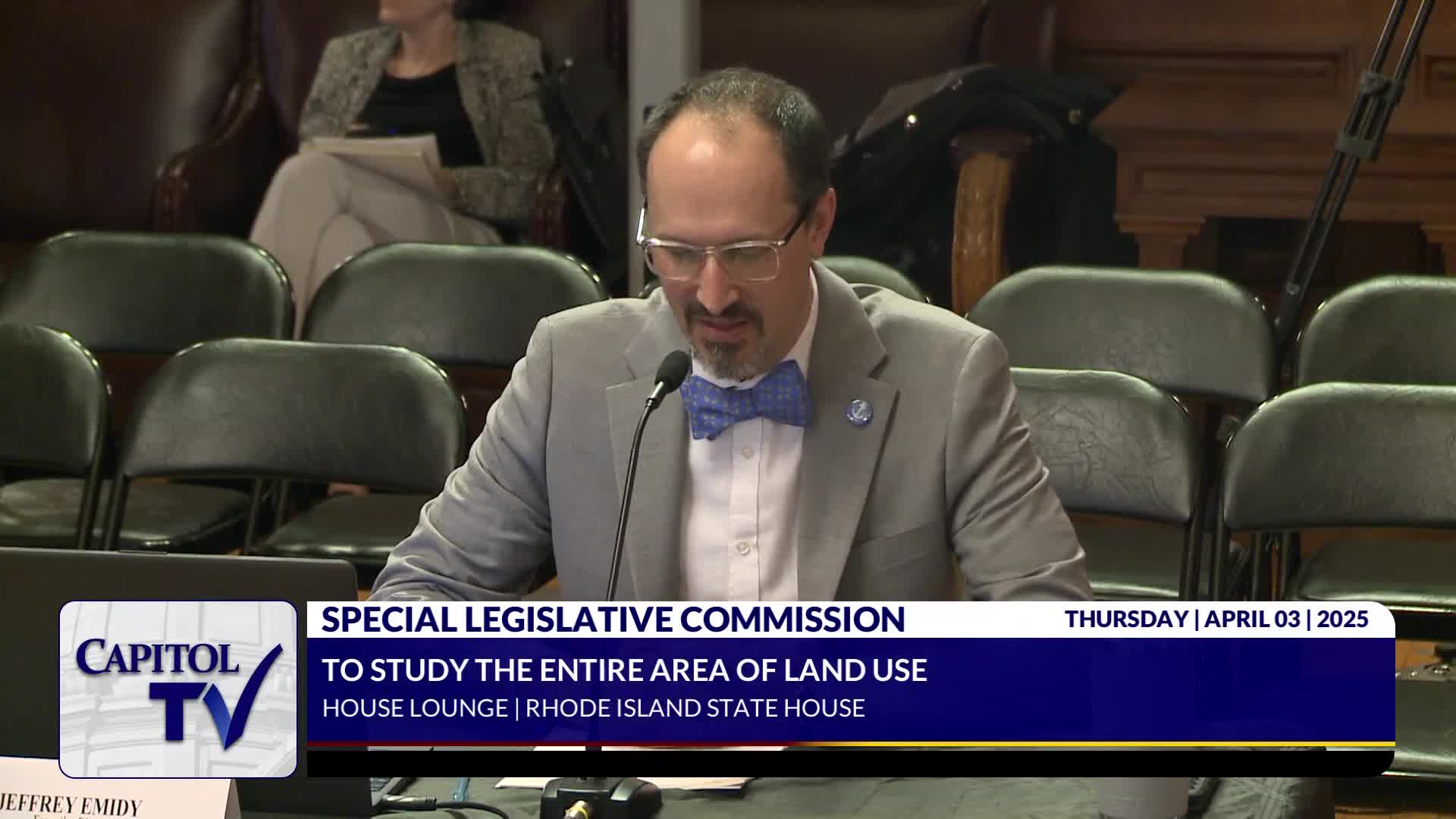
Jeff Emmity, executive director of the Rhode Island Historic Preservation and Heritage Commission and the state historic preservation officer, told the commission for the study of the entire area of land use that federal Section 106 and comparable state review are triggered when housing projects use federal or state funds, require federal or state permits, or occur on federal or state property.
Jeff Emmity, executive director of the Rhode Island Historic Preservation and Heritage Commission and the state historic preservation officer, told the commission for the study of the entire area of land use that federal and state preservation reviews are triggered when housing projects use federal or state funding, require federal or state permits, or occur on federal or state property. "Historic preservation and development, particularly housing development, are not mutually exclusive pursuits," Emmity said.
Emmity described the standard review sequence under the National Historic Preservation Act (Section 106) and the comparable state review called for under Rhode Island law: notification by the lead federal or state agency, identification of historic resources within an area of potential effect, a determination of effect (no historic resources, no effect, no adverse effect, or adverse effect), and consultation toward avoidance, minimization or mitigation when an adverse effect is identified. He emphasized that an adverse effect does not automatically stop a project: it triggers further consultation and, if needed, mitigation measures.
Why it matters: many housing projects receive federal or state support, which brings them into the preservation review process. Emmity gave a recent example in Lincoln, where HUD-funded rehabilitation of mill housing in Manville required a determination that led to listing the Manville Worker Housing historic district on the National Register and allowed the housing project to proceed.
Under Section 106, federal funding or licensing draws the federal review; under state law, the review is triggered for projects undertaken by the state or municipality. Emmity cited the National Historic Preservation Act of 1966 and the state statute establishing the preservation office, and referenced the Rhode Island Code of Regulations that sets out procedural steps. "Any of your housing project money that comes from the federal government triggers a Section 106 review," he said.
Emmity walked the commission through typical outcomes:
- If no historic resources are found within the area of potential effect, the office issues a letter and the project proceeds.
- If historic resources are present but a project will not affect their character-defining features, the office will concur with a "no adverse effect" determination and the review ends.
- If a proposed change would harm character-defining features or introduce visually incongruous elements, the office may find an adverse effect and staff will continue consultation to explore feasible and prudent alternatives and mitigation.
Mitigation options Emmity described include redesign to avoid the adverse effect, salvaging and reusing building materials, documentation (reports, interpretive panels, websites or apps), moving structures where feasible, and funding preservation work on affected or other historic properties. He cited an airport terminal exhibit as an example of mitigation that documented a lost hangar.
Emmity said the Secretary of the Interior’s Standards guide decisions in federal and tax-credit reviews, but noted the standards are intentionally general and sometimes feel subjective in application. "The standards... are intentionally designed to be vague. And, kind of subjective," he said, adding that experienced project teams and the commission’s long-tenured architects usually help find acceptable compromises.
Questions from commission members and others addressed common developer concerns: whether clearer, prescriptive lists of acceptable materials (for example, windows) might speed approvals; how local historic district commissions (HDCs) vary in capacity; the relationship of preservation review to environmental review under NEPA; and the role of tribal historic preservation offices. Emmity advised project proponents to seek early consultation with the preservation office to reduce delay.
Ending: Emmity closed by reminding developers and local officials that preservation reviews take time and work but—if engaged early—can often accommodate housing development while protecting historic resources. "If project proponents plan accordingly and are prepared to work together and creatively, we should all be able to meet our goals, get housing developed, and preserve historic properties at the same time," he said.