
Arlington board delays vote on 531‑unit Hotel Pentagon redevelopment after hours of public testimony
Get AI-powered insights, summaries, and transcripts
Subscribe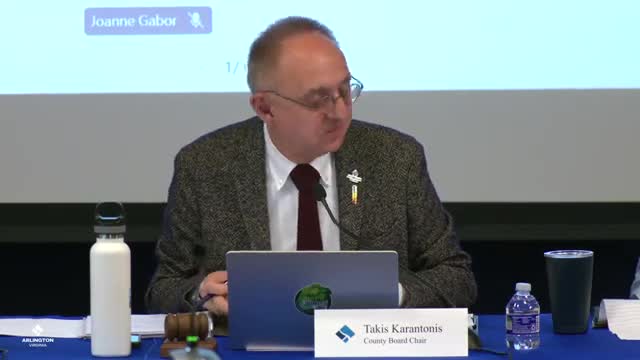
Summary
The Arlington County Board postponed a decision on the proposed redevelopment of 2480 South Glebe Road into an eight‑story, 531‑unit apartment complex after several hours of public comment, commission debate and concerns about traffic, impacts to Lomax AME Zion Church and affordable housing.
The Arlington County Board on April 5 delayed a final vote on a major redevelopment proposed for 2480 South Glebe Road, commonly called the Hotel Pentagon site, after more than three hours of public testimony and lengthy staff and applicant presentations. Board Member Julius “JD” Spain Sr. moved to defer consideration to the board’s April 9 meeting; the motion passed 5‑0.
The proposal from Rockefeller Group and Crescent Communities would replace two existing hotels and surface parking with a mid‑rise development that includes an eight‑story multifamily building (Building E), four townhouse‑style buildings (Buildings A–D) and an integrated above‑grade parking structure. “The project consists of 531 units at a density of around 96 dwelling units per acre,” Planning Division staff member Kevin Lam said in his presentation.
Why the board delayed the decision: opponents and some advisory commissioners pressed the board for more time to resolve traffic impacts, the project’s relationship to Lomax AME Zion Church and its adjacent cemetery, and whether the affordable housing contribution is sufficient. Lomax Church leaders described the site as a sensitive historic neighbor and urged stronger protections and additional community benefits. Reverend Dr. Adrian Nelson II warned the board that community trust is at stake: “The handwriting on the wall says that if this county continues to disrespect and disregard the concerns of members of Lomax and Green Valley, the days of the county as you know it are numbered,” he said.
What the plan would deliver: the applicant is asking for a General Land Use Plan (GLUP) amendment (service industry → medium residential for a portion of the 5.5‑acre site), a Master Transportation Plan map amendment to add new internal streets, and a major site plan amendment to permit modifications (density bonuses, reduced parking ratios and other exceptions) needed to build the proposal consistent with the RAH (residential‑hotel) zoning district. Staff said the project would provide about 10,300 square feet of publicly accessible open space via a permanent easement, three new street segments reserved for future extension, nine on‑site committed affordable units (CAFUs) and a $2,000,000 Affordable Housing Investment Fund contribution.
Traffic, streets and transit: applicants and county transportation staff said the project’s net new vehicle peak‑hour trips—estimated at roughly 74 in the morning and 55 in the afternoon—were manageable with signal timing adjustments, new turn lanes and the removal of some existing curb cuts. Applicant traffic consultant Grove Slade said those changes would add pedestrian and bus improvements and an internal drop‑off circulation plan intended to keep short‑term vehicle activity off 20th Street. Opponents and some commissioners countered that the nearby intersections, including the offset intersection at South Glebe and South 20th/20th Road South, already operate poorly and that the corridor would benefit from a larger, multi‑jurisdictional study jointly with VDOT and neighboring Alexandria.
Historic neighbor and mitigation: Lomax AME Zion Church, listed on the National Register and adjacent to the site, pressed for stronger protections. The Planning Commission negotiated several conditions, adopted with the commission’s recommendation, including an 8‑foot permanent barrier along the property line to protect the cemetery, restrictions on construction hours around church services and funerals, a gate at the existing cemetery arch (subject to Historic Alexandria or county HALRB approval), signage to prevent trespass and additional community coordination during construction.
Affordable housing and policy context: the project’s baseline density (400 units) and the additional density requested were framed by the existing RAH zoning and the county’s site‑plan density rules. Staff explained that because the site lies within the county‑adopted Four Mile Run Valley Area Plan, it did not follow the alternate GLUP change process used when a property lacks an area plan; that difference affects how on‑site affordable commitments are calculated. Planning staff summarized the ordinance mechanics for earning density through contributions such as CAFUs, on‑site public space and green building incentives (the applicant is pursuing LEED Gold as part of a green‑building incentive).
Advisory bodies and public engagement: the Planning Commission recommended approval with amended motions responding to the church and neighbors; the Transportation, Housing and Forestry & Natural Resources commissions also considered the case and provided letters and suggested conditions. The Planning Commission voted with amendments that included additional construction monitoring, a fence (later refined to an 8‑foot permanent barrier) on the western property line and added monitoring and mitigation commitments.
Next steps: the board deferred a final vote until its April 9 meeting to allow more time for community and board review and for board members to consider remaining requests from nearby residents and Lomax Church. If the board approves the package on final reading it would also need to adopt the related map/GLUP amendment and site plan ordinances. The applicant said it remains available to continue negotiating community benefits, but warned lender and financing timelines may be affected if the delay extends beyond next week.
Why it matters: the project would deliver hundreds of housing units—including family‑sized units the applicant said are in demand—along with public space and transit connections in a redevelopment area, but it raises classic local tensions: scale and massing adjacent to an historic church and cemetery, whether traffic capacity and mitigation are adequate, and how to balance developer contributions, on‑site affordable units and other community benefits in a long‑standing, ethnically diverse neighborhood.
Ending: the board will reconvene the matter on April 9. In the interval staff, the applicant and community representatives are expected to continue focused talks about traffic timing and monitoring, additional on‑site protections for the church and cemetery, and possible refinements to community benefits and public‑art proposals.