
Committee defers governor's housing bill after lengthy debate over 'vesting' provisions
Get AI-powered insights, summaries, and transcripts
Subscribe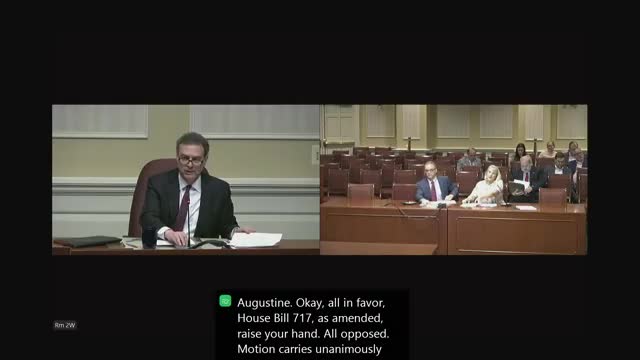
Summary
The Education, Energy, and the Environment Committee held an extended Saturday hearing on a governor-backed housing bill that would change when housing projects acquire ‘vested’ land-use rights; after extensive testimony from county officials, builders and municipal groups, the committee postponed a vote for further stakeholder work.
The Education, Energy, and the Environment Committee heard more than an hour of testimony Saturday on a governor-sponsored housing bill that would change how and when proposed housing development projects gain "vested" land-use rights. After extensive questioning from senators and testimony from county officials, builders and municipal representatives, the committee declined to vote and said it would continue work and reconvene before the legislative session.
Kathleen Boucher of Montgomery County’s Office of Intergovernmental Relations told the committee the county executive supports placing vesting duties with the proposed commission but that the Montgomery County Council had not had time to act and therefore had no formal council position. Boucher said the bill’s vesting language is broad and unclear and that key definitions — such as when an application is “substantially complete” — lack precise standards. “We have no idea what ‘substantial majority’ means. We have no idea what ‘substantive errors’ means,” Boucher said, describing implementation concerns and the potential for litigation.
Developers’ representatives told the committee that the uncertainty around vesting discourages investment. Mr. Powell, appearing for home builders, described vesting as a central concern for developers and argued that the current regulatory climate deters projects: “This is the last chance people have to stop a development,” he said, adding that litigation over vesting is longstanding.
Committee members pressed the administration and stakeholders on multiple technical and policy points. Among the issues raised were:
- Two separate “prongs” of vesting in the draft: an early vesting tied to submitting an application (which opponents said could grant perpetual rights before approvals) and a second prong that would extend vested rights after approval for a set period (the draft set five years; a suggested amendment would reduce that to two years).
- The bill’s definition of “housing development project,” which committee witnesses said sweeps in many different approvals (building permits, site plan, variances, conditional uses) and therefore pulls multiple agencies into a single vesting rule.
- The draft’s use of “substantially complete application” language without objective thresholds, which local officials said would be difficult to implement consistently.
- Concerns about state-local interactions for enforcement of technical standards such as building codes and stormwater management; municipal witnesses said the committee could work to align statutory language so local enforcement of state-required codes remains effective.
Angelica Bailey Thupari of the Maryland Municipal League (MML) said the League was neutral on the current House version of the package but noted that incorporating elements from earlier drafts would require additional conversations with municipalities and other stakeholders. Haley Lemieux, director of policy development for the Department of Housing and Community Development (DHCD), said DHCD reviewed other states’ approaches and was not aware of any jurisdiction that later repealed early-vesting laws; she also said some states have strengthened such provisions recently.
Committee members discussed whether doing nothing would be worse than passing an imperfect bill, or whether rushing a major change without full stakeholder review would do more harm than good. Several senators asked for more technical fixes and additional stakeholder meetings. Senator Augustine and others indicated that some implementation concerns were resolvable after hallway conversations but that other substantive questions remained.
The chair said the committee would not take a final vote with two members absent and encouraged the parties to continue work; the committee planned follow-up meetings and pre-session work on Monday. No motion to adopt the bill was made on Saturday; the item was postponed for further negotiation.