Boulder planning board recommends council adopt small‑cell wireless code update
Summary
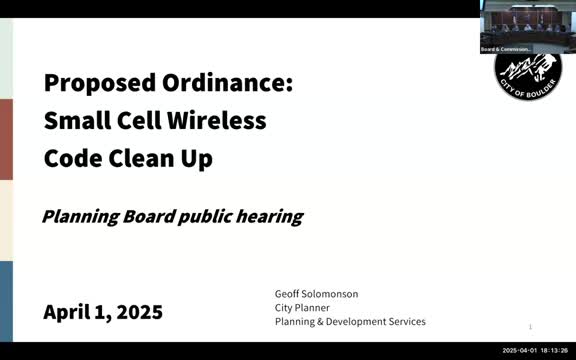
The City of Boulder Planning Board voted 6-0 to recommend that City Council adopt an ordinance updating Boulder Revised Code chapters governing wireless communications and small‑cell facilities to align with federal rulings and clarify fees, application routing and technical definitions.
The City of Boulder Planning Board voted 6-0 on April 1 to recommend that City Council adopt an ordinance amending portions of the Boulder Revised Code to update standards for wireless communications facilities and small‑cell deployments.
Staff presented the ordinance as a technical cleanup and alignment with Federal Communications Commission (FCC) rulings, and with recent and pending state actions. City Planner Jeff Solomonson told the board the package is intended to clarify fees, application routing, design standards for small cells in the public right of way, and the city’s definitions of which deployments qualify as “small cell.”
Why it matters: the changes would (1) set clearer application procedures and fee language consistent with FCC fee limits and “shot clock” timeframes for review, (2) incorporate federal guidance on concealment, size and when equipment changes constitute a “substantial change,” and (3) direct small‑cell right‑of‑way applicants to a unified administrative review pathway. Supporters said the updates will help Boulder process future applications following the city’s recent streetlight transfer from Excel Energy to the city — a change staff said could increase interest from wireless providers in placing equipment on city poles.
Staff presentation and legal context Jeff Solomonson, city planner in Planning and Development Services, described a series of FCC rulings (2018, 2019, 2020) that established a federal “shot clock” for reviewing collocation applications and clarified what counts as a substantial change, concealment rules and an excavation/deployment allowance. Solomonson said the ordinance would amend Title 4, Chapter 20 (fees); Title 8, Chapter 6 (public right of way and small cell permitting); Title 9, Chapter 6 (use standards); and Title 9, Chapter 16 (definitions) of the Boulder Revised Code "to amend the standards for wireless communications facilities and small cell facilities," and to unify where applicants should look in the code for fees and review standards.
Solomonson summarized key points staff included in the draft: - Clarify fees and where they are charged, consistent with FCC limits for small cells and vertical infrastructure. - Specify which review route applies (eligible facilities requests, equipment changes, small cell facilities in right‑of‑way, or macro sites). - Add clearer completeness and shot‑clock/tolling language and notification requirements. - Update the code to reflect federal guidance on excavation/deployment (staff noted a 30‑foot allowance around a base station that is not treated as a substantial change in certain contexts) and federal size limits (federal rules allow primary equipment enclosures up to 28 cubic feet for some small cells).
Board questions and clarifications Board members pressed staff for local details. Solomonson said staff believe only two small‑cell permits for right‑of‑way small cells had been issued in the last five years, though larger macro or concealed antennas exist on the city’s building stock. He said the city code currently includes a 600‑foot separation rule and tiered height limits by zone, and that where possible providers are expected to colocate on existing vertical infrastructure (streetlights, traffic signals) rather than install new monopoles.
Board members asked about: siting near sidewalks and ADA clearance; whether new monopoles must meet streetlight design standards; the permitting process (revocable right‑of‑way permit plus electrical and building permits); and whether providers could ‘‘just start digging’’ under the excavation rule. Solomonson and staff clarified that deployment would still require applicable permits and staff review, and if in the right of way would use a revocable right‑of‑way permit and other standard permits.
Legal advice and definition concerns Brandon Dittman, an outside telecommunications attorney assisting staff, participated by phone and told the board the draft’s small‑cell definition largely follows the FCC’s statutory framework and acknowledged the wording in the draft could be hard to parse. "This small cell facility definition isn't wieldy as it is; it is, again, an artifact of the FCC's regulations and what they say a small cell is," Dittman said. He recommended staff reformat or clarify the definition language so readers can more easily tell the two different ways a facility may qualify as a small cell.
State legislation and timeline Solomonson noted Colorado enacted HB 17‑1193 in 2017 to align state law with pending federal changes and that staff were tracking a March 2025 state bill that would set a state shot clock for eligible facilities and related matters. He said the March 2025 bill had not been signed by the governor at the time of the meeting and — if enacted — would not take effect until Jan. 1, 2026. Staff told the board they focused the current draft on already‑effective federal and state law and would revisit text if statewide legislation changed requirements.
Deliberation, public comment and vote No members of the public raised hands to speak during the item’s public hearing. After limited board deliberation and clarifying edits requested by board members, the planning board voted 6‑0 to recommend that City Council adopt the proposed ordinance. The motion was made on the record and seconded; the recorded roll call in the meeting transcript shows all six members present voting yes.
Key technical details cited by staff - Small‑cell equipment: staff referenced a 28 cubic foot maximum equipment enclosure allowance under federal interpretations for some small cells. - Excavation/deployment: staff cited an FCC interpretation allowing up to a roughly 30‑foot footprint (staff described it as "30 feet in any direction") around a base station for related ground equipment without creating a substantial change in some cases; staff emphasized applicable permits are still required. - Separation and height: existing Boulder code includes a 600‑foot separation rule and tiered mounting height limits by adjacent zoning; draft language seeks to better link right‑of‑way small cell standards (Title 8) with the wireless facility use standards (Title 9).
What staff recommended Staff recommended the planning board forward the ordinance to City Council for adoption, saying the changes would make Boulder’s review and fee language consistent with federal rulings, state legislation and other Front Range cities that have updated codes.
Next steps The planning board’s action was a recommendation to City Council; the ordinance must still be considered and adopted by council for the code changes to take effect. Staff said they will continue to refine definition language and formatting before transmittal to council.