
Boulder Landmarks Board swears in new member, holds orientation and program briefing
Get AI-powered insights, summaries, and transcripts
Subscribe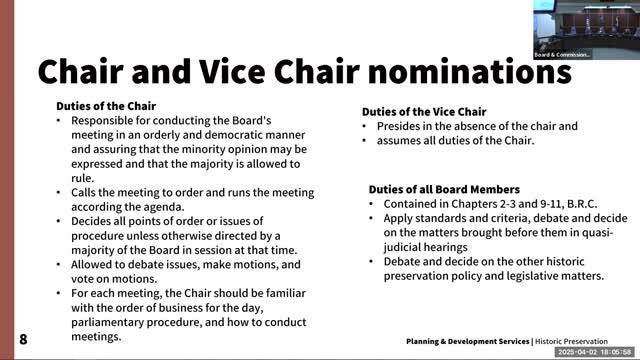
Summary
At its April 2 meeting the City of Boulder Landmarks Board swore in Michael Ray, reviewed the board’s workload and procedures, and heard staff briefings on the preservation program’s caseload, upcoming plan update and process changes.
The City of Boulder Landmarks Board on April 2 administered the oath of office to its newest member, Michael Ray, and used an orientation session to review the board’s responsibilities, recent process changes and upcoming work.
"Thank you. I'm Michael Ray. Do solemnly swear that I will support the constitution of The United States Of America and the state of Colorado and the charter and ordinances of the city of Boulder and faithfully perform the duties of the office of a member of the landmarks board, which I am about to enter," Ray said as he recited the oath and signed the hard copy provided by staff.
The orientation combined brief personal introductions with a staff presentation on how the historic preservation program operates. Marcy Goring, principal historic preservation planner, told the board the program manages roughly 320–370 applications annually, and that Boulder has more than 1,300 designated properties across about 10 historic districts and roughly 220 individual landmarks, representing about 4% of the city’s properties.
"We review about, I'd say, 320 to 370 applications each year," Goring said, adding that roughly half of Boulder’s properties are more than 50 years old and therefore potentially subject to review.
Planning and Development Services Director Brad Mueller described the Landmarks Board’s quasi‑judicial role and said staff aims to provide concise, record‑ready packets to support board decisions. Christopher Johnson, senior manager for comprehensive planning, noted the upcoming Boulder Valley comprehensive plan update and said historic preservation will be part of that conversation.
Staff outlined recent operational changes: many routine reviews are being shifted to the Landmarks Design Review Committee (LDRC) or to staff to reduce volunteer time; historically the LDRC handled about 63% of cases and the full Landmarks Board hears a minority of matters. Over the past five years the program averaged 170 landmark certification applications and 136 demolition applications annually, with 2–6 tax credit applications and 2–6 new designations each year.
Goring and other staff also described two multi‑year projects in progress: a major update to the city’s Historic Preservation Plan (the plan was first adopted in 2013 with a minor update in 2018) and a migration of application materials from PDF to an online direct‑apply system intended to simplify filings and reduce staff processing time.
Board members discussed board duties and etiquette. Abby Daniels, the board chair, said the group traditionally elects a chair and vice chair soon after new members are seated and encouraged members interested in leadership roles to notify staff before the May 7 meeting. "This is something that the board could do at your next meeting on May 7," Daniels said, asking interested members to email staff in advance so staff can anticipate how many candidates there are.
The board also noted calendar items: the Square Nails awards ceremony is scheduled for May 12, and the next regular Landmarks Board meeting is on May 7. No formal policy votes were recorded during the orientation session; the oath of office for Michael Ray was the sole formal action taken on the record.
The meeting was intended as an introductory session rather than a public hearing; staff said a more detailed orientation and shadowing of LDRC will be scheduled before Ray’s first meeting with a public hearing docket.