
Parks & Recreation reports 2024: operating budget nearly fully spent, CIP underspend and rising recreation demand
Get AI-powered insights, summaries, and transcripts
Subscribe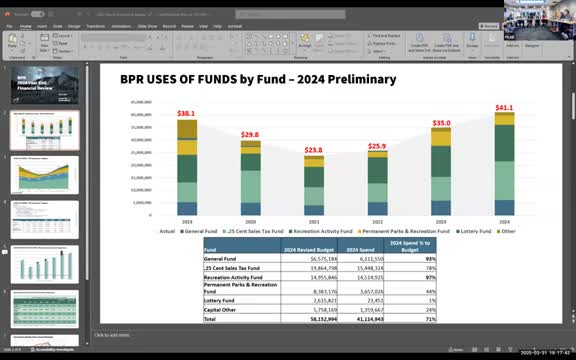
Summary
Department staff told the advisory board that 2024 operating spending reached roughly 96% of budget while capital project spending ran at about one-third of the planned CIP; recreation revenue and center visitations rose but cost escalation and infrastructure needs remain concerns.
City finance staff briefed the Parks and Recreation Advisory Board on the department’s 2024 financial results and key metrics, reporting higher earned revenue and participation while flagging capital spending shortfalls and ongoing cost pressures.
The department presentation said the operating budget was about 96% spent in 2024 — a level staff described as close to best practices — while capital improvement project (CIP) spending was about 34% of the budgeted CIP for the year. Staff attributed the CIP underspend to the multiyear nature of planning, permitting and design and said future budgets will phase larger project totals across multiple years.
Key figures and trends
- Operating and reserves: staff reported operating spending at about 96% of budget and said better budget realism and multi‑year phasing will help match CIP budgets with realistic delivery schedules.
- Recreation Activity Fund (RAF): earned revenue for the RAF grew year over year. Staff reported approximately 16% year‑over‑year growth in earned revenue for the department’s quasi‑enterprise rec fund, while acknowledging some revenues were one‑time or ARPA‑related in prior years.
- Visitation and program trends: recreation‑center visitation was up about 20% year over year; outdoor pools increased and golf rounds have grown substantially since 2019, with golf reported as roughly 46% higher over a five‑year span. Reservoir visitation was cited as slower to recover than other sites.
- Subsidies and transfers: the general‑fund subsidy to recreation remained at roughly $1.6 million annually. Staff also noted a one‑time transfer of roughly $3.3 million from a dedicated 0.25¢ sales‑tax fund in prior years to support community benefit programs.
- Staffing: department benefited‑eligible headcount has fluctuated since 2019. Staff reported a 2019 peak of roughly 144.25 benefited FTE, a dip to about 121 FTE in 2021, and an FY2024 headcount near 152–154 benefited positions. Nonstandard/hourly workers remain a large operational cohort — staff cited about 600 nonstandard employees logging roughly 180,000 hours per year.
Staff cautioned that cost escalation on projects and rising personnel costs have outpaced revenue growth in some areas. They said fee increases have helped revenue but warned that raising user fees can create access barriers for priority populations. As a result, staff noted the department is working on a community access framework to incentivize third‑party providers to align with city goals and to structure financial aid and scholarships more effectively.
Quotes and board reaction
Jackson, the staff presenter, told the board that the department is “cautiously optimistic” but that “cost escalation is outpacing our revenue growth,” and that the long‑term financial strategy will be used to align services and funding priorities.
Board members asked about comparisons to other cities, the makeup of full‑time staff versus hourly hires, and whether recreation programs could be expanded in‑house rather than rely on private providers. Staff said those tradeoffs are part of the community access and partnership work under way and will be part of budget development in spring and summer 2025.
Next steps
Staff will use the retreat and upcoming budget development cycle to fold departmental performance into citywide long‑term financial planning and will return to the board with more detailed FTE comparisons and the Community Access Framework results later in 2025.
Ending
The report framed 2024 as a year of recovery and growth for participation and earned revenue, with capital delivery and cost pressures remaining the department’s principal financial risks.