
Commission approves CAP guidelines clarifying eligibility, contracts and evaluation rules
Get AI-powered insights, summaries, and transcripts
Subscribe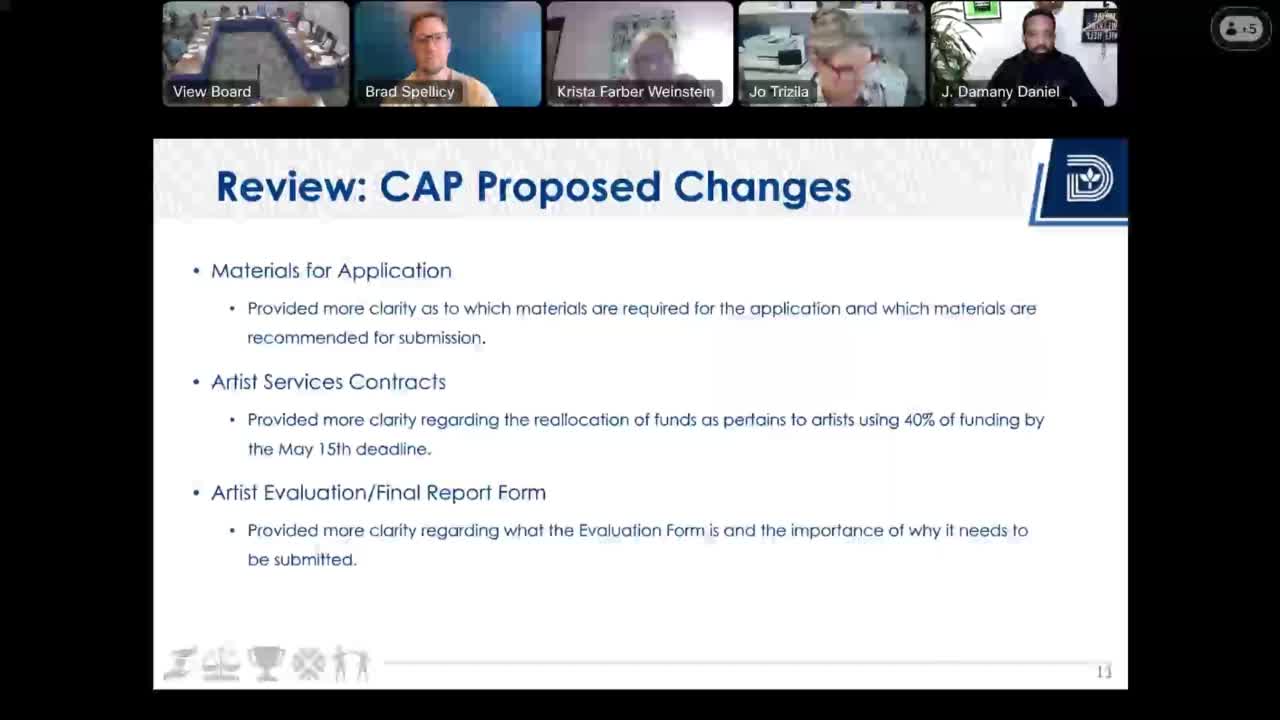
Summary
The commission approved revisions to the Community Artists Program (CAP) guidelines, clarifying eligibility for in-school vs. community-facing services, contract terms, evaluation requirements and funding reallocation when artists spend less than specified thresholds.
The Arts and Culture Advisory Commission voted on March 20 to approve the fiscal-year 2025–26 Community Artists Program (CAP) guidelines after staff presented clarifying updates to eligibility, contract language and administrative procedures.
Rhonda (program staff) and Ms. Ivory reviewed the updates, which clarified that CAP provides artists for community-facing events (free and open to the public) rather than in-school curriculum services that are not community-facing. The guidelines also explain how staff monitor spending: artists who have not spent at least 40% of their allocated funds by a review point in May may have some of their remaining funds reallocated to other artists who need additional support, while leaving artists enough funds to complete contracted work.
Staff reiterated that CAP contracts generally pay artists for an hour of availability even if a performance is shorter, and that artists must submit an evaluation form with demographic and attendance information each time they provide a service. The guidelines replace an older community-arts logo with the Office of Arts and Culture (OAC) logo and adjust application materials and contract clarifications to reduce confusion.
Commissioners asked how reallocated funds are handled; staff said reallocated funds are pooled and distributed to requests as they arise. Commissioners also raised concerns about host guidelines and artist treatment; staff said the host-facing guidelines will be updated to spell out conditions that could make a host or engagement ineligible.
Commissioner Breganoff emphasized the core CAP test: “free and open to the public,” and urged commissioners to share the CAP artist list with their networks. A motion to approve the guideline revisions passed unanimously with no recorded opposition.