Get Full Government Meeting Transcripts, Videos, & Alerts Forever!
Get email alerts on the Mental Health topic
No spam. Unsubscribe anytime.
City’s new chief mental health officer describes grants, youth initiatives and crisis-response coordination
Summary
Dr. Rebecca Hubbard, Tulsa’s chief mental health officer, briefed the Tulsa Women’s Commission on the city role in coordinating children's mental health, community violence intervention, opioid-abatement funding, and the community-engaged genealogy project tied to the Race Massacre investigation.
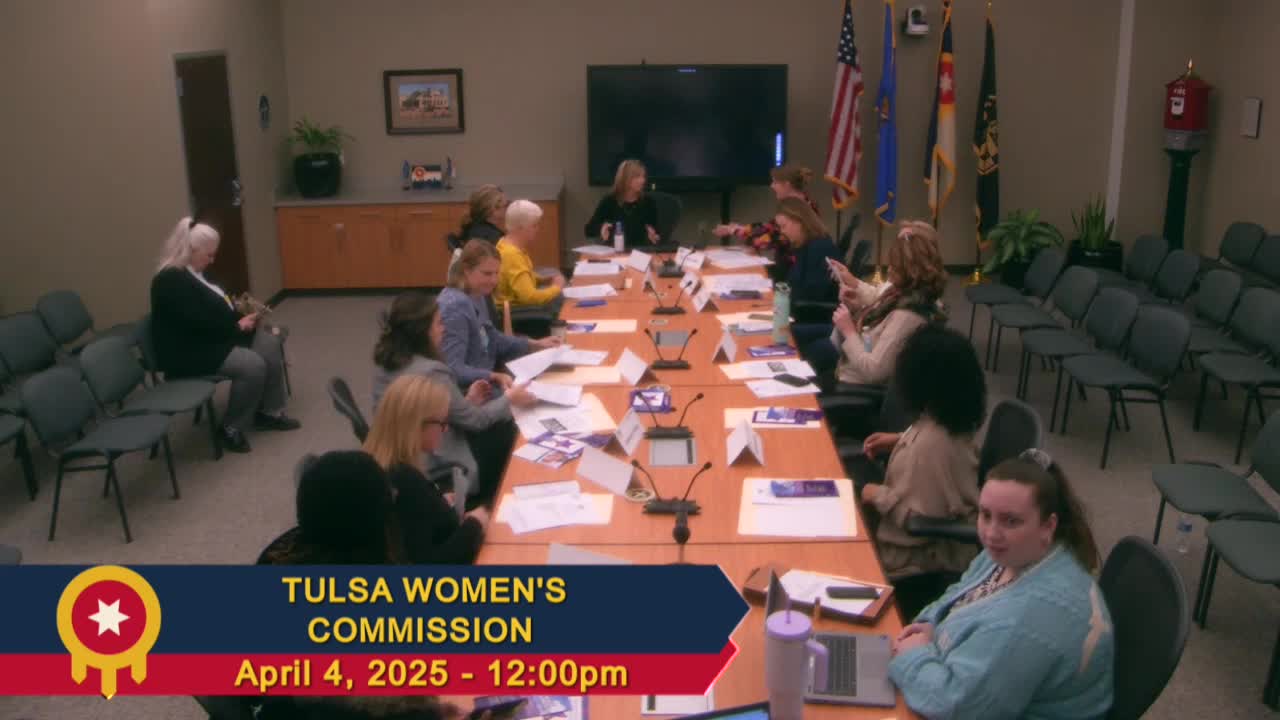
Dr. Rebecca Hubbard, the City of Tulsa’s chief mental health officer, told the April Tulsa Women’s Commission meeting that the municipal post exists to coordinate a wide set of programs across mental-health, youth, substance-use and community resilience initiatives.
Hubbard said the position sits within the Department of Resilience and Equity and reports to the deputy mayor. "I am the chief officer for the city of Tulsa," she said, describing work that includes research, cross-sector coordination, grant management and program launch support.
She reviewed seven broad work areas the office supports and highlighted several funded initiatives: a SAMHSA four‑year grant for the Children's Mental Health Initiative (now in year two); a Department of Justice community-based violence intervention grant managed with Impact Tulsa; and opioid-abatement funding used to expand substance-use recovery and school-based prevention efforts. Hubbard said the city recently hired an opioid-abatement response coordinator and was recruiting a community youth resilience coordinator for the violence- intervention work.
Hubbard described the Children's Mental Health Initiative as including peer and family supports and said local partners—counseling providers, school districts and higher-education researchers—are collaborating on implementation. She also said the city has received a DOJ-funded community genealogy project tied to the Tulsa Race Massacre investigation; the project will embed trauma‑responsive supports for participants and may seek a no‑cost extension to continue through community outreach.
On grants, Hubbard acknowledged national and state funding instability for some programs but said the city has received carryover and amended Notices of Award in several cases that provided short-term stability. "We received an amended NOA and our carryover budget for the second year," she said, describing formal approvals that allowed continuation of services.
Hubbard said the role is intended to be both operational—helping launch programs and hire coordinators—and stabilizing, serving as a "safe space" for public-agency directors as they renegotiate contracts and adapt to funding changes. She invited commission members to stay engaged and said the office will recruit coordinators and partners to keep initiatives staffed.
Commissioners asked about comparable positions in other cities; Hubbard said few municipalities have an equivalent chief mental health officer and that Tulsa’s office is still building a set of best practices and peer relationships.
No formal action was taken on the presentation. Hubbard provided contact emails for follow-up.