Get Full Government Meeting Transcripts, Videos, & Alerts Forever!
Get email alerts on the Domestic Violence topic
No spam. Unsubscribe anytime.
Family Safety Center outlines polyvictimization, services and funding uncertainty; new building planned for Oct. 2025
Summary
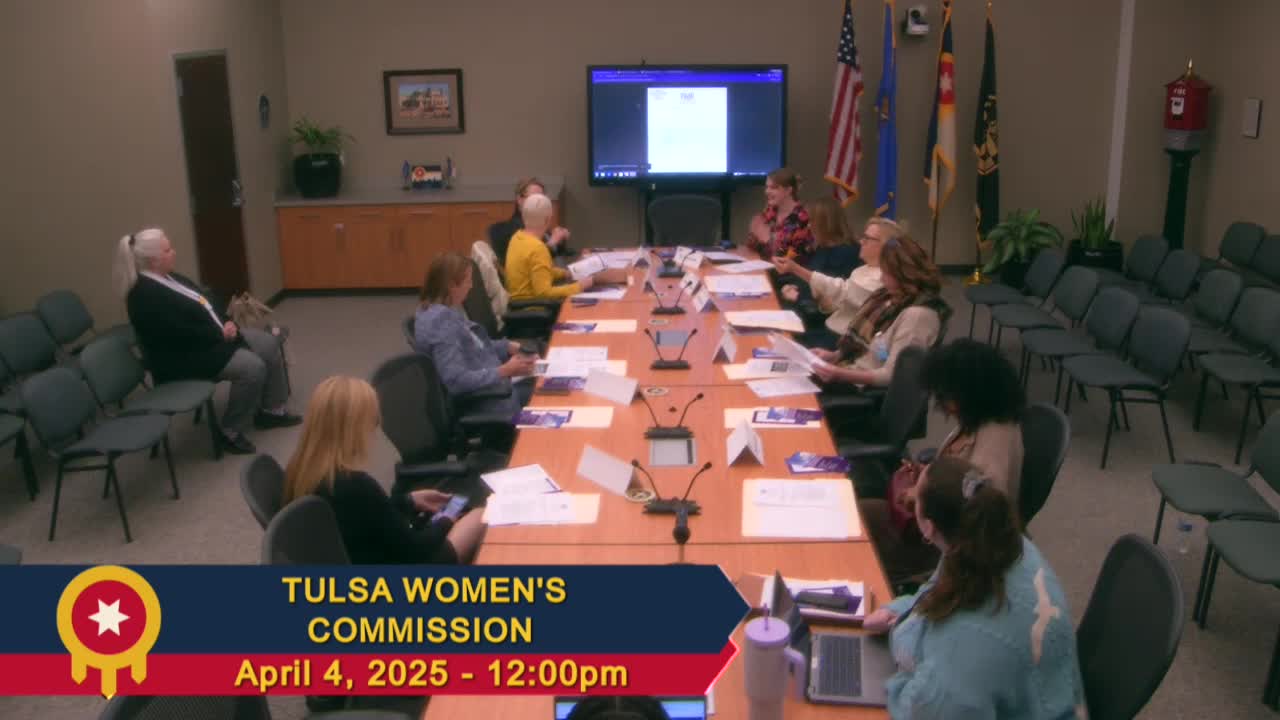
Suzanne Stewart, chief executive officer of the Family Safety Center, told the April Tulsa Women's Commission meeting the center is expanding trauma-informed services even as federal grant funding remains uncertain and a new, larger facility is scheduled to open in October 2025 at 2829 South Sheridan.
Suzanne Stewart, chief executive officer of the Family Safety Center, told the April Tulsa Women's Commission meeting that the center is expanding trauma-informed services even as federal grant funding remains uncertain and the nonprofit prepares to open a new building in October 2025 at 2829 South Sheridan.
Stewart said the Family Safety Center treats intimate-partner violence, sexual assault, stalking and the long-term effects of stacked traumas—what researchers call polyvictimization—and that those layered experiences drive many of the community’s worst health outcomes. "When we talk about trauma, this is a lot of people," Stewart said. "Over 240 individuals will be physically assaulted by the time this is over." She added that the center’s local data uses 2023 figures and that Oklahoma has ranked "number 2" in state domestic-violence measures in recent years.
The center is the local multidisciplinary adult equivalent of a child advocacy network, Stewart said. On-site partners include law enforcement victim-advocacy units and staff attorneys from two civil legal-service partners, which she named as Divis and Legal Aid services. Stewart said about 65% of clients come to the center seeking emergency protective orders and that Tulsa Police Department advocates refer many cases: "Law enforcement is required by statute to refer to advocacy in your family safety center," she said.
Stewart described the Family Safety Center’s casework: danger assessments, safety planning, advocacy for emergency protective orders, forensic nursing for injury documentation and psychoeducation delivered by licensed clinicians. Quoting research and the state fatality review board, Stewart said most domestic homicides involve victims who never sought services: "95 percent of the homicides that occur statewide are with victims who never sought any kind of services whatsoever," she said.
The center has partnered on an evidence-driven assessment project with the U.S. Department of Justice, Alliance for Hope International and OU Tulsa researchers that Stewart said reviewed 100 tools and produced a new instrument measuring 26 trauma types and 26 symptom areas. Stewart described the assessment as a way to identify overlapping needs and to guide longer-term referrals beyond immediate crisis response.
Stewart warned that federal grant awards that fund many partner positions are under review by agencies including the Department of Justice and the Office on Violence Against Women. "The uncertainty of it," she responded when asked about their biggest challenge. She said the organization faces a roughly $1,400,000 annual program budget and will face new operating costs of about $350,000 a year for utilities and maintenance once it moves out of space the city currently provides.
Stewart said the new building will expand services and co-locate partners, including tribal victim services and federal partners for relevant cases. She also urged the commission and community to raise awareness and to consider pro bono legal help: "If you know of any attorneys who are willing to do some pro bono work, we're happy to take it," Stewart said.
Stewart repeatedly emphasized survivor-driven decision-making and safety planning: advocacy staff do not require survivors to leave abusive relationships but work to reduce lethality and improve safety whether a survivor stays or leaves. She said 99.6% of those who seek the center’s services are not killed by the abuser, a figure she presented to highlight the protective impact of service-seeking.
The presentation concluded with a request for public outreach and fundraising as the center prepares its move and faces a federal funding landscape that Stewart described as changing: "They will not come back the way they were," she said of some grant programs, and the center is raising philanthropic support and preparing for different federal priorities.
The commission did not take formal action on the presentation; members thanked Stewart and asked how they could assist with outreach and legal referrals.