Lifetime Citizen Portal Access — AI Briefings, Alerts & Unlimited Follows
Senate EEE committee narrows statewide BEPS push, sends reprint for study; clears package of concurrences and local bills
Loading...
Summary
The Senate Education, Energy and the Environment Committee on May 20 advanced a reprint that narrows immediate implementation of Maryland's Building Energy Performance Standards (BEPS), preserves several exemptions including Montgomery County's existing program, and orders a detailed MDE study of policy options before broader statewide enforcement.
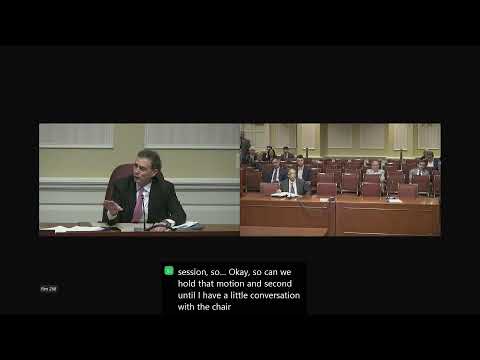
ANNAPOLIS — The Senate Education, Energy and the Environment Committee on May 20 advanced a revised approach to Maryland's Building Energy Performance Standards (BEPS), moving a reprint that narrows immediate compliance obligations, preserves a set of exemptions and requires a detailed study of policy options before broader implementation. The committee also took up and approved a large set of concurrences, local bills and departmental studies, with many votes recorded by roll call.
Committee members said the reprint aims to give regulators and stakeholders more time to analyze the tradeoffs of alternative compliance mechanisms, while explicitly preserving Montgomery County's existing program and exempting certain categories of buildings from the current BEPS regulatory path. "We've got a lot of questions about the cost and what the best approach is," sponsor Senator Clarence Hester said during the discussion. "This version tries to keep Montgomery free to proceed while we study scenarios for statewide policy."
The measure replaces immediate performance mandates in part with an extended study that requires the Maryland Department of the Environment (MDE) to analyze policy options: direct on-site greenhouse gas targets, energy use intensity (EUI) standards, or a combined approach. The department's analysis must evaluate greenhouse gas reduction potential, energy savings, life-cycle costs, implementation complexity, impacts on building owners (including counties, community colleges, emergency facilities, manufacturers and multi-family/residential properties), and recommend program design elements such as alternatives to monetary penalties. Committee staff and MDE testified that the agency would also continue benchmarking work and needs time and funding to complete a rigorous study while carrying out current regulatory duties.
MDE officials described the operational challenge: "We were directed to implement benchmarking and begin performance regulation under the existing statute while stakeholders are asking for more time and a design review," said Adam Ortiz, Deputy Secretary at MDE. Chris Hoagland, director of MDE's Air and Radiation Administration, summarized the existing timeline: buildings 35,000 square feet and larger began benchmarking in 2025 and performance standards are scheduled to phase in beginning in 2030 under current law. "If you change key exemptions now, we will have to revisit the regulations," Jeremy Baker, MDE government-relations director, said.
Committee members pressed for clarity about what is and is not covered and whether certain elements should be set aside. The reprint retains several carve-outs drawn from the House work and adds additional study language. Exemptions and special considerations in the adopted reprint include energy used for sterilization and certain emergency backup power in health care, laboratories and life-sciences facilities; agriculture and manufacturing in defined circumstances; and a critical-infrastructure carve-out as described in the reprint. Senator Watson asked specifically about data centers and backup generators; committee members flagged the need to ensure that emergency backup power for critical facilities is treated consistently with previous policy decisions.
The committee also adopted a separate set of technical clarifications and committed to continued coordination with the House of Delegates before final enactment. Several members urged the department and stakeholders to secure resources so the study will be robust. "If the goal of the study is to reassess the architecture, MDE must have sufficient funding and staff to do the work," said a Sierra Club representative during a brief floor-intervention.
Votes at a glance - BEPS reprint (committee motion to advance reprint with study language and specified exemptions): motion by Senator Hester; second Senator Augustine; adopted by roll call. The reprint preserves Montgomery County's program, lists exemptions (health care sterilization-related energy and emergency backup power in limited cases, manufacturing and agricultural buildings in defined circumstances, and critical infrastructure as described in the reprint), and requires MDE to analyze multiple policy scenarios and implementation considerations prior to expanded statewide compliance.
- House Bill 12-53 (Department of Social and Economic Mobility): carried by roll call, 8 yes, 3 no. (Roll call recorded in committee transcript.)
- House Bill 11-62 (HVACR equipment sales, licensing enforcement): carried by roll call, 9 yes, 2 no.
- House Bill 4-89 / Senate cross-file (single-staircase building study): carried by roll call, 10 yes, 1 no.
- House Bill 7-47 (on-site wastewater systems; inspection/pump-out and delayed implementation): carried by roll call, 8 yes, 3 no.
- Multiple concurrences and local bills: The committee unanimously concurred on a long series of cross-filed bills and other local measures and departmental studies, including measures on automated external defibrillators in public libraries (SB369 concurrence), carbon monoxide warning labels for certain vessels (SB1028 concurrence), and study or reporting bills such as a Montgomery County Agricultural Reserve economic study (HB1228). Where roll calls were requested the transcript records the vote tallies indicated above.
Context and next steps The reprint is intended to be sent back to the House for concurrence or further consideration. Committee members and staff emphasized coordination with the House counterpart committee to avoid a conference committee or other procedural deadlock. MDE said it will need to balance current regulatory implementation work with the new study tasks if the reprint is enacted. Several members signaled that additional floor amendments remain possible and that further technical cleanup could be offered before final passage.
For Montgomery County and stakeholders who have already implemented local BEPS-style programs, the committee's action preserves their ability to proceed while the state study is completed. Advocates for stronger statewide standards urged the committee to ensure the study is funded and comprehensive so that policymakers have robust evidence before making a statewide choice on greenhouse-gas- or EUI-based limits.
The committee also advanced a broad slate of other bills during the same session, most by unanimous voice or by roll calls noted above; those measures will proceed through the legislative calendar or return to the House as required.
Sources: Education, Energy and the Environment Committee transcript (committee discussion and roll-call votes); on-the-record statements by Senator Clarence Hester (sponsor), Adam Ortiz (MDE deputy secretary), Chris Hoagland (MDE), and Jeremy Baker (MDE).