Get Full Government Meeting Transcripts, Videos, & Alerts Forever!
Get email alerts on the Common Carrier Definition topic
No spam. Unsubscribe anytime.
House Judiciary Committee concurs to remove Uber, Lyft from common-carrier definition in House Bill 860
Summary
On April 4 the House Judiciary Committee voted to concur with Senate amendments to House Bill 860 that strike "transportation network company" (commonly understood as Uber and Lyft) from a new definition of "common carrier." The committee also concurred with Senate amendments to House Bill 1123 (Senate Bill 181) by voice vote.
The House Judiciary Committee voted April 4 to concur with Senate amendments to House Bill 860, approving an amendment that removes "transportation network company" — the term commonly used for services such as Uber and Lyft — from a new definition of "common carrier" that applies to provisions about damage to public infrastructure.
The change matters because the bill, introduced by the minority leader, addresses damage to public infrastructure by common carriers. Counsel Holly told the committee the Senate amendment strikes the transportation network company category so the bill focuses on larger-scale carriers such as railroads and transit operators. "They specifically wanted the transportation network companies out," Counsel Holly said, adding the sponsor agreed to the change.
Committee members raised questions about the amendment during the discussion. Delegate Williams asked how the change would apply if a rideshare driver accidentally struck state-maintained infrastructure, saying hypothetically, "what would happen if someone's driving a ride to your car that accidentally, for whatever reason, runs into something?" Counsel Holly and other members responded that individuals would still have ordinary causes of action against an individual driver, while the bill is intended to address large-scale carriers and large-scale damage.
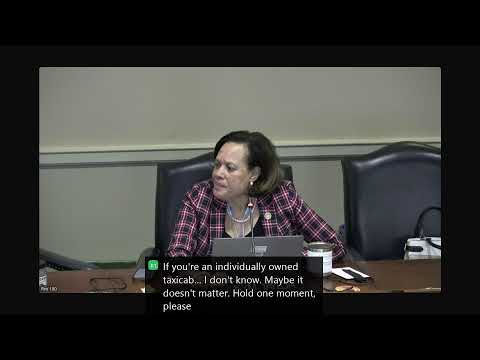
Delegate Dahlica Taylor noted that the bill's list still includes "taxi cab company," and said some taxi operators are single-owner businesses rather than large fleets, asking whether that raised a practical distinction. Counsel Holly and other members said the sponsor opted to keep taxi companies in the definition, and the committee did not remove taxis.
Delegate Kaufman said for the record she "would have preferred that Uber and Lyft be in it," but that she would vote to concur because the senator sponsor supported the amendment and the committee was preparing to send the concurrence ahead of forthcoming deadlines.
Votes and formal action: The committee took voice votes on both measures. A motion to concur with the Senate amendments to House Bill 1123 (relating to Senate Bill 181) was made and seconded and approved by voice vote. Later, a motion and second to concur with the Senate amendments to House Bill 860 were called and the committee "moved to concur"; the chair called for those in favor, and the committee proceeded to concur with House Bill 860 by voice vote. Committee members indicated the concurrence was unanimous; no roll-call tally was provided in the transcript.
The committee adjourned following the voting session. No additional directives, amendments, or implementation steps for either bill were stated on the record during this transcript.
Votes at a glance: House Bill 860 — motion to concur with Senate amendments (removal of "transportation network company"); outcome: concurred by voice vote, unanimous (no roll-call recorded). House Bill 1123 (Senate Bill 181) — motion to concur with Senate amendments; outcome: concurred by voice vote, unanimous (no roll-call recorded).